
AI agents are not a future idea, a developer playground, or a speculative R&D concept. They’re executing critical tasks in live production systems across some of the world’s most advanced enterprises. But the real story isn’t just that agents exist, it’s what role they’re actually playing.
While many are just discovering agentic AI, retrofitting platforms, and hoping to catch the wave, Torque was built for this moment from the start. Agentic AI isn’t a feature bolted on; it’s the foundation. Years of strategic development are now compounding into a first-mover advantage that’s nearly impossible to catch. Because every day Torque operates, its agentic layer gets smarter, more optimized, and more capable.
This article isn’t about what might be possible. It’s about what’s already working. And why the infrastructure behind agentic AI must be as autonomous and context-aware as the agents it supports.
Agentic AI refers to systems that make decisions and execute multi-step actions autonomously, without constant human cueing. These agents plan, act, adapt, learn, and collaborate with other systems and services as they strive toward defined goals. In doing so, they push traditional infrastructure models, designed for provisioning and automation, past their breaking points.
Today’s infrastructure tooling can provision compute, automate repeatable tasks, and support isolated AI workloads, but it cannot support autonomous, goal-driven decision systems at scale. Gartner notes that many current agentic AI initiatives will fail or stall because legacy systems lack the capacity to provide context, governance, and real-time optimization that true agentic workloads require.
This is where the Agentic AI Control Plane, as embodied by Torque, comes into play. It’s not a hypothesis; it’s a working technology built for what organizations are already trying to do: run AI that thinks for itself across hybrid, multi-cloud environments while remaining safe, governed, and efficient.
Why Context, Purpose, and Agency Matter
The defining trait of agentic systems isn’t autonomy alone, it’s contextual autonomy. That means understanding not just the data agents interact with, but the why of infrastructure decisions: business priorities, compliance boundaries, cost thresholds, performance goals, SLAs, and risk tolerances. Without context, autonomy is unpredictable, at best inefficient, at worst dangerous.
Today’s enterprise AI challenges aren’t theoretical:
- Legacy stacks treat AI like any other app, as something to deploy, monitor, and scale — but agents don’t behave like apps. They reason and act.
- Enterprise data is siloed, governance is reactive, and compute resources are managed manually, a mismatch for systems that must plan, adapt, and act in real time.
- Security and compliance frameworks are designed for predictable workflows; agents introduce dynamic, context-driven behavior that requires governance built into the infrastructure fabric itself.
Agentic AI doesn’t just demand infrastructure that keeps up, it demands infrastructure that understands, reasons, and optimizes alongside agents.
A New Architecture for a New World
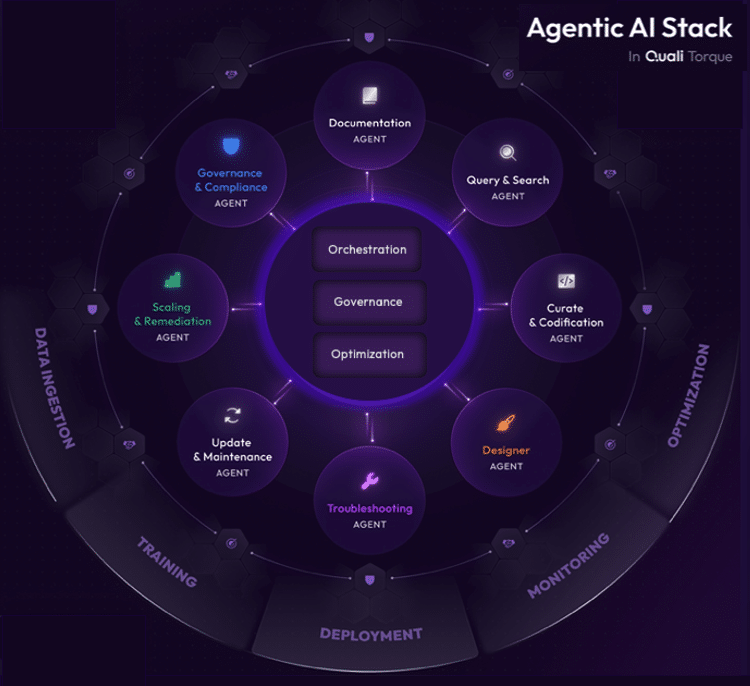
Figure 1 :The Agentic AI Stack: A context-rich, governed, and optimized control plane for autonomous infrastructure
The Agentic AI Stack challenges the old model, where infrastructure tools sit beneath AI workloads, reactive and siloed, and replaces it with an architecture that is:
- Context-rich: real-time state, policy, intent, and telemetry are shared across all components.
- Governed by design: policies are embedded into orchestration and enforcement layers, not bolted on.
- Optimized continuously: resource allocation, cost efficiency, and execution paths are adjusted in flight according to current workloads and goals.
At the center of this stack is the control plane, responsible not just for orchestration, but for decisioning, based on governance constraints and optimization imperatives.
Surrounding this core are specialized agents, not generic scripts, but purpose-built intelligences for areas such as scaling, governance, documentation, remediation, and troubleshooting. These agents don’t operate in isolation; they collaborate over shared context and contribute to a coherent infrastructure strategy.
In a traditional stack, an automated job might restart a server when a metric crosses a threshold. In an agentic stack, a scaling agent would anticipate demand spikes, reallocate GPU resources across clouds, enforce compliance rules, and update documentation — all before performance impacts the business.
The Inflection Point: From Reactive to Autonomous
Industry research confirms we are at an inflection point. McKinsey and advisory firms describe agentic AI as the technology that will help organizations transcend the limitations of generative AI, not just automating tasks, but automating decision-making and complex business workflows.
But enterprise adoption faces structural barriers: legacy infrastructure paradigms, fragmented governance, and toolchains that weren’t designed for autonomous agents. These barriers aren’t trivial; Gartner predicts many early projects will fail if they rely on traditional automation tooling.
Torque represents the first infrastructure control plane purpose-built for these realities:
- Every environment becomes an agentic participant, capable of negotiating resources, enforcing policy, and contributing to a larger autonomous ecosystem.
- Governance and compliance are continuous, not checkpoints in a deployment pipeline.
- Optimization is built into execution, reducing idle GPU waste and maximizing workload throughput.
This isn’t speculative. It’s the operational backbone for organizations already pushing beyond generative experimentation toward agentic execution at scale.
The Future Is Not Just AI. It Is Autonomous Infrastructure
Agentic AI is reshaping enterprise platforms, far beyond chat interfaces and copilots. It’s transforming the very infrastructure that businesses rely on, turning static stacks into adaptive ecosystems capable of supporting intelligent workload behavior.
Infrastructure that was once reactive must now be self-aware, contextual, and autonomously governable. Torque isn’t adding agency to legacy tooling, it introduces an infrastructure fabric that is inherently agentic.
That’s why this matters: not because autonomous systems are possible, but because they’re already here, executing in production, demanding real-time context, and requiring infrastructure that can reason as effectively as the agents it supports.
In the agentic era, infrastructure doesn’t just serve AI. It enables its autonomy, ensures its governance, and optimizes its execution. Torque stands at that intersection, not as a theoretical future, but as the first technology built for the now of agentic operations.
Torque is already enabling enterprises to operationalize agentic AI, not in labs, but in production.
If you’re building for autonomy, governance, and scale, you’re already behind if your infrastructure can’t think for itself. Explore how Torque brings agentic orchestration to reality: smarter control, continuous optimization, and a foundation that evolves with your AI stack.
Visit the Torque product page, launch the Playground, or activate your 30-day trial and experience infrastructure that reasons, not just reacts.