
Agentic AI isn’t just for platform engineering PoCs, it’s now being used successfully in live production environments.
Yet, many engineers are still skeptical about agentic AI. But remember that they were also skeptical about Terraform or Kubernetes back in 2014 when those services were first released. As agentic AI matures and more enterprises adopt it, that attitude may change: Agentic AI promises intelligent automation that understands contexts and can learn from different patterns, both of which make it appealing to platform engineering teams.
In this article, we’ll explore agentic AI in platform engineering, how to approach this paradigm shift, and how Quali can help.
What is agentic AI?
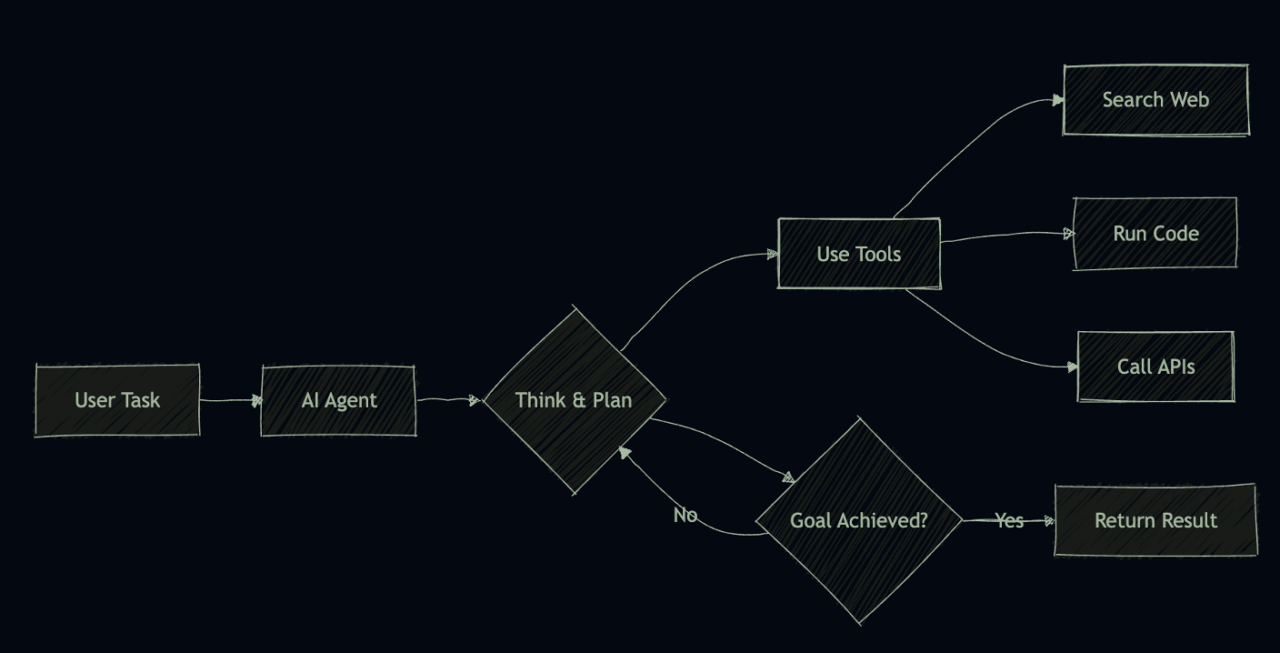
Agentic AI is an autonomous system, one that can break down objectives into steps and work through those steps with minimal guidance.
The agents that are part of this system interact with different tools and APIs to solve these objectives, and when they encounter errors, they adapt their approach, trying different solutions until they reach the end goal. You should really think about these agents as junior/middle engineers who don’t get tired and are always happy to help you with your most boring tasks.
In platform engineering, for example, agentic AI might help you with provisioning cloud resources for your development environment, checking your organization’s policies, setting up monitoring, and notifying your team when everything is ready. This can all be done with minimal or no human intervention, so it brings you back the time you need to focus on implementing new features in your platform.
The diagram below shows a theoretical agentic AI workflow. For a more in-depth discussion, check out this post…
how agentic AI platforms look under the hood.
State of agentic AI today
While the agentic AI approach sounds great, let’s take a step back and understand that these systems are nowhere near full autonomy without human supervision. Agentic AI systems are as good as the LLM being used behind the scenes, how it was architected, and the quality of the information that was fed to the system.
Agentic AI can be excellent for Terraform code generation, Kubernetes manifest creation, or even building different CI/CDs, but will it always give you the quality you want and respect your organizational rules? The short answer is no. There will be some cases where it will nail everything on the first try, and in the others, with human supervision, it will get there.
Agentic AI can be very useful in routine troubleshooting, as agents excel when investigating common issues, thanks to their powerful pattern recognition capabilities. In contrast, policy enforcement and compliance continue to be problematic. Agents can apply rules when they are explicitly told, but because they don’t have access to the larger context, they might make poor decisions in situations that aren’t explicitly covered by your rules. Organizations run on undocumented knowledge as well, but agents don’t have access to conversations you had in the office or on Slack.
What problems does agentic AI solve?
Today, agentic AI can provide your platform engineering teams with important benefits:
- Configuration drift detection and remediation: Agentic AI can consistently compare the actual state with the desired state of your infrastructure, tracking and solving infrastructure drift with ease.
- Reducing new environment provisioning: Using agentic AI can reduce the time required for provisioning a new environment considerably, and by adding different constraints, you can ensure that you get the environment you need with minimal human intervention.
- Enabling junior engineers to become self-sufficient faster: Junior engineers can rely on agents to understand faster what is happening in the organization, and leverage those agents to bridge their knowledge gaps.
- Documentation generation: Parsing code and generating documentation for it is one of the things that AI systems can do really well.
- Platform engineering cognitive issues: Agents don’t need any sleep, so your platform engineers can offload repetitive tasks on them and focus their efforts on more important work.
Read more about the benefits agentic AI capabilities provide
Quali Torque uses agentic AI to evolve infrastructure orchestration, transforming your Terraform, Kubernetes, and CloudFormation assets into intelligent and self-governing solutions that respond to requests, proactively optimize performance, detect and remediate drift, enforce policy compliance, and more.
The risks of using agentic AI
Agentic AI, while introducing new capabilities, also introduces new ways to fail, and some of these failures can be expensive or damaging.
- More misconfigurations at a faster pace: A skilled engineer might introduce one or two misconfigurations per week, while an unsupervised AI system can introduce dozens per hour.
- Compliance and auditing can be a nightmare: The “it works on my machine” statement seems to be replaced in this new era with “the AI did it.” This happens because it’s hard to track exactly what happens, and blaming AI seems like the best excuse you can use when your auditors come knocking on your door. Learn more about how to secure your agentic systems in this guide.
- Costs can increase considerably: Without guardrails, such as explicitly telling your agentic AI systems that they shouldn’t use expensive compute power, they can spin up dozens of resources, which you won’t really use.
- Role shift: Relying heavily on agentic AI systems, especially in platform teams, will make your engineers lose some of their troubleshooting skills, and the ones that are just starting might even be disconnected from the fundamentals. Most of the platform engineers like to consider themselves builders, but by diving deep into agentic systems, some of them will have to shift to becoming AI supervisors.
Gains vs. losses when adopting agentic AI
Adopting agentic AI isn’t just a technical choice, but an operational tradeoff. Being an early adopter and implementing the constraints agentic AI needs at the moment will most likely get you ahead of your competitors. Here’s what you stand to gain, and what you will need to manage to transform your development workflow successfully.
What you gain
The most tangible gain is developer velocity, especially when it comes to repetitive and well-understood tasks. Infrastructure provisioning can now take minutes, documentation is generated automatically, and your team can handle 3-5 times more volume of the requests they receive without needing extra headcount.
Your senior engineers will be able to stop context switching and focus on architecture decisions and technology evaluation, as they have their mental energy saved. At the same time, your junior engineers will be able to accomplish tasks that previously required senior expertise: They will have access to AI systems that not only implement different tasks in their organization, but they can also be leveraged to explain why certain things happened and what was the reasoning.
If you implement agentic AI right, you enable consistency at scale, as these systems never have bad days, take shortcuts because they’re tired, or rush because they have other things to do.
What you lose
The most tangible thing you lose is control and predictability. You might receive some clever solutions from your agents, while others can be disasters. It can be hard to understand why agents make decisions, even though it’s very easy to see what it did.
Your infrastructure stack also becomes more complex. Now you also need to maintain your agent systems, their configurations, the guardrails you implement for them, and the observability.
In some cases, as mentioned before, if your agents handle the routine troubleshooting, your junior engineers might lose the opportunity to develop their foundational skills.
How to approach this change?
If you want to introduce agentic AI successfully, don’t let it run wild in your production environments. This should be a step-by-step process, and you should have safety mechanisms built in from the start.
Have a human checkpoint at every critical decision point. Before even letting agentic AI propose changes, make sure you’re feeding it code and configurations that reflect your organization’s standards. In this way, your agents won’t invent new standards that have nothing to do with how your organization works.
As soon as the agentic AI system has the information related to how you do things, you can begin using it as an advisor and let it suggest new code or configurations, but don’t let it execute anything without a thorough human review. By letting your engineers go through everything the AI is planning to do, they will learn its patterns and build trust in its judgment. Once they’re comfortable with the suggestions, go to action-by-action supervised execution. In this way, you’ll learn which tasks the AI handles reliably and which require human intervention.Take the next steps towards agentic AI
Agentic AI is becoming a powerful tool in platform engineering; it delivers real value when implemented thoroughly. The fundamental principle that you should keep in mind is that agentic AI should amplify your platform engineering team, not replace it.
If agentic systems handle routine requests, boilerplate generation, and troubleshooting common issues, your platform team gets more time to focus on what really matters. The future of platform engineers relies on having your engineers work closely with AI, each doing what they do best.
At Quali, we understand that adopting agentic AI is an organizational transformation. Check out Quali Torque and see how we’re helping platform teams leverage AI to deliver infrastructure at scale.
Try out the Quali Torque playground to get a hands-on experience and see for yourself.