
Modern infrastructure demands more than manual management and reactive operations. With hybrid cloud complexity, AI workloads, and increasing cost scrutiny, operational roles across FinOps, DevOps, SRE, and Data Science are strained. Most are stuck firefighting, reporting cost overruns, responding to drift, or waiting on provisioning queues. What’s missing is an intelligent layer that coordinates, optimizes, and acts without human intervention.
Torque, Quali’s Infrastructure Control Plane, brings this to life. It transforms traditional roles into autonomous agents that detect, decide, and act, coordinated by a unified fabric of orchestration, policy, and optimization.
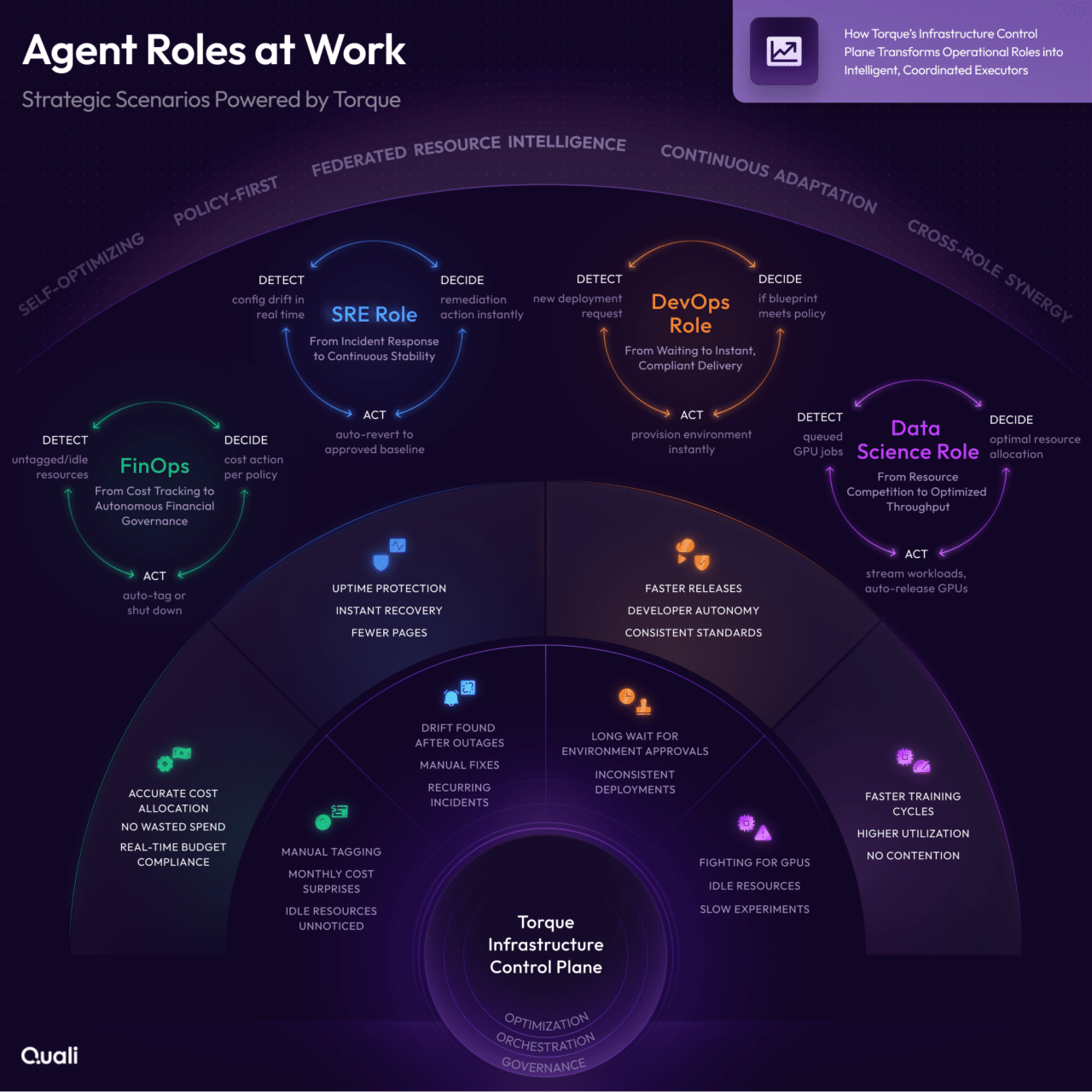
Visualizing the shift from reactive operations to real-time, intelligent execution.
At the center is Torque’s Infrastructure Control Plane, governance, orchestration, and optimization in one intelligent nucleus. From it extend four transformation arcs, each representing how Torque redefines a core operational role: FinOps, SRE, DevOps, and Data Science. Each arc illustrates a decision loop (detect → decide → act), showing how previously manual, disconnected tasks are unified and automated. The outer ring reflects the future-ready foundation, continuous, self-optimizing, and aligned to business value.
Four Role Transformations, One Intelligent Backbone. Torque doesn’t just automate tasks; it redefines how key operational roles function. Here’s how.
1. FinOps: From Manual Cost Scrutiny to Real-Time Financial Intelligence
Traditional FinOps:
- Multiple tools, none of which agree, none of which understand “why” cloud cost changes happen.
- Budget planning based on stale data and post-mortem reports.
- No visibility into who created what, or why, creating a blind spot in accountability.
- Rigid, unenforceable tagging policies with inconsistent adoption across business units.
- AI workload volume adds unpredictable, spiky demand to an already chaotic environment.
- Manual attempts to track cost anomalies, often too late to act.
- Zero alignment between cloud usage and actual business intent.
FinOps remains reactionary. Costs continue to spiral due to missed shutdowns, inconsistent tagging, and fragmented tools. AI spend surges without oversight. Financial planning becomes guesswork, and cost visibility becomes a post-mortem exercise, not a strategic lever. The organization is unable to identify or manage 30–50% of its cloud spend in real time, adding significant manual effort (often $500K+/year in headcount), increasing risk exposure, and undermining budget predictability.
Intelligent FinOps in Action with Torque
- Dynamic, real-time tagging on resource creation, with full traceability to blueprint, user, and project.
- Budget guardrails that proactively prevent overspend.
- Idle shutdown automation that reclaims waste automatically.
- AI-aware orchestration intelligently schedules GPU jobs based on cost, usage, and business value.
- Real-time cost visualization per environment, team, and workload.
- Unified control over provisioning, cloud-native, IaC, and non-IaC.
- Cost-aware governance deeply integrated with infrastructure intent.
Torque eliminates cost blind spots, automates financial guardrails, and transforms FinOps from retroactive reporting to predictive, real-time cost governance. Teams gain the clarity to plan, the tools to enforce policy, and the intelligence to align spending with strategy.
2. SRE: From Reactive Firefighting to Autonomous Uptime Assurance
Traditional SRE:
- SREs buried in alerts, with no context, chasing environment drift without understanding root cause.
- Lack of traceability between infrastructure changes and incident triggers.
- Manual remediation across sprawling multi-cloud environments.
- No centralized visibility across clusters, services, and IaC-driven change.
- SLOs are defined, but not enforceable due to fragmented tooling.
Unacceptable Impact: Outages escalate. Drift compounds. SREs remain in triage mode, resolving issues hours or days late. SLAs are breached. Root causes go undetected. The system becomes reactive, brittle, and prone to repeat failures. Teams spend up to 60% of their time firefighting, leading to burnout, talent churn, and millions in revenue risk from downtime and degraded user experience.
Autonomous Reliability Operations with Torque
- Continuous drift detection with automatic remediation.
- Environment lineage tracking: every change tied back to code, user, or automation.
- Declarative state enforcement across clouds and stacks.
- Integration with incident platforms for automated root-cause linkage and resolution.
- Pre-built policies for uptime SLAs, with enforcement and rollback built-in.
Torque transitions SREs from fire prevention to reliability engineering. Incidents drop. Time to resolve shrinks. Error budgets are preserved through policy-driven consistency, allowing teams to scale reliability strategy, not just alerts.
3. DevOps: From Pipeline Bottlenecks to Self-Service Execution at Scale
Traditional DevOps
- Long delays for infrastructure provisioning.
- Tickets for every variation of the same environment.
- Non-compliant environments slipping through shadow pipelines.
- Tool sprawl across teams: Terraform, Ansible, Helm, each with their own process.
- Lack of reuse and standardization, every environment built from scratch.
Backlogs grow. Dev velocity slows. Developers circumvent process, introducing risk. Environments become inconsistent, costly, and hard to maintain. Compliance is optional. Innovation slows under the weight of bureaucracy. Every deployment involves manual coordination and wait states, costing enterprises millions annually in delayed releases and lost agility.
Compliant Self-Service Delivery with Torque
- Self-service blueprint catalog with pre-approved configurations.
- GitOps-driven execution: every change traceable, auditable, and reproducible.
- Full-stack environments provisioned in minutes, not days.
- Centralized policy enforcement, duration, region, resource types, and naming.
- Integrated with CI/CD, issue tracking, and ITSM for complete lifecycle governance.
DevOps teams gain speed with governance without sacrificing control. Provisioning accelerates by 10x–15x. Governance happens automatically. Developers deploy safely, repeatedly, and at scale
4. Data Science: From Infrastructure Gridlock to Autonomous AI-Ready Environments
Traditional Data Science
- GPU overprovisioning to avoid contention, wasted spend.
- Inefficient GPU resource optimization
- Manual provisioning delays result in lost productivity.
- Limited ability to track cost per model, per training run, or per team.
- AI workloads compete with standard environments for shared compute.
- Resource cleanup forgotten, leading to runaway cloud bills.
AI experiments stall. GPUs sit idle or become unavailable. Costs balloon without visibility. Infrastructure becomes a bottleneck. Projects are delayed, insights missed, and competitiveness erodes in the race to production AI. Manual provisioning wastes days per model iteration and contributes to double-digit underutilization of expensive GPU resources, slowing time to insight and market.
AI Optimized Infrastructure with Torque
- Streaming AI job scheduling with built-in cost and priority logic.
- GPU resources ‘allocated’, scheduled and fully optimized.
- Auto-release of GPU and storage resources post-job.
- Blueprinted AI environments: Jupyter, Spark, Airflow, all pre-configured.
- Per-run, per-model cost tracking with policy enforcement.
- Dynamic cluster spin-up/down based on usage and tagging.
Torque ensures data scientists focus on models, not infrastructure. GPU utilization rises. Environments are instantly available. Budgets are tracked. Experiments scale without waste.
Why Now: The Strategic Shift Toward Agentic Infrastructure
Enterprises face mounting pressure to scale AI workloads, reduce operational costs, and unify fragmented environments. Torque sits at the intersection of these demands. It provides:
- A control plane to unify IaC, containers, and APIs.
- Embedded decision loops (detect-decide-act) across roles.
- A governance-first model that doesn’t slow execution.
With partners including Cisco, Dell, Hitachi and Nvidia leveraging Torque to enhance and augment their solutions, and customers reporting up to 50% cost savings and 15x faster provisioning times, it’s clear: the infrastructure status quo is no longer viable.
The Torque Advantage: Enterprise Control with Autonomous Execution
Torque is more than a platform; it’s a paradigm shift.
- Real-Time Visibility: Cost, drift, utilization, and changes—all tracked live.
- Frictionless Governance: Policy-as-Code that doesn’t block progress.
- Change Control by Default: Every update traceable, reversible, enforceable.
- Self-Service at Scale: Teams launch what they need, when they need it.
- AI-Ready: From GPUs to workflows, Torque orchestrates infrastructure around AI’s unique demands.
- Unlimited Scale: From sandbox to supercluster, all governed, all optimized.
- Future-Proof: Unified across clouds, IaC types, and team needs.
From Roles to Intelligent Results
If you’re in FinOps, DevOps, SRE, or Data Science, Torque doesn’t just make your job easier, it evolves your role into an intelligent function. Discover how your team can unlock real-time control, governance, and optimization across your infrastructure.
To start your journey, visit the Quali website, and quickly understand how Torque can transform your business. Then explore Quali Torque’s capabilities by watching this video and head over the to Playground to see the difference for yourself. Intelligent infrastructure isn’t the future, it’s what Torque delivers now.