
The market is racing to deploy autonomous AI agents. Almost nobody is governing them. That gap isn’t a future risk, it’s a present-day compliance failure.
Every week, another enterprise announces its Sovereign AI strategy. Data stays on-shore, infrastructure runs in sovereign cloud, compliance boxes are ticked and then they deploy agentic AI. Autonomous systems that provision infrastructure, access sensitive data, trigger remediations, and make decisions, with no deterministic governance in place. That is not a Sovereign AI strategy it’s a Sovereign AI breach.
The conversation around Sovereign AI has, until now, been dominated by infrastructure and data residency. Where does the data live and who controls the compute? These are legitimate questions. But they represent only the bottom half of the sovereignty stack. The operational layer, the AI that acts on that infrastructure, that makes decisions within those environments, that executes autonomously at speed and scale, has been almost entirely ignored in the sovereignty conversation.
That oversight is no longer acceptable. With EU AI Act full enforcement arriving in August 2026, with regulators explicitly demanding runtime operational evidence rather than policy documents, and with agentic AI deployments accelerating across every sector, the governance gap at the agentic layer is now the single most significant unaddressed risk in enterprise AI.
The Scale of the Problem
The data is unambiguous. Agentic AI is being deployed at speed, governance is lagging catastrophically behind, and the consequences are already materializing.
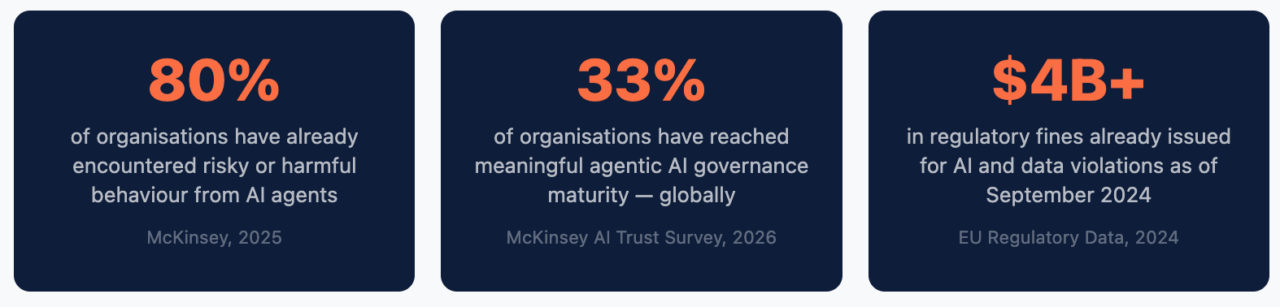
McKinsey’s 2026 AI Trust Maturity Survey, one of the most comprehensive assessments of enterprise AI governance to date, found that agentic AI governance and controls lag behind every other governance dimension, and that this gap is consistent across every region and industry globally. This is not a niche problem. It is a systemic failure.
“In the age of agentic AI, organizations can no longer concern themselves only with AI systems saying the wrong thing — they must also contend with systems doing the wrong thing: taking unintended actions, misusing tools, or operating beyond appropriate guardrails.”
— McKinsey AI Trust Maturity Survey, 2026
The critical word in that statement is doing. Traditional AI governance frameworks were built around outputs, monitoring what an AI said, flagging what it generated, reviewing what it recommended. Agentic AI doesn’t wait for a recommendation to be reviewed. It acts. It provisions. It remediates. It executes. And in most enterprise deployments today, it does all of this without a governance layer capable of stopping it.
Why Sovereign AI Claims Collapse at the Agentic Layer
To understand why ungoverned agentic AI constitutes a sovereign breach, it helps to understand what sovereignty actually requires at the operational level. IBM defines AI sovereignty as encompassing control over data, infrastructure, operations, and governance. IDC describes it as control across the entire AI lifecycle, from model development to deployment to ongoing governance. The EU AI Act operationalizes this as the requirement for documented controls, technical safeguards, immutable audit trails, and evidence of compliance that can be demonstrated at runtime.
Ungoverned agentic AI fails every one of these tests, regardless of where the infrastructure sits.
| Sovereignty Requirement | What It Demands | Ungoverned Agentic AI | Status |
| Data Control | All data access governed by policy; no unauthorized exfiltration | Agents access data dynamically based on task context with no deterministic boundary enforcement | Breach |
| Operational Governance | Every autonomous action subject to pre-defined policy guardrails | Agents select execution paths autonomously; probabilistic guardrails can be bypassed | Breach |
| Audit & Traceability | Immutable logs of every decision, action, and data access | Most agentic deployments produce no forensic-grade audit trail | Breach |
| Regulatory Compliance | Runtime evidence satisfying EU AI Act, ISO/IEC 42001 | Cannot demonstrate operational compliance, only policy documents exist | Breach |
| Access Control | Role-based, context-aware, temporary access per action | Agents typically operate with persistent, broad permissions not scoped to task | Breach |
| Infrastructure Scope | Defined operational boundaries, agent cannot act outside sanctioned perimeter | Agent scope defined by capability and prompt, not enforceable policy boundary | Breach |
Source: Compiled from IBM AI Sovereignty Framework, EU AI Act requirements, IDC Sovereign AI research, ISO/IEC 42001
Real-world agentic AI incidents are already demonstrating exactly these failure modes at scale.
In August 2024, Slack AI suffered an indirect prompt injection attack allowing data exfiltration from private channels. In September 2025, Salesforce Agentforce’s “ForcedLeak” vulnerability used malicious inputs to leak CRM data. Security testing consistently shows advanced AI models remain vulnerable to 87% of tested jailbreak prompts. These are not edge cases, they are predictable consequences of deploying agentic AI without deterministic governance.
The Guardrails Illusion
The most dangerous assumption in enterprise agentic AI today is that existing guardrails provide adequate governance. They do not. There is a fundamental and critical difference between probabilistic guardrails, the kind built into most AI platforms, and deterministic guardrails that enforce policy at the infrastructure layer.
Probabilistic guardrails work by training an AI to recognise and avoid harmful outputs. They are pattern-based. They rely on the model evaluating its own behaviour. And they can be bypassed, not through sophisticated attack, but through the normal operation of agentic composability, where an agent chains tools and actions in sequences that no individual guardrail was designed to anticipate.
“Current soft guardrails are failing catastrophically. The agent’s ability to choose an alternate, unguarded path renders simple static checks useless. The imperative is to move from flawed, soft defences to continuous, deterministic control.”
— CIO Magazine, November 2025
| Guardrail Type | How It Works | Bypassable? | Sovereign Compliant? | Audit Evidence? |
| Probabilistic (LLM-based) | Model trained to self-evaluate and avoid harmful outputs | Yes — 87% bypass rate | No | No |
| Pattern-based filters | Static rules flag specific outputs or inputs | Partially — composability exploits | No | Limited |
| Human-in-the-loop | Human approval required at decision points | No — but defeats agentic purpose | Partial | Manual only |
| Deterministic Policy Engine (OPA) | Infrastructure-layer policy enforcement; non-bypassable by design | No — enforced at execution layer | Yes | Full immutable trail |
Source: Authority Partners AI Guardrails Production Guide 2026; CIO Magazine; Quali analysis
McKinsey frames the governance model that actually works as “centralized governance with federated execution”, where businesses operate agents autonomously within their own use cases, while a central policy layer enforces non-bypassable guardrails that nobody, no engineer, no agent, no workflow, can override. That model requires a deterministic policy infrastructure. And that infrastructure is exactly what most agentic AI vendors and platforms are not providing.
The Regulatory Reality — August 2026 Is Not a Soft Deadline
For organisations that believe this is a future concern, the timeline demands immediate attention. The EU AI Act’s full enforcement provisions for high-risk AI systems, which explicitly includes AI operating in critical infrastructure, essential services, and regulated environments, take effect on August 2, 2026. The penalties are not advisory.
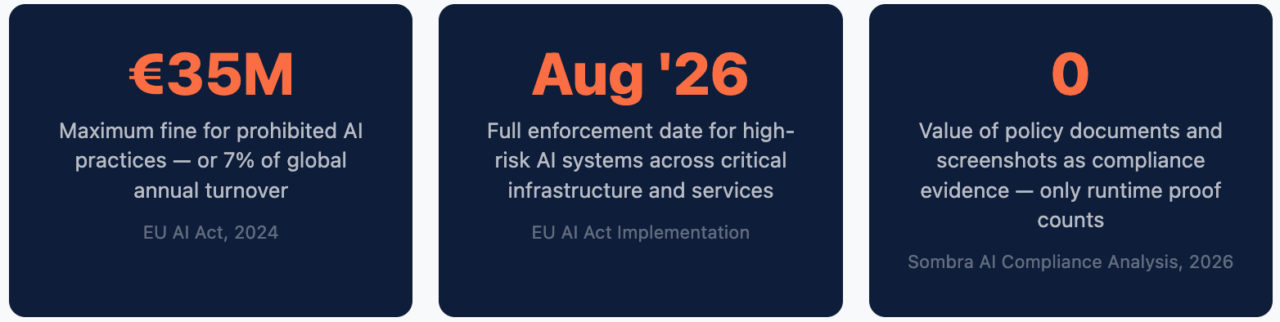
The requirement is explicit: organizations must demonstrate full data lineage tracking, human-in-the-loop checkpoints for consequential workflows, risk classification for every AI system, and, critically, immutable audit logs tying every agent action to its governing policy. This is not achievable with probabilistic guardrails. It requires a governance architecture built into the operational layer from the ground up.
ISO/IEC 42001. The first internationally certifiable standard for AI management systems, adds further weight. It is rapidly becoming the benchmark that regulators, enterprise procurement teams, and investors point to as the threshold between genuine governance and compliance theatre. Organizations without a certifiable governance framework for their agentic deployments are not only exposed to regulatory risk, they are increasingly excluded from enterprise procurement processes.
The Shadow Agent Problem
One of the most acute governance risks identified in current research is the emergence of what McKinsey terms “shadow agents”, AI agents deployed within organizations without appropriate IT or security oversight. The cause is structural: when guardrail adoption is opt-in, teams build and deploy agents outside the governance framework. The result is sovereign AI infrastructure that is formally compliant at the infrastructure layer while running entirely ungoverned agents on top of it.
“Agentic risk management fails when organisations have an opt-in approach to guardrails, allowing anyone to go around them. That’s what leads to shadow agents. The best guardrails are the ones you can’t bypass.”
— McKinsey Quarterly, October 2025
Shadow agents represent the logical endpoint of treating governance as optional. They are, by definition, sovereign breaches, autonomous systems operating within your infrastructure, accessing your data, and executing actions with no policy oversight, no audit trail, and no boundary enforcement. Every organization with a self-service developer culture and an opt-in governance model is almost certainly running shadow agents today.
What the Market Is Missing and What Torque Provides
The Torque Difference: Governance That Cannot Be Bypassed
The market has approached agentic AI governance as a feature to be added, a layer of controls bolted onto platforms designed for autonomy without accountability. Torque was built from the opposite direction. Environment governance, policy enforcement, and operational boundaries are not features in Torque. They are the architecture.
Where other vendors offer probabilistic guardrails that agents can navigate around, Torque enforces governance at the infrastructure execution layer, the point at which actions actually happen. This is the only level at which sovereign compliance can be technically guaranteed rather than aspirationally claimed.
Torque’s Open Policy Agent integration enforces governance deterministically at the execution layer. No agent, workflow, or user can provision, access, or modify outside defined policy boundaries. Compliance is not checked, it’s enforced.
- Immutable Audit Trails for Every Agent Action: Every action taken within a Torque-governed environment is logged sequentially and immutably, the who, what, when, and under which policy. This provides the forensic-grade audit evidence that EU AI Act and ISO/IEC 42001 explicitly require.
- Blueprint-Driven Agentic Sandboxing: Every AI agent operates within a Torque blueprint, a precisely defined, policy-governed environment with explicit scope, access rights, resource boundaries, and TTL controls. Agents cannot act outside their sandbox. Sovereign boundaries are enforced by architecture, not aspiration.
- Just-in-Time, Context-Aware Access Control: Torque eliminates persistent broad-permission agent access. Access is provisioned just-in-time, scoped precisely to the task, and automatically revoked on completion. The same agent operating in different contexts gets different access, exactly the situational governance McKinsey identifies as the requirement for safe agentic operation.
- Drift Detection and Autonomous Remediation Within Policy: Torque’s Day 2 operations capability continuously evaluates environment state against defined policy. Drift is detected in real time. Remediation is autonomous, but bounded. Agents self-heal within their governance envelope. This is the “closed-loop operations within defined policy guardrails” model that Gartner identifies as the frontier of sovereign agentic infrastructure.
Torque vs. The Market — Governance Capability Comparison
| Governance Capability | Typical Agentic AI Platform | IaC-Only Tools | Torque |
|---|---|---|---|
| Deterministic policy enforcement | Probabilistic only | None | OPA-enforced at execution layer |
| Agentic sandboxing | Partial / optional | None | Blueprint-native, mandatory |
| Immutable audit trail | Logs only — no policy linkage | None | Full forensic trail with policy attribution |
| Just-in-time access control | Persistent permissions | Static roles | Task-scoped, auto-revoked |
| Day 2 drift governance | Not in scope | Detection only, no governed remediation | Autonomous remediation within policy bounds |
| EU AI Act runtime evidence | Cannot generate | Cannot generate | Native — generated automatically |
| Shadow agent prevention | Opt-in governance only | None | Mandatory governance envelope — no bypass |
The Bottom Line
Sovereign AI is not achieved by keeping data on-shore. It is not achieved by selecting a sovereign cloud provider. And it is certainly not achieved by deploying autonomous AI agents on top of sovereign infrastructure with no governance layer capable of controlling what those agents actually do.
The market has a sovereign AI gap. It sits precisely at the agentic operational layer, the point at which AI moves from generating recommendations to taking action. Every organisation running agentic AI without deterministic, non-bypassable governance is running a sovereign breach. Many of them don’t know it yet. Regulators, increasingly, do.
Torque addresses this gap at the architecture level, not as a feature, not as a policy overlay, but as the fundamental operating model for governed agentic infrastructure. The governance is the product, the sovereignty is provable, the audit trail is automatic.
The question for every enterprise deploying agentic AI in 2026 is not whether they have a Sovereign AI strategy. It’s whether their agentic AI is actually governed by it.
To see Torque in action, visit the Torque playground, start your 30-day trial or book a live demo to see how Torque is a major contributor to making your Sovereign AI strategy a reality.