Everyone is building an MCP server. It has become the default response to the question of agentic readiness, connect your platform to the protocol, call yourself agent-compatible, and that should be enough. Torque has an MCP server. So do dozens of other infrastructure tools. So, a level playing field.
Not even close.
MCP solves connectivity. It does not solve control. And when agents are making autonomous decisions against real infrastructure, provisioning resources, scaling workloads, modifying configurations, connectivity without control is not a feature. It is a liability. The gap between those who understand that and those who don’t is going to be measured in outages, cost chaos, and compliance failures.
What MCP Actually Does
MCP solves a real problem. Before it, every agent framework talked to every tool differently, custom connectors, bespoke APIs, integrations rebuilt from scratch for every new framework. MCP standardizes that. An agent that speaks MCP can call any compatible tool without custom work.
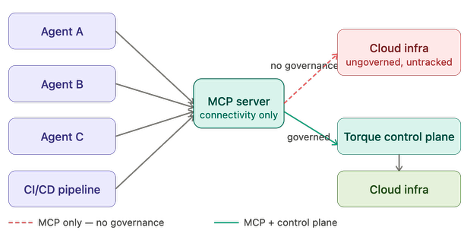
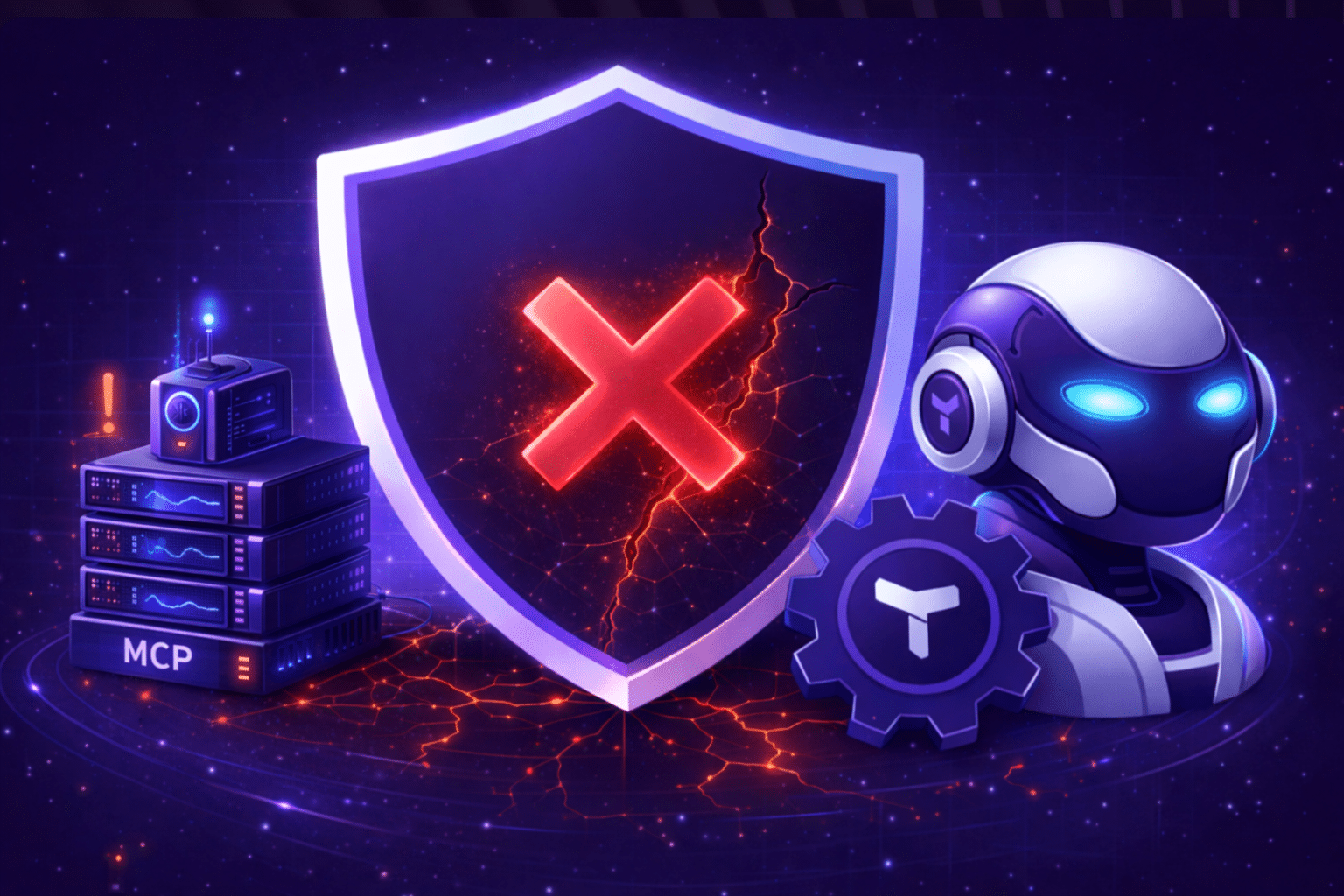
The diagram above shows the reality. MCP connects agents to infrastructure. What sits behind that connection determines whether that access is governed or not. An MCP server with no control plane behind it is just a faster, better-connected way to create ungoverned infrastructure.
The Data Nobody Is Talking About Loudly Enough
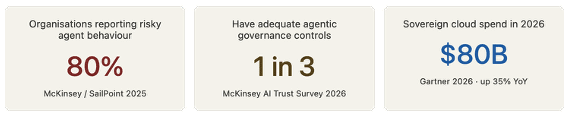
These numbers are not projections. 80% of organizations have already encountered risky behavior from AI agents, improper data access, unauthorized system changes, actions that couldn’t be reconstructed afterward. Only one in three have governance controls adequate for agentic systems. And sovereign cloud spending, the regulatory response to exactly this problem, is at $80 billion this year, up 35% year on year.
McKinsey said it best, “The scariest failures are the ones you can’t reconstruct, because you didn’t log the workflow.” That is precisely what happens when agents operate through MCP with no control plane enforcing attribution, policy, and audit.
What Happens Without a Control Plane
Picture a production multi-agent system. A planning agent determines a workload needs more capacity and instructs an execution agent to scale up a GPU cluster. Simultaneously, a cost management agent, acting on a budget breach detected thirty seconds ago, instructs a scale-down. A monitoring agent, seeing instability, triggers a remediation workflow that begins tearing the environment down entirely.
All three agents are acting in good faith. All three are using MCP. All three are making the situation worse.
None of them know what the others are doing. The MCP server facilitated every call without question. The result is not intelligent automation. It is three autonomous systems pulling an infrastructure environment apart simultaneously, with no arbiter, no coordination, and no single source of truth about what the correct state should be.
Does the execution agent know what the remediation agent just did? Does it understand not to countermand another agent’s action? Does any agent in that system understand its boundaries relative to every other agent operating on the same infrastructure? Without a control plane, the answer to all these questions is no.
The Risk Is Not Theoretical
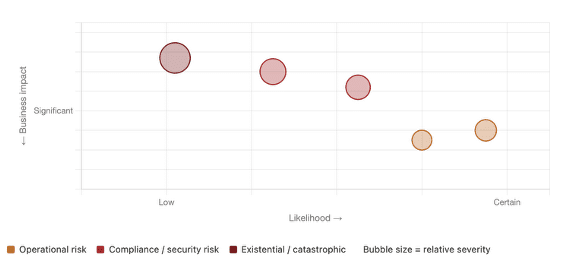
Likely outcomes (ordered by likelihood, sized by business impact) when AI agents operate against infrastructure without a control plane.
The risks range from the certain to the catastrophic. Unattributed cost is virtually guaranteed, agent-provisioned infrastructure with no tagging, no ownership, no cost ceiling runs until someone notices the bill. Conflicting agent actions corrupting environment state is highly likely in any multi-agent deployment. Compliance failure follows directly from undocumented infrastructure changes in regulated industries, that is not an edge case, it is an audit finding waiting to happen. Security breach via agent identity exploitation and cascading production failure sit lower on the likelihood scale, but their business impact is existential.
As McKinsey notes: “A flaw in one agent can propagate downstream and massively amplify the impact. Agent risk isn’t just wrong answers, it’s wrong answers at scale.”
Sovereign AI Makes This a Mandate, Not a Choice
Gartner predicts that by 2028, 65% of governments will introduce technological sovereignty requirements. The EU AI Act enforcement deadline is August 2026. Sovereign cloud infrastructure spending is $80 billion this year and accelerating.
Sovereignty, as McKinsey defines it, is about who is in charge when AI makes decisions, who controls the data, the models, the infrastructure, and the decision-making. Once AI systems become agentic, sovereignty is a risk issue, not a policy debate.
An MCP server cannot prove control. It can only prove connectivity. Sovereignty requires the former.
Torque Is the MCP and the Control Plane
Torque is not just an MCP server. It is an MCP server backed by a control plane built specifically for infrastructure governance at scale.
Every agent request arriving through Torque’s MCP interface passes through a policy engine before anything executes. Conflicting instructions are resolved against a single authoritative view of environment state. Cost ceilings are evaluated before GPU clusters spin up. Every action is attributed, agent, workflow, timestamp, cost, outcome, automatically, in real time.
Torque knows what every environment looks like, what its intended state is, who last changed it, and what rules govern it. When multiple agents operate across the same infrastructure, Torque is the arbiter that prevents them working against each other. The agents move fast. The control plane ensures they move in the same direction.
The Question Every Enterprise Should Be Asking
When an infrastructure management vendor tells you they are agent-ready because they have an MCP server, ask what happens when two agents issue conflicting instructions simultaneously. How do they attribute cost to an autonomous action weeks later. Ask what prevents an agent provisioning a GPU cluster that breaches your budget at 2am or what their audit trail looks like when a regulator asks which system made a specific infrastructure change and why. The answer is not “the MCP handles that”. It doesn’t.
The protocol connects the agents. The control plane governs what they do and identifies/remediates conflict. Without this, you don’t have intelligent automation. You have a very fast, very expensive way to find out what happens when no-one is in charge.
To see Torque in action, visit the Torque playground, or book a live demo to see how Torque is a major contributor to making your Sovereign AI strategy a reality.