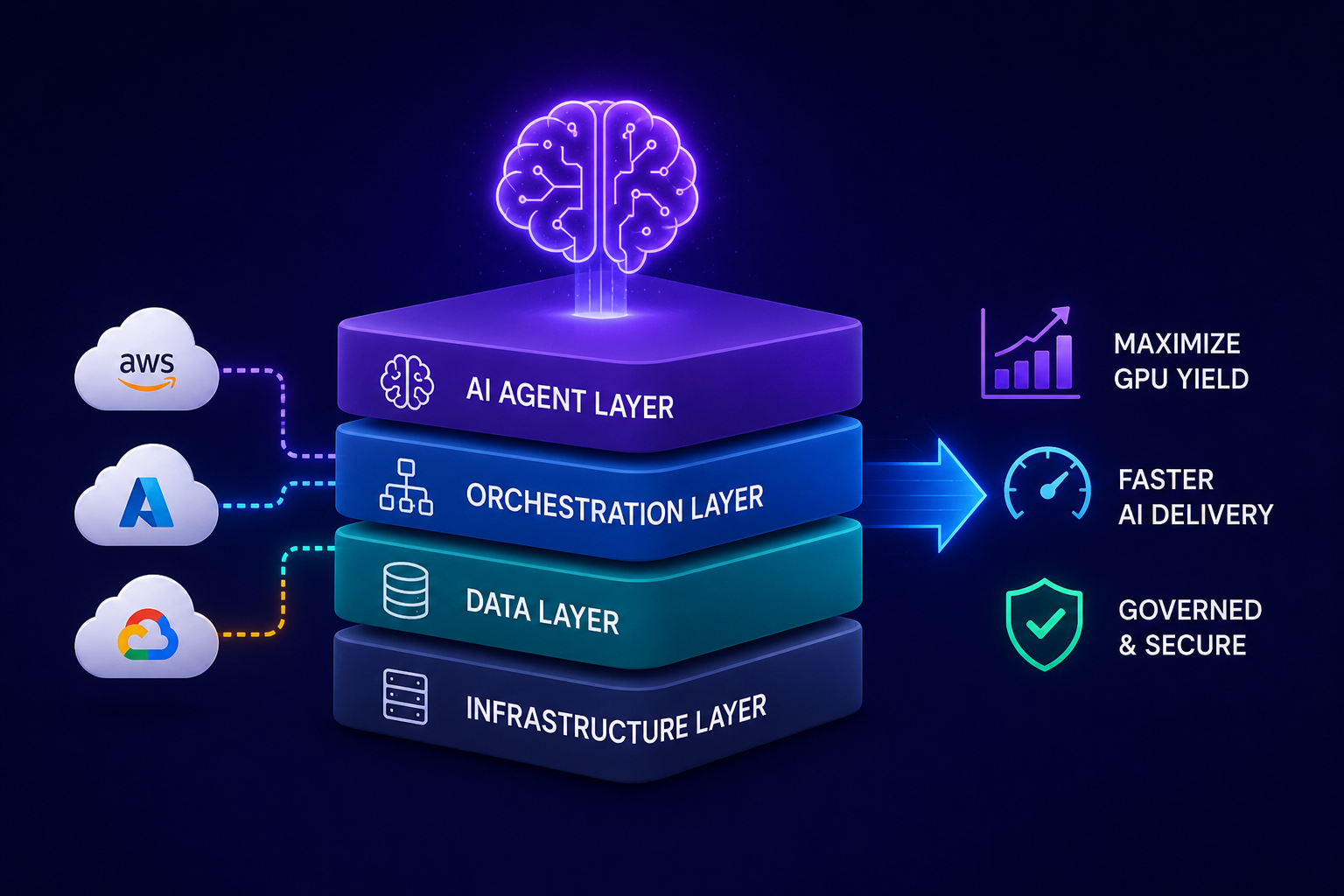
Agentic AI has reached 72% production deployment across enterprises. Cloud infrastructure spending surged 29% year-over-year in the last quarter of 2025 alone. AI and ML workloads now account for 22% of total cloud costs, and unlike traditional SaaS infrastructure, those costs don’t follow predictable patterns. They spike, sprawl, and compound.
The velocity is not the problem. The problem is that governance never kept pace with it. And that gap is now large enough to derail the organizations moving fastest.
Creation Got Fast. Operations Didn’t.
Generative AI made infrastructure creation genuinely faster. Natural language to Terraform. Blueprints in minutes. Self-service provisioning that used to require a two-week ticket queue. That was real progress.
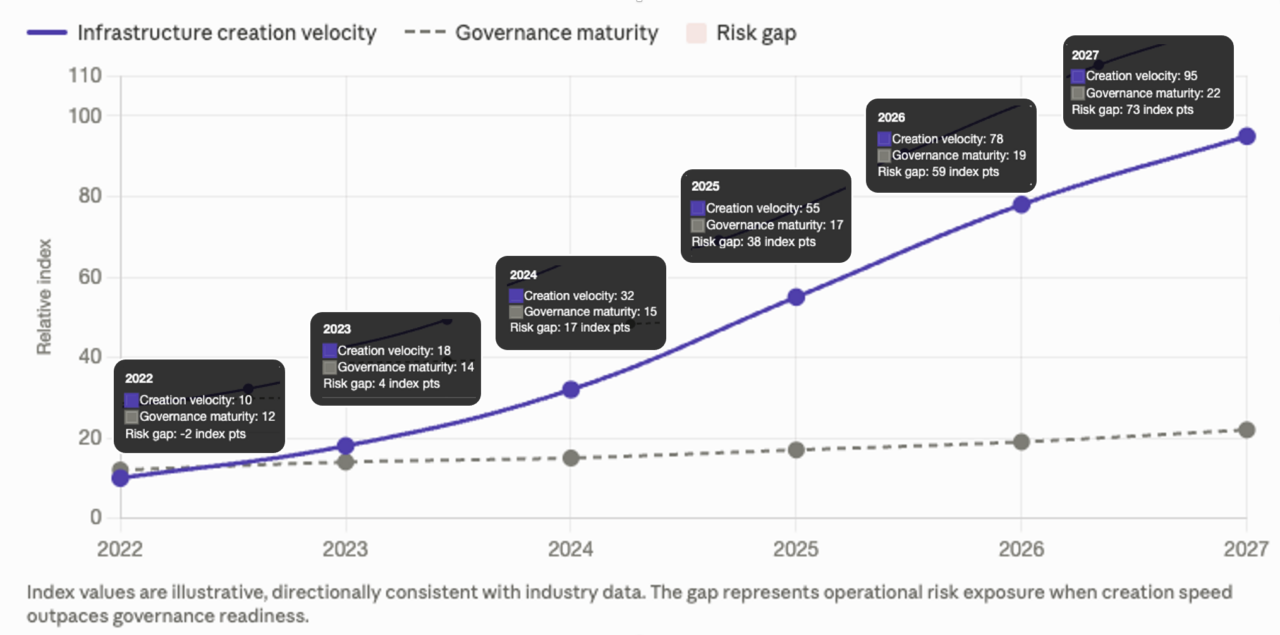
It also created a structural imbalance. Creation velocity went up 10x. Governance maturity stayed flat. The result is an enterprise landscape littered with environments that were never decommissioned, GPU clusters that sit idle, configuration states that nobody can fully account for, and audit trails that don’t exist.
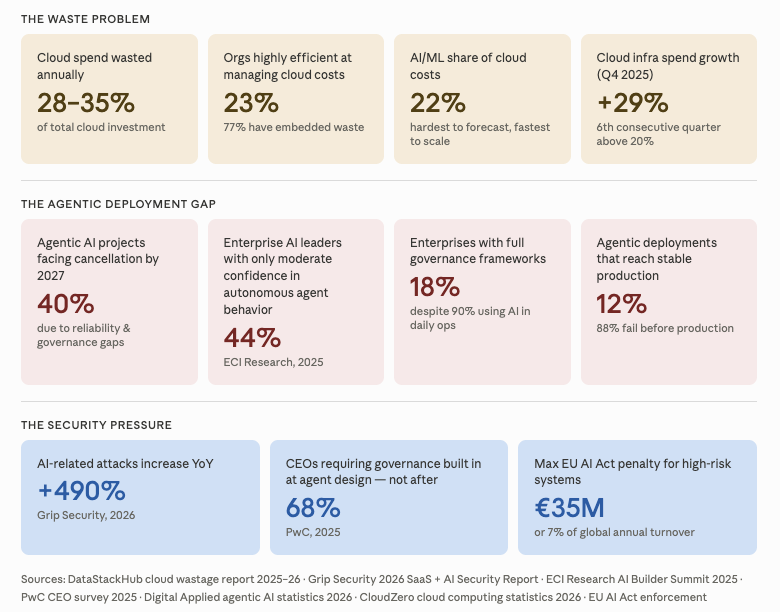
The numbers are bad. Baseline cloud waste across enterprises now runs between 28% and 35% of total spend, and that’s before accounting for the compounding effect of AI workloads, which are harder to forecast, faster to scale, and far less likely to have automated lifecycle controls in place. Industry analysts estimate 40% of agentic AI projects will face cancellation by 2027, not because the AI doesn’t work, but because the infrastructure around it can’t be governed reliably enough to justify continued investment.
Faster infrastructure creation without operational readiness is a new category of risk, not a solved problem.
The Part Nobody Sees
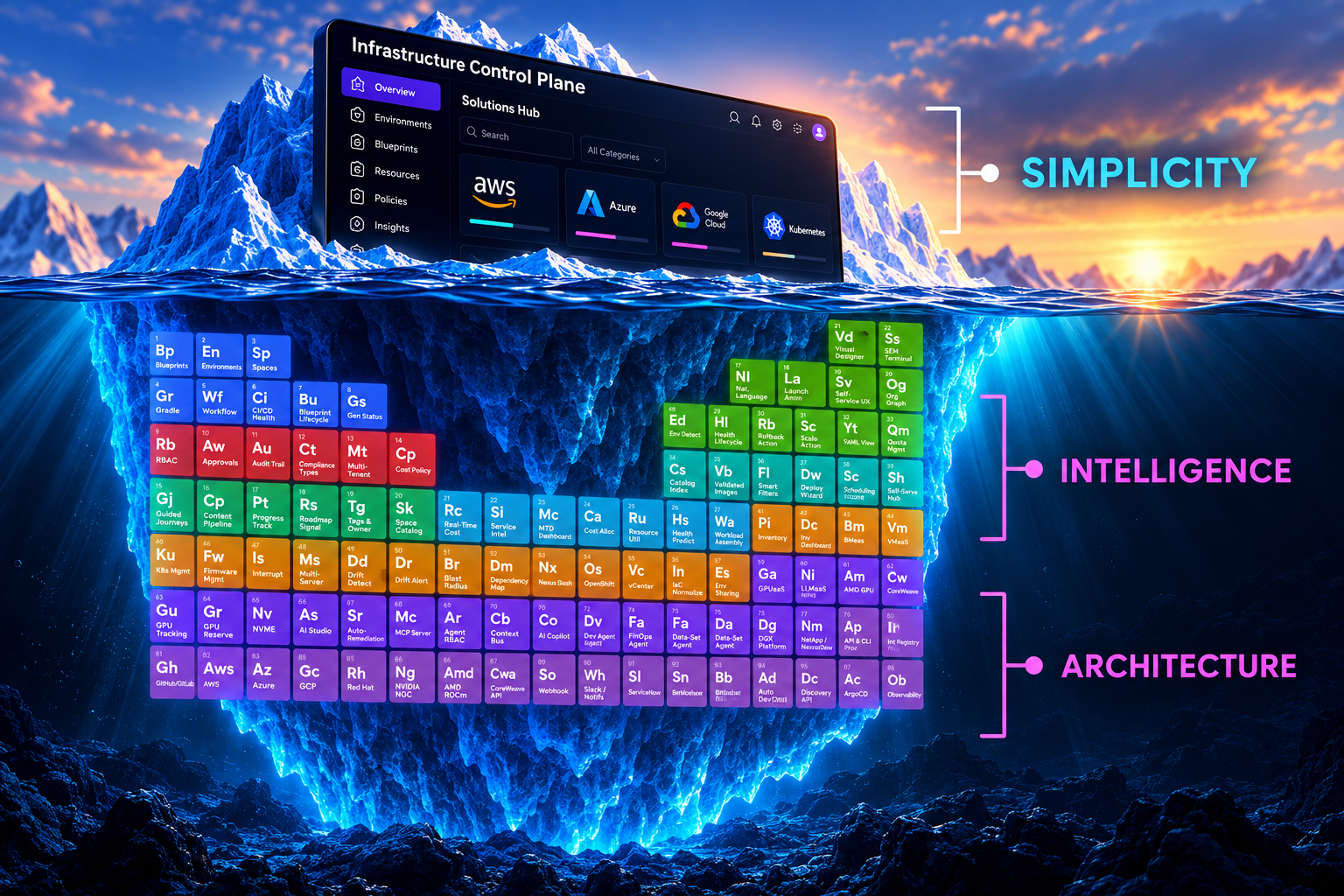
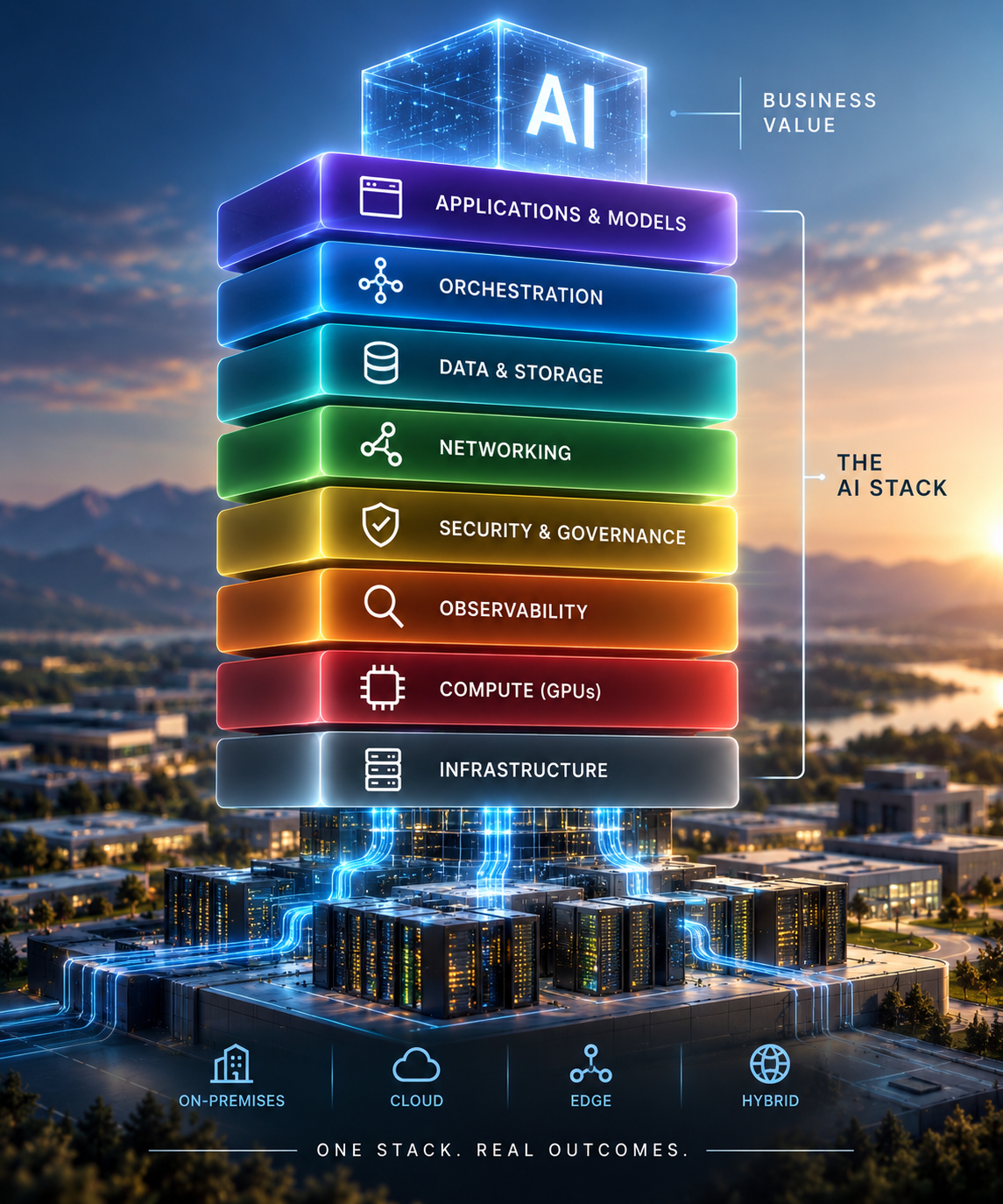
The visible layer of agentic AI gets most of the attention: the LLMs, the CI/CD pipelines, the autonomous agents, the test suites. That’s where budget conversations happen and where demos live.
Below that layer is where the real operational complexity sits, environment provisioning, configuration drift, infrastructure compliance, policy enforcement, hybrid workload consistency. These aren’t glamorous problems. They’re also not optional ones.
Every agentic system assumes the infrastructure beneath it is stable, governed, and auditable. A 2025 PwC survey found 68% of CEOs now require governance integration during agent design, not retrofitted afterward. That’s the right instinct. But instinct and execution are different things. Only 18% of enterprises have fully implemented governance frameworks, despite 90% using AI in daily operations. The gap between those two numbers is where quality breaks down, costs spiral, and releases get stuck.
What Actually Breaks
The failure modes are consistent across organizations and they tend to arrive quietly before they arrive loudly.
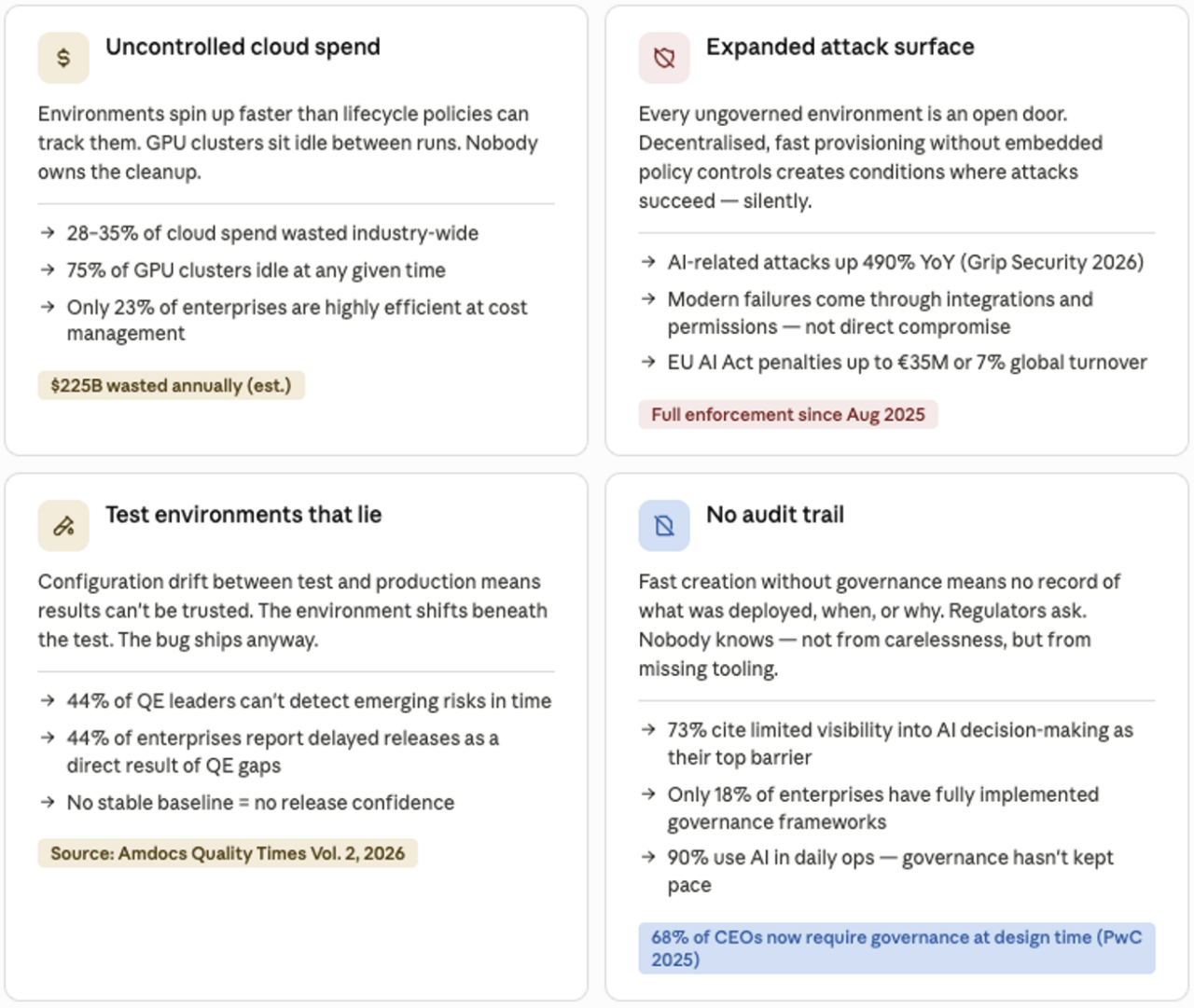
- Cloud spend that nobody controls. Environments spin up and never get torn down. GPU clusters sit idle between training runs. Budgets exceed projections not because anyone made a bad decision, but because there was no automated policy enforcing lifecycle rules. Only 23% of organizations consider themselves highly efficient at managing cloud costs. The other 77% are operating with some degree of invisible waste baked into their infrastructure.
- Security posture that degrades silently. Every ungoverned environment is an expanded attack surface. AI-related attacks increased nearly 490% year-over-year according to Grip Security’s 2026 report. Decentralized, fast provisioning without embedded policy controls doesn’t cause those attacks directly, it creates the conditions where they succeed.
- Test environments that produce unreliable signals. Configuration drift between test and production means results can’t be fully trusted. The environment changed beneath the test. The bug ships anyway. For QE teams operating in agentic pipelines, this isn’t a minor inconvenience, it’s a fundamental challenge to release confidence. When 44% of enterprise AI leaders report only moderate confidence in autonomous agent behavior, that hesitancy is often rooted in infrastructure instability, not agent capability.
- Audit trails that don’t exist when regulators ask. The EU AI Act entered full enforcement for high-risk systems in August 2025, with penalties up to €35 million or 7% of global annual turnover. When a regulator asks what was deployed, when, and why, the answer needs to exist before the question is asked.
The Shift That Changes the Operational Model
Traditional infrastructure was designed for a world of predictable workloads, static provisioning, and human-driven governance that could keep pace because the pace of change was slow. AI infrastructure operates differently. GPU bursts. Ephemeral environments. Multi-agent systems spawning their own compute. Dynamic orchestration happening faster than any human review cycle can track.
The operational challenge is no longer provisioning infrastructure. It is continuously adapting infrastructure in real time, with policy enforcement that doesn’t require a human in every loop.
The organizations succeeding at this share a specific set of attributes: pre-deployment infrastructure investment, governance documentation before deployment, baseline metrics captured before pilots, and dedicated ownership with accountability for post-deployment performance. These aren’t coincidental traits. They’re the characteristics of teams that treat infrastructure governance as a first-order engineering problem, not a compliance checkbox.
What Next-Generation Environment Management Requires
The answer isn’t adding friction to slow creation down. It’s making governance as fast and automated as creation itself.
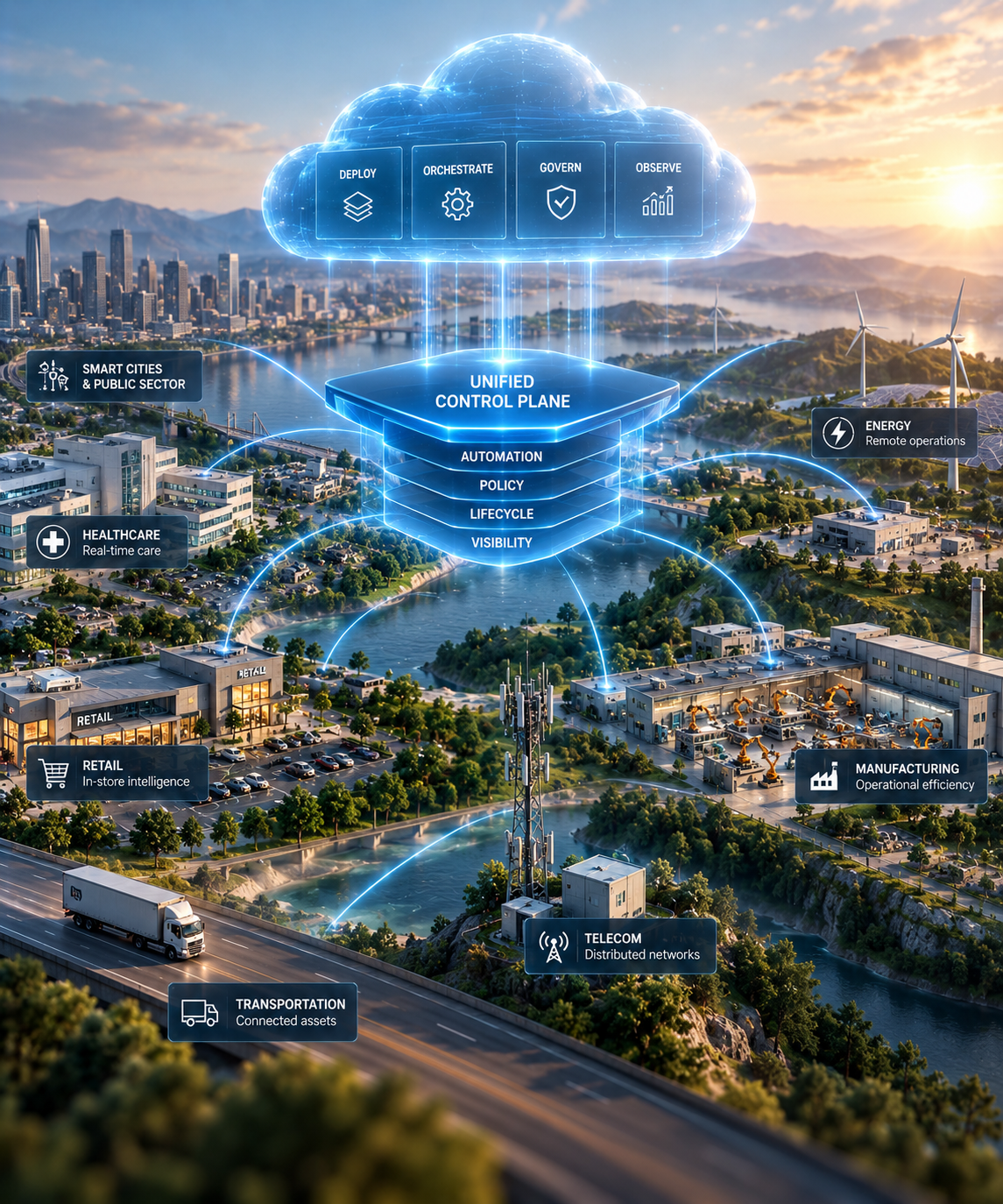
That means on-demand provisioning, environments that spin up in minutes without tickets or waiting. Policy as code, governance that’s version-controlled, automated, and embedded in the deployment pipeline. Environments as blueprints, composable, repeatable, and auditable across every team and workload type. Full auditability, every deployment traceable, every change recorded, every cost attributable. And a single governance model that works across traditional IT and agentic workloads without requiring different tooling for each.
The 12% of agentic deployments that succeed in production share one structural advantage: they built the governance layer before they needed it. The 88% that don’t make it to stable production largely didn’t.
Agentic QE and Environment Intelligence Are Not Separate Problems
There’s a direct dependency between infrastructure governance and quality engineering. Unstable, ungoverned environments produce unreliable test signals. Unreliable test signals produce false release confidence. False release confidence produces production incidents, which is a significantly more expensive outcome than solving the governance problem earlier.
Agentic QE and environment intelligence need to develop together. Organizations investing in autonomous testing pipelines without investing equally in the infrastructure governance underneath them are optimizing one half of a system that depends on both halves working.
The organizations that will define the agentic era aren’t simply the ones with the most capable AI. They’re the ones whose governance infrastructure is as advanced as their AI capability, and who treated those two investments as inseparable from the start.
Quali Torque is a purpose-built for this model, giving engineering teams agentic AI that works within guardrails, surfaces its work for human review, and develops the contextual awareness to become genuinely more capable over time.
To see Torque in action, visit the Torque playground, book a live demo focused on SRE and platform use cases to see how Torque plugs into your existing application pipelines and tooling.