Why the return on AI infrastructure depends less on how long the hardware lasts than on how long it can reach paying demand
A 26 percent price cut moved the break-even line further than utilization can follow
Over roughly thirteen months, the hourly rate neocloud customers paid for an NVIDIA H100 fell from about $2.70 to $2.00, according to J.P. Morgan Asset Management. On Quali’s illustrative cost model, that single change raised the utilization an operator needs simply to break even from 54 percent to 73 percent. On a four-year depreciation schedule, the requirement rises from 68 percent to 92 percent.
Few GPU fleets run at 92 percent across their life. An operator in that position cannot schedule its way to a return. The asset is losing money because the price it can realize has fallen below the price its cost structure assumed, and better scheduling does not change the price.
Most of the industry debate about this problem is framed as a hardware question: how long a GPU stays useful before newer accelerators make it obsolete. That framing misses the variable operators actually control. A GPU’s economic life ends when it can no longer reach a buyer willing to pay more than it costs to run. How long that takes depends on distribution.
EXHIBIT 1 | Break-even utilization rises sharply as realized price falls
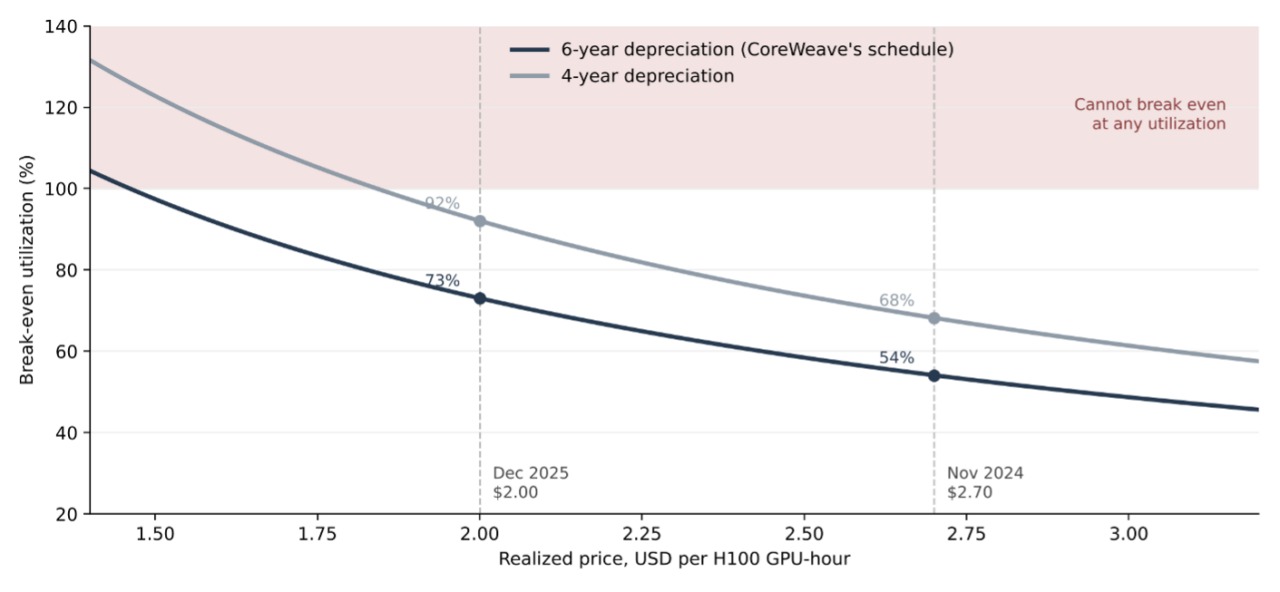
Source: Quali illustrative model. Price points from J.P. Morgan Asset Management, Eye on the Market, January 2026. Assumptions: $40,000 all-in capital cost per H100 including server, networking and storage share; about $0.45 per installed GPU-hour for power, facility and operations; financing at about 11% on the average outstanding balance; straight-line depreciation over six years (CoreWeave’s stated schedule) or four years. Break-even utilization equals total cost per installed GPU-hour divided by realized price. Figures are directional and will vary by operator.
Selected price observations show the direction, not a single market rate
GPU-hours are not sold at one price. Hardware generation, cluster topology, contract length and service guarantees all move the realized rate. The J.P. Morgan observations below track selected offerings over time, which makes them useful for measuring direction. Silicon Data’s market median for neocloud H100 capacity in the second half of 2025 was higher, at $3.33 per GPU-hour, as cited in Quali’s earlier article on infrastructure market power. The two measures answer different questions. Both point the same way: prices fell by a fifth to a quarter across every category J.P. Morgan tracked.
EXHIBIT 2 | Selected H100 hourly rental observations
| Provider category | Nov. 2024 | Dec. 2025 | Change |
| Neoclouds | $2.70 | $2.00 | −26% |
| Hyperscalers | $8.90 | $7.00 | −21% |
| AWS | $4.50 | $3.40 | −24% |
Source: J.P. Morgan Asset Management, Eye on the Market, January 2026. Selected quoted observations; offerings and terms differ and are not directly comparable across categories.
The depreciation debate is asking the wrong question
Investors and operators disagree sharply about how long an AI accelerator earns its keep. Investor Michael Burry has argued that the true economic life of a data center GPU is two to three years. CoreWeave depreciates GPUs and related equipment over six years. Amazon has moved in both directions: it extended server lives from four to five years in 2022 and to six years in 2024, then shortened a subset back to five years in 2025, citing the increased pace of technology development in artificial intelligence and machine learning. That reversal added an expected $1.4 billion to depreciation.
Each side treats useful life as a property of the silicon. The accounting schedule is a forecast of something else: the number of years an asset can generate revenue above its cost of operation. A GPU that is technically sound but cannot reach a buyer has no economic life left. A previous-generation GPU that keeps finding demand at a viable price is still a productive asset, whatever its launch date.
Two cost lines decide whether a GPU is paying its way, and each answers a different question.
Full cost: is the investment paying back? This line includes everything it takes to own the GPU: the purchase price spread across its depreciation schedule, interest on the money borrowed to buy it, and the power, data center space and staff to run it. In Quali’s illustrative model it comes to about $1.46 for every hour the GPU is installed. When hourly revenue stays above that line, the purchase is paying for itself.
Running cost: is the GPU still worth keeping on? This line counts only what it takes to keep the GPU powered, housed and operated, about $0.45 per installed hour in the same model. The purchase price has already been spent, so it no longer changes the decision. A GPU rented out at $1.00 an hour loses money against its full cost, yet it still brings in $0.55 an hour more than it costs to run. Switching it off would leave the operator worse off.
Full cost governs a GPU’s early years, when the investment has to pay back and lenders want evidence that it will. Running cost governs its later years. A GPU’s economic life ends when no buyer will pay more than its running cost, and distribution decides when that point arrives.
Exhibit 1 shows why this matters. The difference between a four-year and a six-year schedule is the difference between needing 92 percent and 73 percent utilization at today’s neocloud price. Extending economic life is one of the largest levers in GPU economics, and the operator does not pull it in the finance department. It pulls it by staying connected to demand.
Older GPUs keep earning when they stay connected to buyers
CoreWeave’s recent disclosures are the clearest evidence. On its second-quarter 2026 earnings call, the company said it had signed an NVIDIA A100 contract running into 2029, nine years after the chip launched. Its CEO separately said that a batch of H100s coming off an expired contract was rebooked at 95 percent of the original price, and the company’s CFO said pricing for prior-generation systems was at or above year-earlier levels.
Those outcomes are not explained by the hardware. Open-market H100 prices fell over the same period. They are explained by CoreWeave’s commercial position. Revenue recognized against customer commitments accounted for 98 percent of revenue in 2025 and in the first half of 2026. Remaining performance obligations grew from $15.1 billion at the end of 2024 to $103.7 billion by mid-2026. The company also reduced its dependence on a single buyer: its largest customer, Microsoft, represented 67 percent of 2025 revenue, while the largest customer in the second quarter of 2026 represented 36 percent.
EXHIBIT 3 | Contracted demand grew while customer concentration fell
| Period end | Remaining performance obligations | Largest customer share of revenue |
| FY2024 | $15.1B | 62% |
| FY2025 | $60.7B | 67% |
| Q2 2026 | $103.7B | 36% (quarter) |
Source: CoreWeave Form 10-K for fiscal 2025 and Form 10-Q for the quarter ended June 30, 2026. Customers are not identified consistently across periods.
CoreWeave operates an integrated AI cloud, not a federated one, and few operators can replicate its scale or contract structure. The lesson is narrower and more useful: when an operator controls access to committed demand, older capacity holds its price and the depreciation schedule becomes credible. When it does not, the same hardware is exposed to the open-market price curve in Exhibit 2.
Lenders already price distribution, even when operators do not
The capital behind AI infrastructure makes this a financing question as well as an operating one. Morgan Stanley estimates roughly $2.9 trillion of global data center spending through 2028, leaving a financing gap of about $1.5 trillion that external capital must fill. It expects private credit to supply around $800 billion of that, led by asset-based finance.
Asset-based lenders underwrite the cash flows an asset can produce over the life of the loan. For GPUs, that means they underwrite distribution. Capacity backed by committed offtake from creditworthy buyers supports more debt on better terms than capacity sold by the hour into a falling market. An operator that can show a durable route to demand for the second and third years of an asset’s life is lowering its cost of capital, not just improving its revenue forecast.
A second and third life requires different buyers
The buyers who need a GPU in its first year are rarely the buyers who need it in its fifth. Frontier training moves to each new generation as soon as it ships. The workloads that remain value different things: predictable cost, a validated software stack, data residency, governance and fast access to a ready environment. A previous-generation accelerator can serve them well.
EXHIBIT 4 | Each stage of a GPU’s life calls for a different buyer and route to market
| Life stage | Typical demand | What the buyer values | Likely route to market |
| First life | Frontier training, large-scale model development | Latest accelerator, cluster scale, interconnect | Direct contracts with model builders and hyperscalers |
| Second life | Inference, fine-tuning, enterprise AI applications | Price per output, reliability, validated stack | Software vendors and AI platforms that embed capacity |
| Third life | Development and test, labs, training, cyber ranges, research, regional and sovereign workloads | Governed, repeatable environments; locality; low cost | Managed service providers, systems integrators, sector specialists |
Conceptual framework; stage boundaries vary by accelerator generation and market.
The later stages are where most operators’ distribution breaks down. A sales organization built to close large training contracts is not built to reach a university lab, a cyber range operator or a regional bank’s development team. Those buyers are reached through partners who already serve them and who package capacity inside their own services.
Quali sees the demand for these workloads directly. Torque customers have long used governed, shared infrastructure to run labs, cyber ranges and development and test environments, where the requirement is a repeatable, policy-controlled environment delivered on demand rather than the newest accelerator. That category of demand is large, persistent and well suited to capacity in its second and third lives.
Federation turns an aging fleet into inventory partners can sell
Federated Infrastructure gives the infrastructure owner a way to reach those later-life buyers without building a new sales channel for each one. The owner publishes its capacity as a governed capability, with defined accelerator class, software stack, location, policy and terms. Partners incorporate that capability into services they already sell. The owner continues to operate the hardware and enforce its policies; the partner owns the customer relationship and the service around it.
This changes the economics described in Exhibit 1 in two ways. It raises utilization in the later years, when direct demand thins. It also supports realized price, because the capacity is sold as part of a differentiated service rather than as an anonymous GPU-hour exposed to open-market rates. Both effects extend the period in which the asset earns more than it costs.
The control plane makes this repeatable by keeping environments consistent, policies enforced and consumption attributable across organizational boundaries. It does not by itself settle revenue sharing, contracting or liability between participants. Those require commercial agreements and systems of their own, and they are where the model is least mature today.
Measure realized revenue per installed GPU-hour
Utilization alone cannot tell an operator whether its fleet is earning a return. A more complete measure combines three factors that each have a different owner and a different fix: the share of installed capacity that is ready for customer workloads (activation), the share of ready capacity that is consumed (utilization), and the price actually realized per consumed hour.
EXHIBIT 5 | Realized revenue per installed GPU-hour = activation × utilization × realized price
| Operator A: direct GPU-hour sales | Operator B: contracted and partner-distributed | |
| Activation | 90% | 95% |
| Utilization | 60% | 80% |
| Realized price | $2.00 | $2.40 |
| Revenue per installed GPU-hour | $1.08 | $1.82 |
| Full cost per installed GPU-hour (six-year schedule) | $1.46 | $1.46 |
| Result | Loss of $0.38 per hour | Margin of $0.36 per hour |
Illustrative example using the cost assumptions in Exhibit 1. Operator B’s price reflects committed contracts and services sold through partners rather than open-market rental.
The two operators own identical hardware with identical costs. One loses money on every installed hour and the other earns a margin, and the gap comes entirely from activation, utilization and price. Activation is an operations problem. Utilization and price are distribution problems.
Investment strategy should start with the route to demand
Operators planning their next expansion should test the economic life of the fleet they already own before adding to it. The relevant questions are practical: which buyers will need this capacity in years three through six, which partners already serve them, what price those channels will sustain after revenue sharing, and whether that evidence will satisfy a lender.
In some cases, adding a cluster is the right answer. In many others, extending the reach of existing capacity will improve returns more than buying the next generation. The operators that keep their GPUs earning longest will not be the ones with the most durable hardware. They will be the ones with the most durable access to demand.
Explore the Federated Infrastructure series
This article is part of Quali’s Federated Infrastructure series, listed here in publication order.
Infrastructure, Unbound: Build Once. Deliver Anywhere. Extend Everywhere. Introduces the four federation patterns that let one organization build an infrastructure capability once and deliver it to others.
The GPU Is the Easy Part. The AI Stack Is the Problem. Explains why turning accelerated hardware into a usable AI environment depends on the full software, networking and governance stack.
Federated Infrastructure: When Infrastructure Stops Belonging to a Location Explains how separating infrastructure from where it runs turns providers and consumers into participants and idle capacity into inventory.
The Infrastructure Control Plane: What Automation Alone Cannot Deliver Explains what an infrastructure control plane adds beyond automation scripts, and why it is the foundation for governed, repeatable delivery.
The New Economics of IT Infrastructure Follows the money through a federated value chain to show how an infrastructure capability accumulates value as partners extend it.
Federated Infrastructure: The New Economics of IT Infrastructure (white paper) Sets out the full operating and commercial model for turning infrastructure from a fixed cost into a reusable, governed asset.
Federated Infrastructure: Opportunity Assessment An interactive tool for identifying where federation could create operational or commercial value in your own infrastructure estate.
The Next Infrastructure Giants Won’t Own the Infrastructure Uses the airline industry’s codeshare model to show why competitive advantage is shifting from owning infrastructure to distributing it.
Federated Infrastructure: From Vision to Reality Describes the operational building blocks, governance and commercial agreements needed to make federation work at scale.
Sources and editorial references
- P. Morgan Asset Management, Eye on the Market, January 2026:
- Silicon Data H100 median rental pricing, second half of 2025, as cited in Quali, The Next Infrastructure Giants Won’t Own the Infrastructure
- CoreWeave, Form 10-K for fiscal 2025
- CoreWeave, Form 10-Q for the quarter ended June 30, 2026 (accession 0001769628-26-000366), SEC EDGAR
- Tom’s Hardware, CoreWeave CEO says it has signed an A100 contract running into 2029, August 2026:
- Morgan Stanley, Thoughts on the Market: Credit markets and the AI financing gap, August 2025:
- com, Forms 10-K for fiscal 2022, 2024 and 2025 (changes in server useful life), summarized by Hudson Labs
- Michael Burry’s GPU useful-life argument, November 2025, as reported by The Motley Fool
See how Torque provides the control plane for infrastructure automation across cloud, data center and edge environments, or talk to us about how federated infrastructure could apply to your environment.