The operating foundations of a new infrastructure economy are already taking shape, and the next challenge is to extend them across organizations.
Most organizations already own more infrastructure than they can put to work. Across tens of thousands of Kubernetes clusters on AWS, Azure and Google Cloud, Cast AI measured average GPU utilization at 5% and CPU utilization at 8%. Flexera’s 2026 State of the Cloud Report estimates that 29% of IaaS and PaaS spend is wasted, the first increase in five years. The constraint is rarely the hardware. It is the inability to package what already exists into something other teams, customers and partners can safely consume.
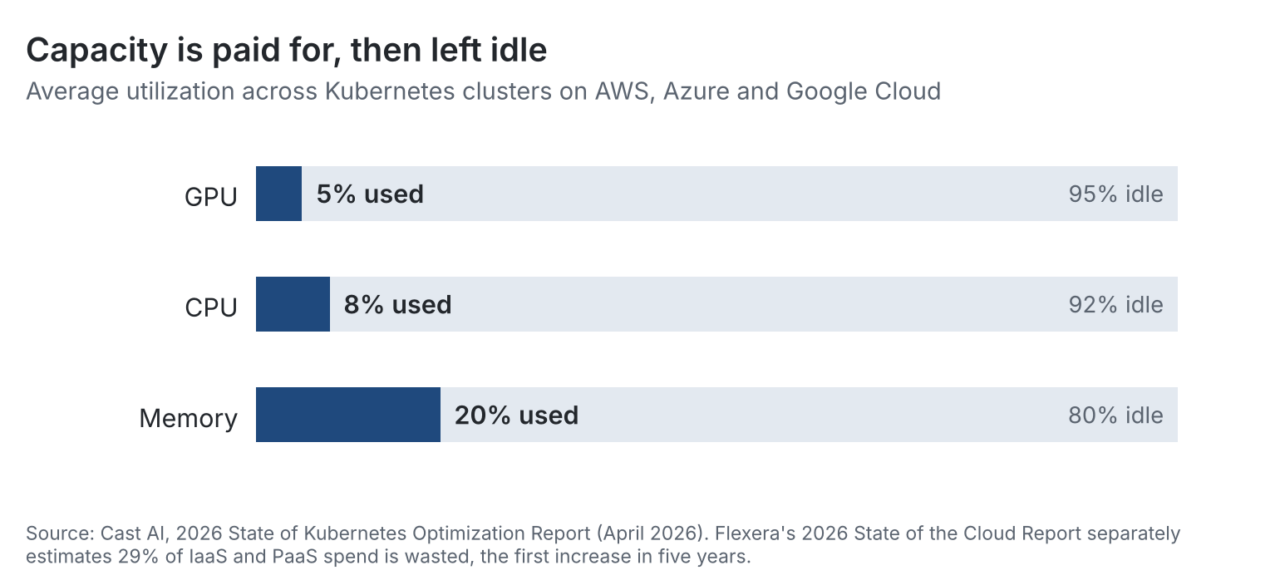
Figure 1. Average resource utilization across Kubernetes clusters. Sources: Cast AI; Flexera.
The promise of Federated Infrastructure is not simply that computing resources can be deployed in more places. It is that infrastructure capabilities can become reusable, governed services that organizations assemble, extend and deliver across technological and organizational boundaries. This is a more demanding proposition than hybrid cloud management or infrastructure automation. It requires a shift in how services are defined, operated and ultimately commercialized.
Across this series, we have examined the economic implications of that shift: the separation of asset ownership from distribution, the commercial challenges of AI infrastructure and the possibility that infrastructure consumers may also become service providers. The central question for the industry is now one of execution. The value of federation will depend on whether its foundational operating capabilities can be demonstrated reliably, repeatedly and at scale.
There is credible evidence that important parts of this foundation already exist. Quali’s Torque infrastructure control plane and Stack Automation co-engineered with Cisco and available exclusively through Cisco, provide concrete examples of reusable environment definitions, governed delivery and coordinated deployment across complex technology stacks. They do not constitute a complete cross-company federation marketplace. They do show how essential technical prerequisites can move from architectural diagrams into operational practice.
The transition from infrastructure automation to infrastructure products
Conventional automation improves the execution of individual tasks. Scripts and infrastructure-as-code tools can provision resources, configure networks and deploy software, but the resulting service often remains dependent on the expertise of the team that assembled it. The process may be repeatable within one environment without being portable, consumable or governed as a complete offering. Extending reach does not solve this on its own. Gartner predicts that more than 50% of organizations will not get the expected results from their multicloud implementations by 2029.
Federation requires a more durable unit of delivery: an infrastructure capability whose dependencies, configuration, access policies and lifecycle can be understood and managed as part of a coherent service. This changes the operating model. Instead of treating each request as a bespoke integration exercise, providers can define reusable environments that preserve operational knowledge and make it accessible through controlled self-service.
Torque addresses this requirement by discovering and incorporating existing infrastructure definitions, including Terraform and Helm assets, into reusable blueprints with policy, governance and lifecycle management. The strategic significance is not the elimination of existing tools; it is the ability to organize their outputs into a consistent operating model that can be consumed beyond the specialists who created them. This is one of the prerequisites for treating infrastructure as a service product rather than a collection of implementation tasks.
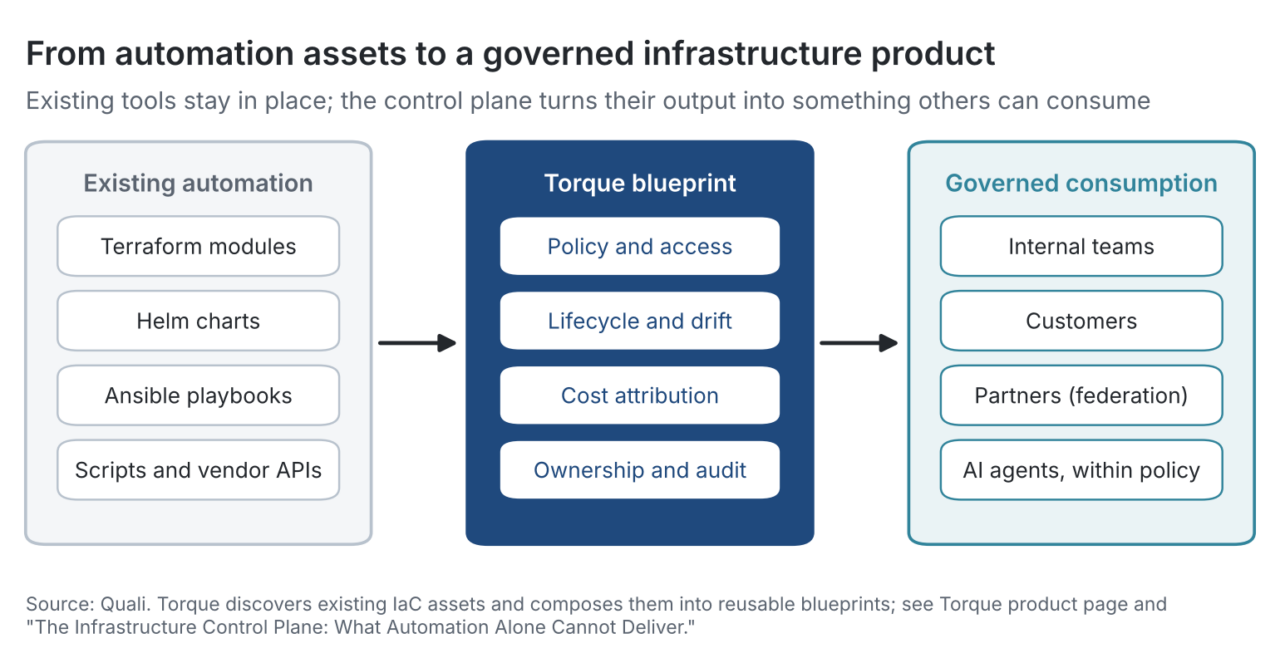
Figure 2. How a control plane converts existing automation into a governed, consumable infrastructure product.
A working example of complexity becoming a repeatable service
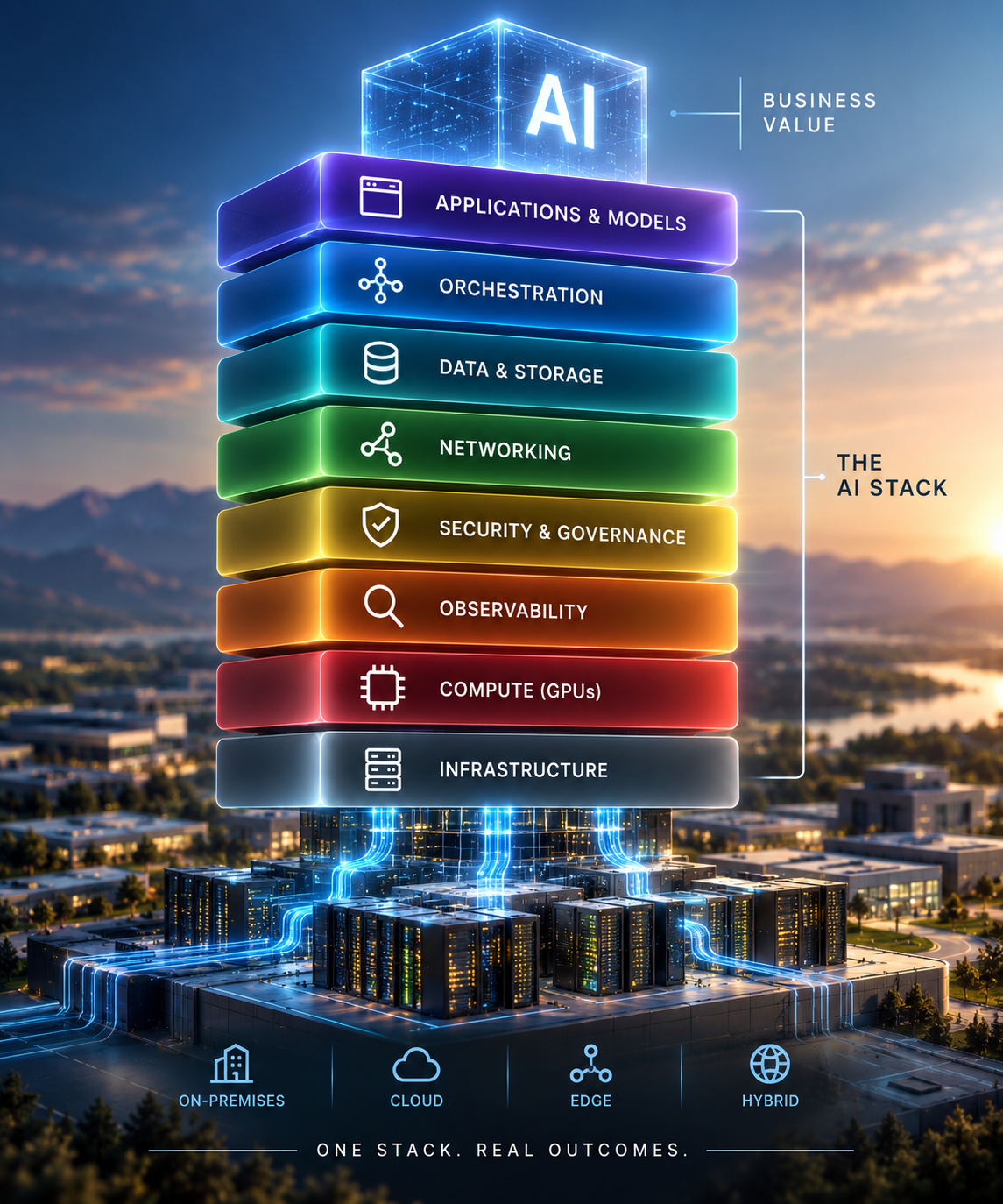
The AI infrastructure market provides an especially useful test. A production-ready AI environment is not a GPU alone. It depends on coordinated compute, networking, storage, security, software frameworks, observability and operational controls Fragmented responsibility across these layers can delay deployment even when the physical hardware is already available. Deloitte’s 2026 State of AI in the Enterprise found that only 25% of organizations have moved 40% or more of their AI pilots into production.
Stack Automation by Quali, developed with Cisco and now generally available, provides a tangible example of this coordination. The offering combines Cisco Validated Designs and Cisco infrastructure expertise with Quali’s automation capabilities to deliver governed, reusable full-stack deployment workflows. Its Solutions Hub provides a catalog of validated solutions, while integrations with Cisco Intersight and Nexus Dashboard connect automation to infrastructure operations. The product is offered exclusively through Cisco, reflecting a concrete collaboration between an infrastructure technology provider and an automation specialist.
The importance of this example extends beyond deployment speed. It demonstrates that complex infrastructure knowledge can be encoded into repeatable offerings, that heterogeneous components can be coordinated as a service, and that governance can be embedded in the delivery process rather than added after provisioning. These are precisely the operational qualities that a broader federated model would require. The example establishes a credible technical foundation; it should not be interpreted as proof that cross-provider revenue settlement or unrestricted service redistribution is already available.
Exhibit 1 | The building blocks of operational federation
| Requirement | Why it matters | Evidence of progress | Status |
| Reusable service definitions | A capability must be understandable and repeatable beyond its original implementation team. | Torque blueprints and governed catalogs; Stack Automation validated solutions in the Solutions Hub. | Available today |
| Heterogeneous orchestration | Complete services span multiple tools and infrastructure technologies. | Torque incorporates existing IaC assets; Stack Automation coordinates full-stack deployment. | Available today |
| Governance and accountability | Access, configuration, lifecycle and consumption must remain visible. | Torque policy, drift detection, lifecycle and cost context; Stack Automation governed workflows. | Available today |
| Partner-scale delivery | Expertise must be distributable through repeatable commercial channels. | Cisco-exclusive Stack Automation offering; Torque federation offerings shared with subscribers. | Available today |
| Cross-provider commercial exchange | Independent parties need agreed entitlements, billing, liability and settlement. | Broader ecosystem development remains necessary. | Ecosystem work ahead |
Governance is the condition that makes reuse sustainable
As infrastructure becomes easier to request and deploy, the risk of uncontrolled consumption can increase. A federated operating model must therefore preserve accountability even when the person or organization consuming a capability is different from the team that defined it. The relevant controls extend from access and security policies to configuration drift, resource ownership, cost attribution and lifecycle termination.
The pressure on those controls is rising. Gartner predicts that by 2029, half of all cloud compute resources will be devoted to AI workloads and more than 50% of multinational organizations will have digital sovereignty strategies, both up from less than 10% in 2025. Workloads are moving faster, and the rules about where they may run are getting stricter at the same time.
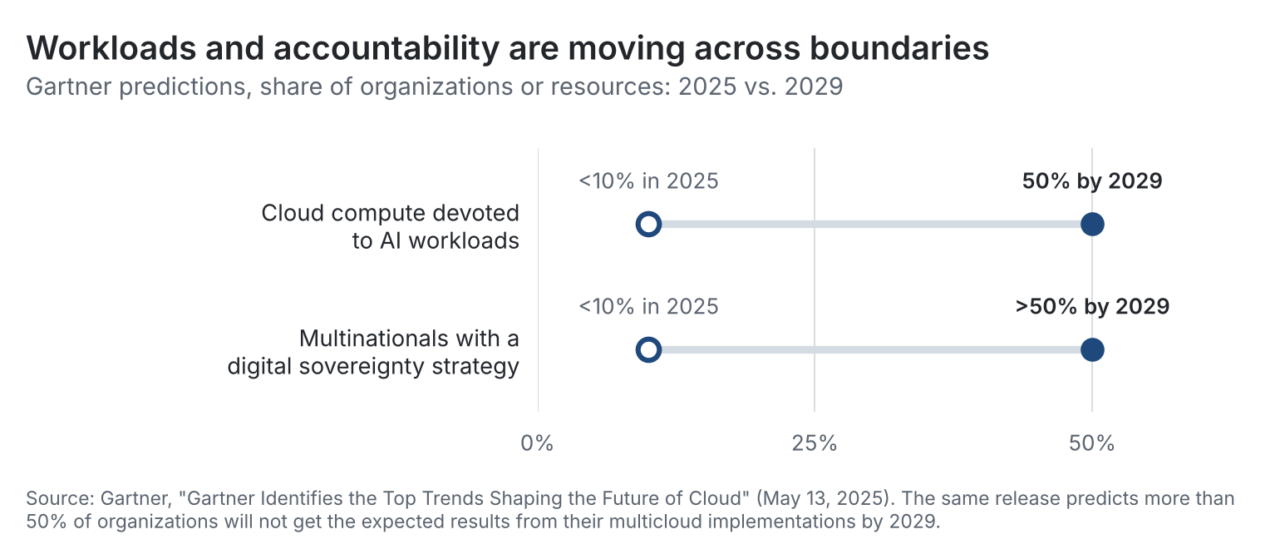
Figure 3. AI workload share and sovereignty requirements are both rising sharply. Source: Gartner.
Quali’s control plane approach treats these functions as part of infrastructure delivery rather than as disconnected operational activities. Torque provides governed self-service and visibility into deployed environments, with mechanisms for tracking ownership, usage and configuration changes. This creates a more reliable basis for delegating infrastructure consumption without surrendering operational oversight. It also helps explain why federation is not synonymous with simply connecting clouds or exposing additional APIs.
Torque federation extends the same model beyond a single organization. A provider publishes an offering to subscribers, and execution can run through an outbound-only agent that keeps credentials with the infrastructure owner. A subscriber can also extend an upstream offering and deliver it onward without forking it.
The distinction becomes more important when AI agents and automated workflows begin initiating infrastructure changes. A service that can be consumed programmatically must still operate within defined permissions, policy boundaries and auditable processes. Embedding governance in the control plane provides a practical mechanism for maintaining those boundaries as the number of consumers and service interactions expands.
Commercial federation requires an additional layer of agreement
Technical progress should not obscure the remaining economic requirements. When several independent organizations contribute to a customer-facing service, they must agree how consumption is measured, which party is responsible for service performance, how licensing restrictions apply, and how revenues and liabilities are allocated. Measurement itself can differ by layer, in tokens for an application and GPU-hours for the compute beneath it. A technical control plane can provide operational evidence and consistency, but it cannot independently establish the commercial terms between businesses.
The size of the distribution opportunity shows why this layer is worth building. Canalys projects that software sold through hyperscaler cloud marketplaces will grow from US$16 billion in 2023 to US$85 billion by 2028, with more than half of those sales flowing through channel partners by 2027. Infrastructure services have no comparable distribution layer yet, and building one depends on the agreements described above.
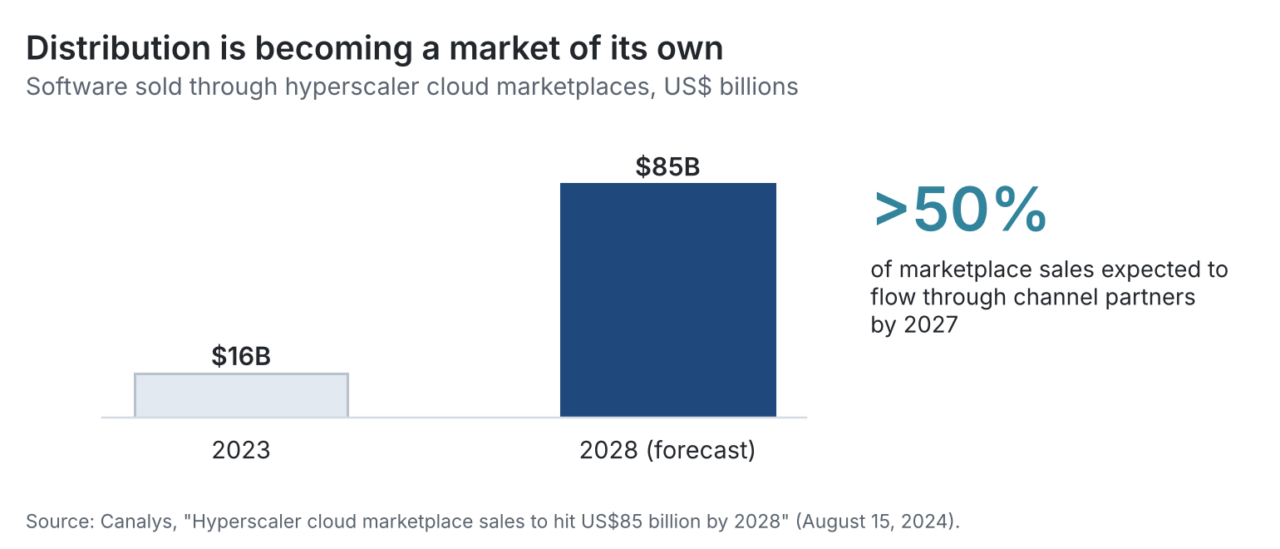
Figure 4. Cloud marketplace sales and channel share show how quickly software distribution has reorganized. Source: Canalys.
This distinction is an advantage for the credibility of the Federated Infrastructure thesis. It makes the development path more concrete. Reusable definitions, lifecycle governance and cross-technology orchestration establish the operational substrate. Partner agreements, service catalogs, contractual standards and settlement systems determine whether that substrate can support a scalable multi-provider economy. These are complementary requirements, not competing explanations of the model.
Exhibit 2 | A practical path from technical capability to federated markets
| Stage | Operational outcome | What must be established | Where it stands |
| 1. Standardize | Complex environments become repeatable governed offerings. | Reusable blueprints, policy and lifecycle controls. | Available today (Torque, Stack Automation) |
| 2. Operationalize | Offerings are delivered reliably across supported environments. | Integrated workflows, validation, observability and accountability. | Available today (Stack Automation through Cisco) |
| 3. Extend through partners | Specialists contribute capabilities to broader solutions. | Supported integrations, entitlements and partner operating models. | Emerging (Cisco collaboration, Torque federation) |
| 4. Federate commercially | Independent providers exchange and monetize composed services. | Contractual trust, metering, settlement and service responsibility. | Ahead (requires industry-wide agreements) |
Why Quali’s position matters
Quali’s relevance to Federated Infrastructure is not based solely on advocating a future industry model. Its products address the difficult operational work of making infrastructure definitions reusable, enabling controlled self-service and coordinating deployment across heterogeneous technology stacks. The Cisco collaboration adds a visible example of these capabilities being incorporated into a major infrastructure vendor’s offering and distribution channel.
This is an important proof point because broad industry transitions rarely begin with a complete end-state ecosystem. They emerge as organizations solve specific, expensive operating problems and turn those solutions into repeatable capabilities. In AI infrastructure, the immediate problem is assembling and governing complex stacks quickly and consistently. In hybrid and enterprise infrastructure, it is making existing investments more accessible without losing control. These operational improvements also create building blocks that could support broader federation over time.
The case should remain precise. Stack Automation is a Cisco-exclusive offering co-engineered with Quali, not an open commercial exchange among arbitrary infrastructure providers. Torque’s control plane capabilities should not be presented as a substitute for the legal and economic arrangements of a mature federation marketplace. Quali’s defensible contribution is to reduce the technical friction that would otherwise make such arrangements difficult to implement reliably.
The next infrastructure economy will be built on operational proof
The evolution toward Federated Infrastructure is unlikely to be a single market event. It will proceed through the expansion of reusable infrastructure offerings, increasingly consistent governance across environments, deeper partner integration and the gradual development of commercial models that support independent contributors. Organizations will adopt these capabilities first where they solve immediate problems, and only later where they enable entirely new business relationships.
That sequence makes the present moment significant. The industry no longer needs to rely exclusively on a conceptual description of infrastructure delivered as governed, reusable services. The operational mechanisms are already visible in products and partnerships, including Quali’s Torque platform and the Cisco Stack Automation offering. Their existence does not complete the federated economy, but it changes the discussion from whether its technical foundations are plausible to how they can be extended.
Federated Infrastructure therefore represents more than an aspiration for a different infrastructure market. It is a direction of development supported by practical advances in service definition, orchestration and governance. Quali is helping establish those foundations today. The opportunity ahead is to connect them to wider ecosystems in which independently owned infrastructure can become part of increasingly valuable, reusable and commercially viable services.
Continue exploring Federated Infrastructure
The strategic and economic dimensions of this transition are developed in The New Economics of IT Infrastructure and the Federated Infrastructure white paper. Organizations considering the implications for their own capabilities, partnerships and operating models can use the Federated Infrastructure Opportunity Assessment as a starting point.
References
Quali Federated Infrastructure series
- Infrastructure, Unbound: Build Once. Deliver Anywhere. Extend Everywhere. Quali blog, David Williams, September 30, 2026. https://www.quali.com/blog/infrastructure-unbound-build-once-deliver-anywhere-extend-everywhere/
- The GPU Is the Easy Part. The AI Stack Is the Problem. Quali blog, David Williams, October 1, 2026. https://www.quali.com/blog/the-gpu-is-the-easy-part-the-ai-stack-is-the-problem/
- Federated Infrastructure: When Infrastructure Stops Belonging to a Location. Quali blog, David Williams, October 5, 2026. https://www.quali.com/blog/federated-infrastructure-when-infrastructure-stops-belonging-to-a-location/
- The Infrastructure Control Plane: What Automation Alone Cannot Deliver. Quali blog, David Williams, October 14, 2026. https://www.quali.com/blog/the-infrastructure-control-plane-what-automation-alone-cannot-deliver/
- The New Economics of IT Infrastructure. Quali blog, David Williams, October 22, 2026. https://www.quali.com/blog/the-new-economics-of-it-infrastructure/
- Federated Infrastructure: The New Economics of IT Infrastructure (white paper). Quali, October 22, 2026. https://www.quali.com/resource/federated-infrastructure-the-new-economics-of-it-infrastructure/
- Federated Infrastructure: Opportunity Assessment. Quali interactive assessment, October 22, 2026. https://www.quali.com/resource/federated-infrastructure-opportunity-assessment/
- The Next Infrastructure Giants Won’t Own the Infrastructure. Quali blog, David Williams, November 3, 2026. https://www.quali.com/blog/the-next-infrastructure-giants-wont-own-the-infrastructure/
Quali products and announcements
- Torque: The Agentic AI Platform to Accelerate Infrastructure Operations. Quali product page. https://www.quali.com/torque/
- Stack Automation by Quali. Quali product page. https://www.quali.com/stack-automation/
- Enterprise AI Has Entered Its Operational Era: Stack Automation by Quali Is Now Generally Available. Quali press release, August 11, 2026. https://www.quali.com/resource/stack-automation-by-quali-is-now-generally-available/
Third-party research
- 2026 State of Kubernetes Optimization Report. Cast AI press release, April 21, 2026. https://cast.ai/press-release/2026-state-of-kubernetes-optimization-report/
- AI workloads drive estimated cloud waste to 29% (reporting Flexera 2026 State of the Cloud Report). TechInformed, April 10, 2026. https://techinformed.com/ai-workloads-drive-estimated-cloud-waste-to-29/
- Gartner Identifies the Top Trends Shaping the Future of Cloud. Gartner press release, May 13, 2025. https://www.gartner.com/en/newsroom/press-releases/2025-05-13-gartner-identifies-top-trends-shaping-the-future-of-cloud
- State of AI in the Enterprise 2026. Deloitte press release, January 21, 2026. https://www.deloitte.com/us/en/about/press-room/state-of-ai-report-2026.html
- Hyperscaler cloud marketplace sales to hit US$85 billion by 2028. Canalys, August 15, 2024. https://canalys.com/newsroom/hyperscaler-cloud-marketplace
See how Torque provides the control plane for infrastructure automation across cloud, data center and edge environments, or talk to us about how federated infrastructure could apply to your environment.