Modern infrastructure has a complexity problem. And despite decades of automation, we have largely succeeded in moving that complexity around rather than eliminating the burden of managing it.
Physical infrastructure, virtualization, cloud, Kubernetes, Infrastructure as Code, and now GPU-powered AI environments have accumulated into an increasingly interconnected estate. Each generation introduced new capabilities, new management tools, and new operational responsibilities. Very little of what came before disappeared. Now agentic AI introduces an entirely new dimension: software that can make decisions and act directly on infrastructure, often without human intervention.
The challenge is no longer simply how to automate infrastructure. It’s how to bring the entire infrastructure estate under a unified, intelligent, and governed operating model.
That is the fundamental purpose of an Infrastructure Control Plane. Not another provisioning tool, orchestration engine, or management dashboard, but an architecture capable of coordinating the capabilities required to deliver, operate, govern, and ultimately retire infrastructure throughout its lifecycle.
Yet the industry has no consistent definition of what that control plane should actually deliver. Definitions tend to reflect existing product portfolios rather than the complete problem enterprises need to solve.
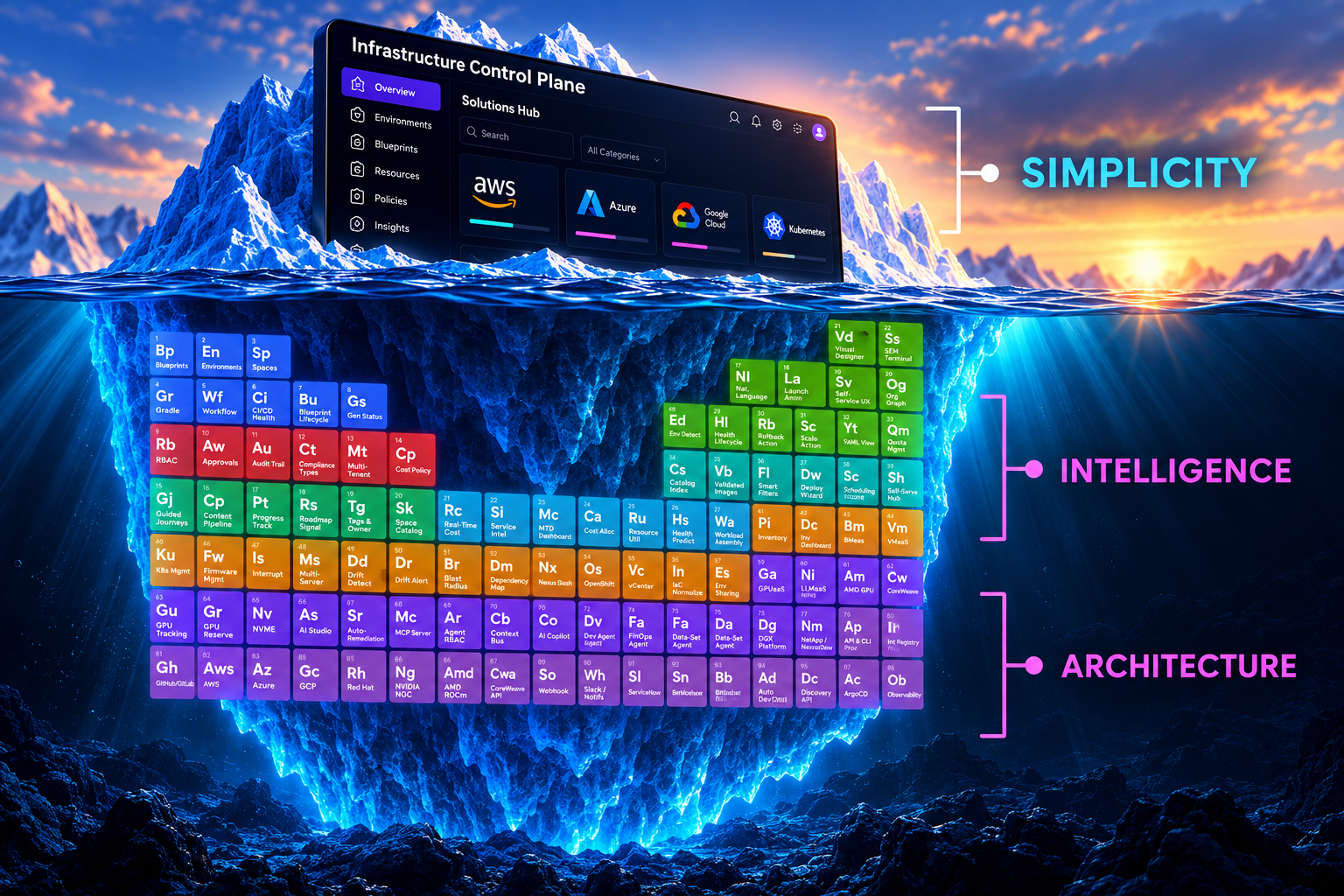
So, we approached the question differently. Instead of starting with technologies or products, we mapped the work itself. We examined everything required to manage modern infrastructure, from traditional systems and cloud platforms to GPU environments, AI workloads, and autonomous agents. We decomposed that work into 104 distinct capabilities across eight domains, creating a vendor-neutral Infrastructure Control Plane Capability Reference Architecture.
But over 100 capabilities are not the achievement. They represent the complexity organizations are already managing, whether through platforms, scripts, disconnected tools, manual processes, or the knowledge of experienced engineers.
The real opportunity lies in three things: Simplicity, Intelligence, and Architecture. Simplicity for the people consuming infrastructure. Intelligence to understand context, dependencies, policy, and operational state. And an architecture that brings the underlying capabilities together as a coherent system rather than another collection of disconnected tools.
A successful Infrastructure Control Plane doesn’t expose 104 things for people to manage. It absorbs that complexity, making infrastructure easier to consume, safer to operate, and increasingly capable of supporting autonomous operations.
AI didn’t create the need for an Infrastructure Control Plane. It made the consequences of not having one impossible to ignore.
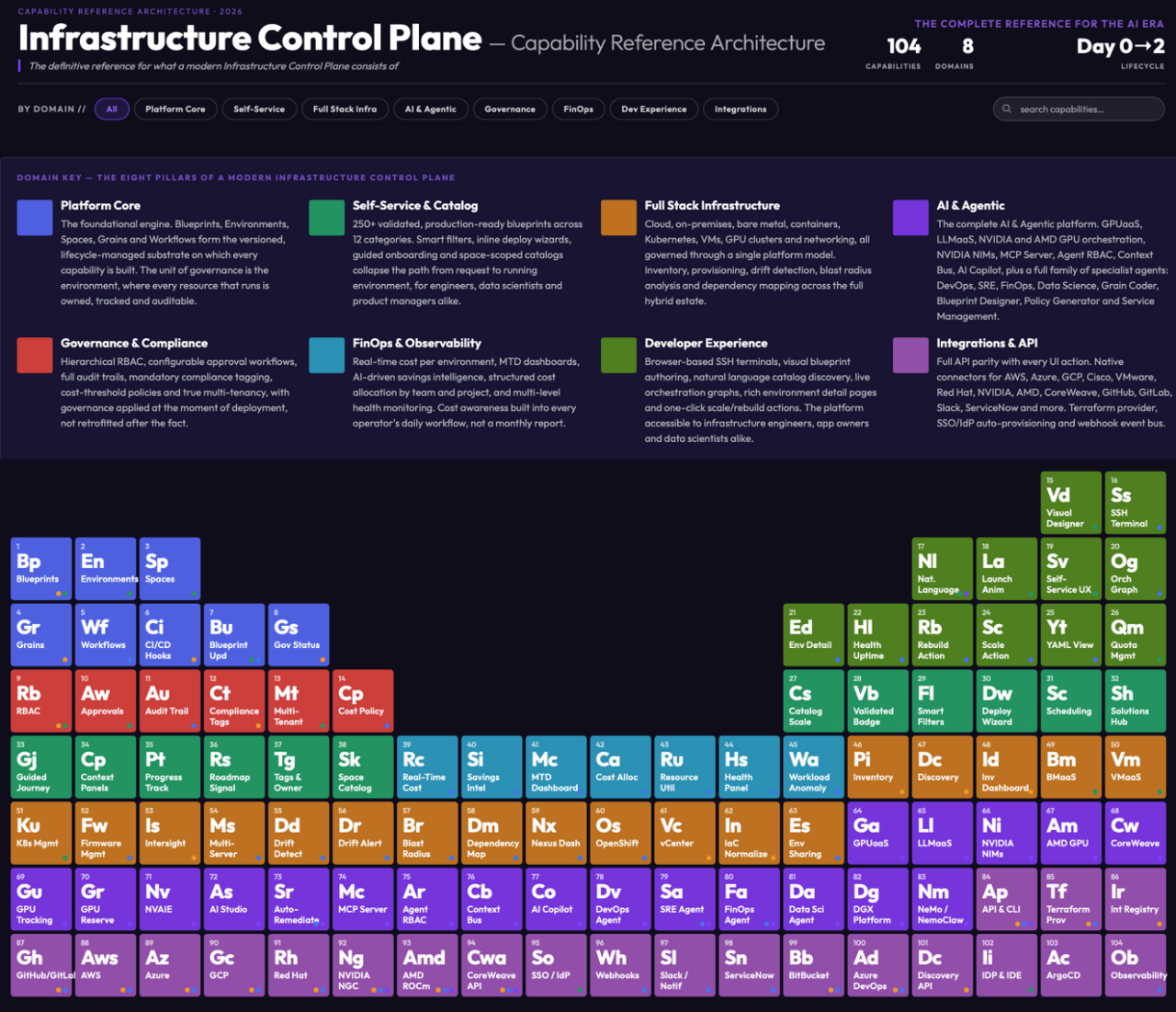
Figure 1. The capability reference architecture maps 104 capabilities across eight domains.
Provisioning is the easy part
Full Stack Infrastructure, the domain where provisioning lives, holds 18 of the 104 capabilities. The other 86 sit across seven domains covering the platform core, governance, cost, self-service, developer experience, AI and integrations. Getting infrastructure running is the smallest part of the job.
Enterprises do not lack automation. Terraform, Ansible, Helm, pipelines and scripts already provision across physical systems, virtualization, public cloud, Kubernetes and now GPU clusters. Ripping that out to put everything under a new product name solves nothing. A control plane should govern the automation teams already trust, not replace it.
The real test comes after deployment. An organization in control can state who owns each environment, what it costs right now, whether it still matches policy, what depends on it and when it will be retired, and it can act on those answers without opening a ticket. An organization that cannot has turned its infrastructure engineers into the integration layer, carrying context and judgment between tools by hand.
Four properties, and why each one fails alone
The reference defines an enterprise infrastructure control plane by four properties. They are not a feature checklist. They describe how the capabilities have to work together.
- Unified. One operating model across cloud services, virtual machines, Kubernetes, networks and GPU systems. The technologies differ. Ownership, policy and lifecycle rules should not.
- Governed. Access, policy, ownership and accountability are enforced as infrastructure is delivered and changed. Finding an unapproved deployment afterward is cleanup, not governance. A dashboard that shows the problem has not prevented it.
- Lifecycle managed. Control lasts as long as the infrastructure does. Health, cost, configuration and dependencies keep moving after day one, and every resource eventually has to be updated, rebuilt or retired by someone with explicit responsibility to do it.
- Self-service. Developers and data scientists get what they need inside those boundaries without becoming infrastructure specialists. A portal that opens a ticket for someone to fulfill by hand is a new front door on the old process.
Pull any one out and the others degrade. Self-service without governance scales risk at the speed of demand. Governance without lifecycle management goes stale the moment infrastructure changes. A unified view with no ability to act gives people a better seat from which to watch the problem.
Hiding the work does not remove it
Take a data scientist who needs a GPU environment for three days. From their side it should be one request. Underneath, something has to validate the environment definition, confirm access, enforce budget and capacity limits, coordinate compute, storage and networking, assign an owner, record the action, monitor usage and reclaim the GPUs when the three days are up.
Strip those steps out and the request looks simpler while the risk moves somewhere else, usually to a GPU node that keeps running after the work is done. A capable control plane makes the request simple by absorbing the work, not by skipping it.
The interactive reference organizes the capabilities through four overlapping views: Curate, Self-Service, Operate and Agentic AI. Operate alone draws 46 capabilities from seven of the eight domains. Day-two operations do not belong to any single tool category, which is exactly why they fall between tools.
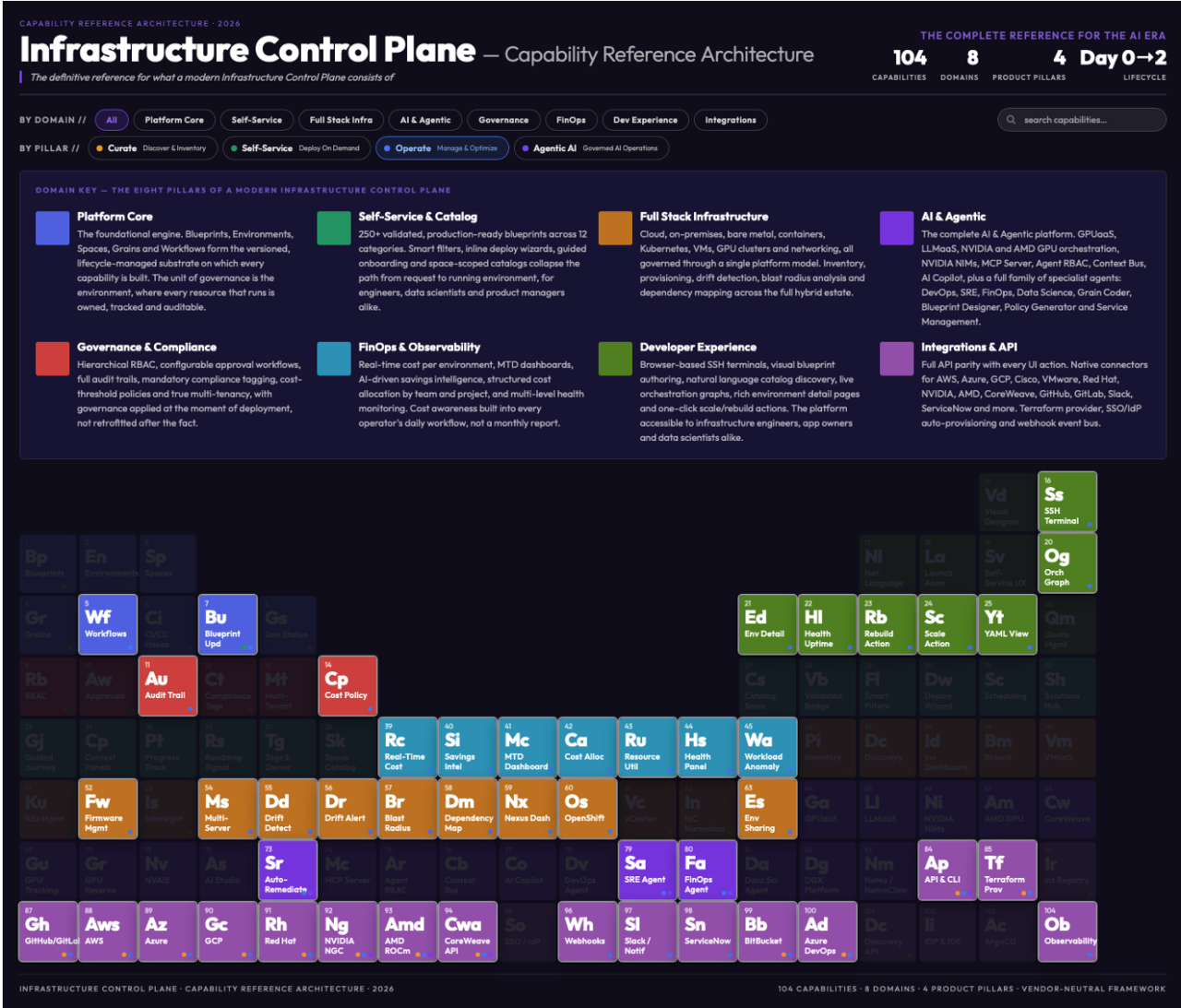
Figure 2. The Operate view highlights the 46 capabilities involved in running infrastructure after deployment.
AI removes the safety net
For years, experienced engineers have quietly held fragmented infrastructure together. They know which configuration is fragile, which resource is shared and who to call before touching it. That knowledge keeps systems running. It does not transfer to software.
GPU infrastructure raises the stakes first. GPU capacity costs far more per hour than general-purpose compute, so every idle or misallocated node shows up on the bill. AI environments also combine compute, storage, networking, data services and models into one stack that has to be governed as a whole.
Agentic AI raises them further. An agent can select an action, invoke automation and react to the result faster than anyone can review it. Connecting an agent to an API gives it a route to your infrastructure. It does not give it permission, context or accountability.
Before an agent gets that authority, the organization needs explicit identity and permissions for the agent itself, enforceable policy, current state, dependency data and an auditable record of every action. The reference treats agent permissions as a capability in their own right, Agent RBAC, so each agent operates inside a defined boundary regardless of the instructions it receives.
It also separates two things that are routinely blurred. Dependency mapping shows that resources are connected. Blast radius shows which environments, teams and consumers a specific change will hit, before anyone makes it. Detecting drift is likewise different from deciding whether to correct it.
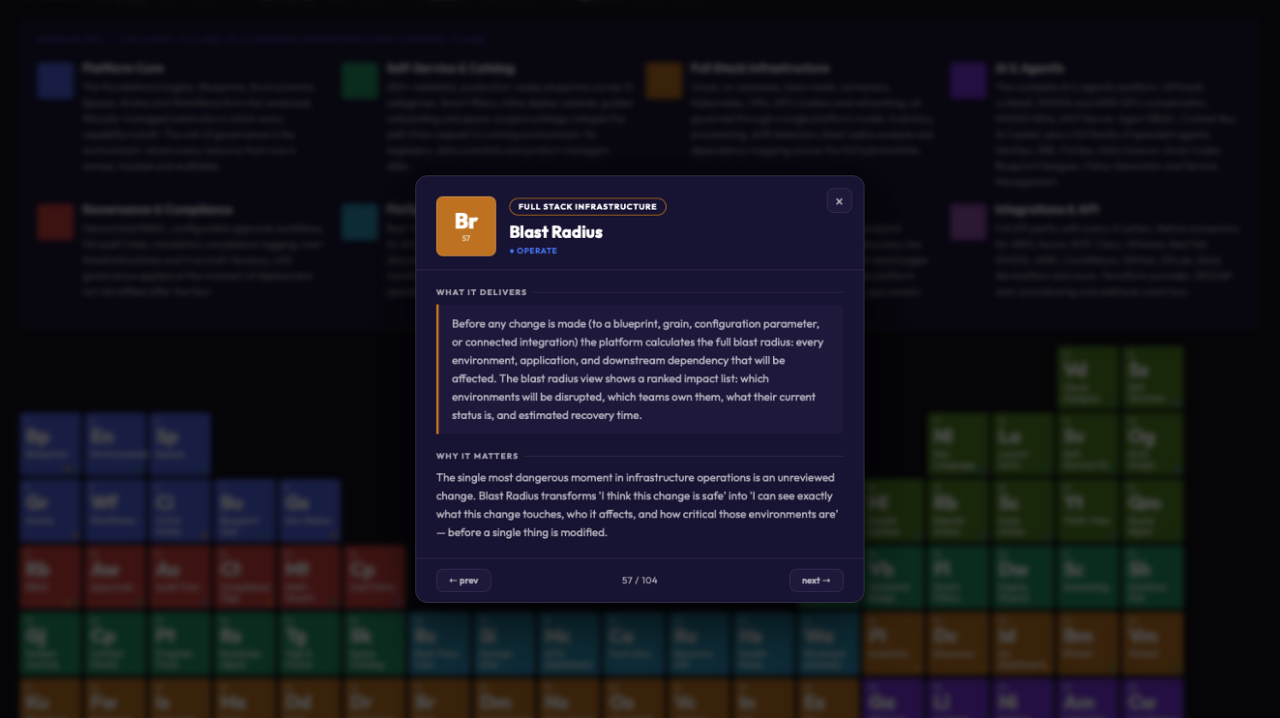
Figure 3. Blast Radius shows what a change will affect before it is made.
Those distinctions are academic while a person reviews every change. They decide the outcome once software is making the changes. Adding intelligence to an incomplete operating model does not fill the gaps. It finds them faster.
Test every platform against the work, including ours
The reference is most useful pointed at a real problem: a delayed environment request, a GPU bill that keeps climbing, a change nobody wants to approve. Identify the capabilities involved, then trace where each piece of that work happens today. Note who does it, what information they rely on, whether policy is enforced before the action or after, and what happens when the environment changes. Follow the handoffs. A capability can exist in three tools and still fail as a workflow.
This is also a sharper way to evaluate products than comparing feature labels. “Automation” and “governance” on a datasheet say nothing about where control ends. What matters is how much of the required work the platform performs, how much it coordinates and how much it leaves to you.
Torque is Quali’s answer to that test. It takes the infrastructure definitions teams already have, assembles them into environment blueprints and delivers them through a governed self-service catalog, with orchestration and Day-2 management around each environment. The automation stays intact. The operating model around it changes.
We built the reference so it could be held against any platform, Torque included. Use it that way.
Make the hidden work visible
The number of infrastructure tools an organization owns tells you very little. What matters is whether the work between them is controlled, repeatable and accountable, or still held together by people. A real infrastructure control plane absorbs that work and keeps the consumer experience simple. It gives AI the context and boundaries it needs to act safely, and it connects delivery to everything that comes after. AI did not create the need for an infrastructure control plane. It removed the option of ignoring it.
Explore the Infrastructure Control Plane Capability Reference Architecture
Discover the 104 capabilities across eight domains that define a modern infrastructure control plane. Use the interactive periodic table to explore what’s required, identify potential gaps, and see how the capabilities work together.
Explore the Interactive Infrastructure Control Plane →
Want to understand the thinking behind the architecture?
Read the full article on Medium, where we examine why the industry struggles to agree on what an infrastructure control plane actually is, and how mapping the capabilities provides a more complete picture.
Read the Full Infrastructure Control Plane Article →