Enterprises have spent enormous amounts of money acquiring GPUs. That turns out to be the easy part.
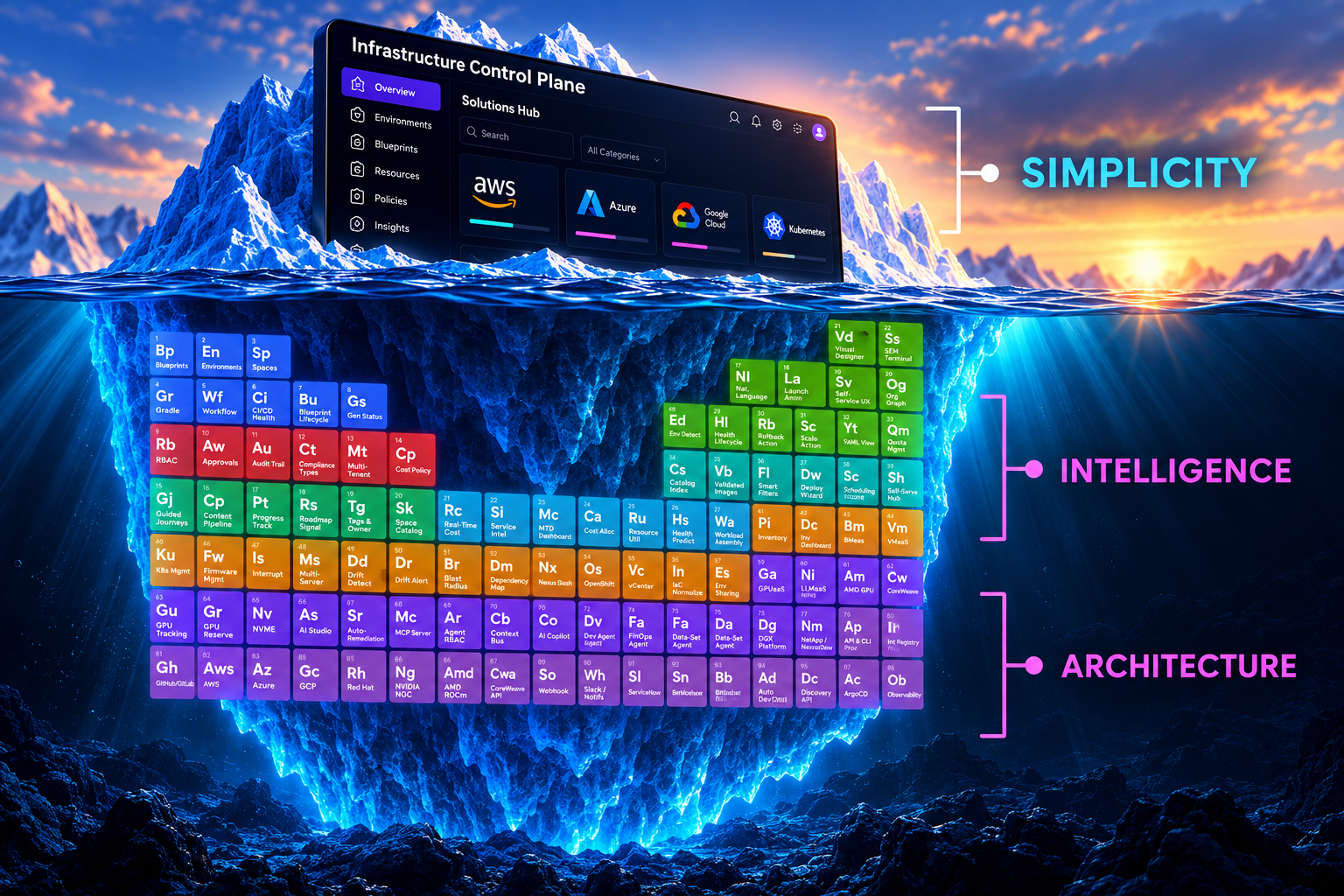
A rack of accelerated compute is not an AI environment. Before anyone can train a model, run inference or deploy an AI application, that compute has to be connected to networking and storage, integrated with orchestration and model frameworks, secured, given access to the right data and services, instrumented for observability, associated with ownership and cost, and validated as a complete working environment.
Every one of those components may already exist somewhere in the organization. The problem is making all of them work together.
In most enterprises, they come from different vendors, belong to different teams and are operated through different management systems. Compute has its tools. Networking has another set. Storage has another. Kubernetes or OpenShift introduces another layer. Security, observability and cost management add more. Each platform may be perfectly capable of managing its own domain while nobody owns the process of assembling all of those domains into a functioning AI stack.
That is why enterprise AI infrastructure deployments can still take weeks to move from procurement to production readiness. The delay is not simply waiting for hardware. It is engineers reconciling configurations and dependencies across infrastructure layers that were never designed to be deployed and governed as a single system.
The AI infrastructure problem is therefore becoming less about how to acquire accelerated compute and more about how to repeatedly turn that compute into complete, production-ready AI environments.
A GPU Is Only One Component of the AI Stack
The term “AI infrastructure” is frequently used as shorthand for accelerated compute. That dramatically understates what has to be delivered.
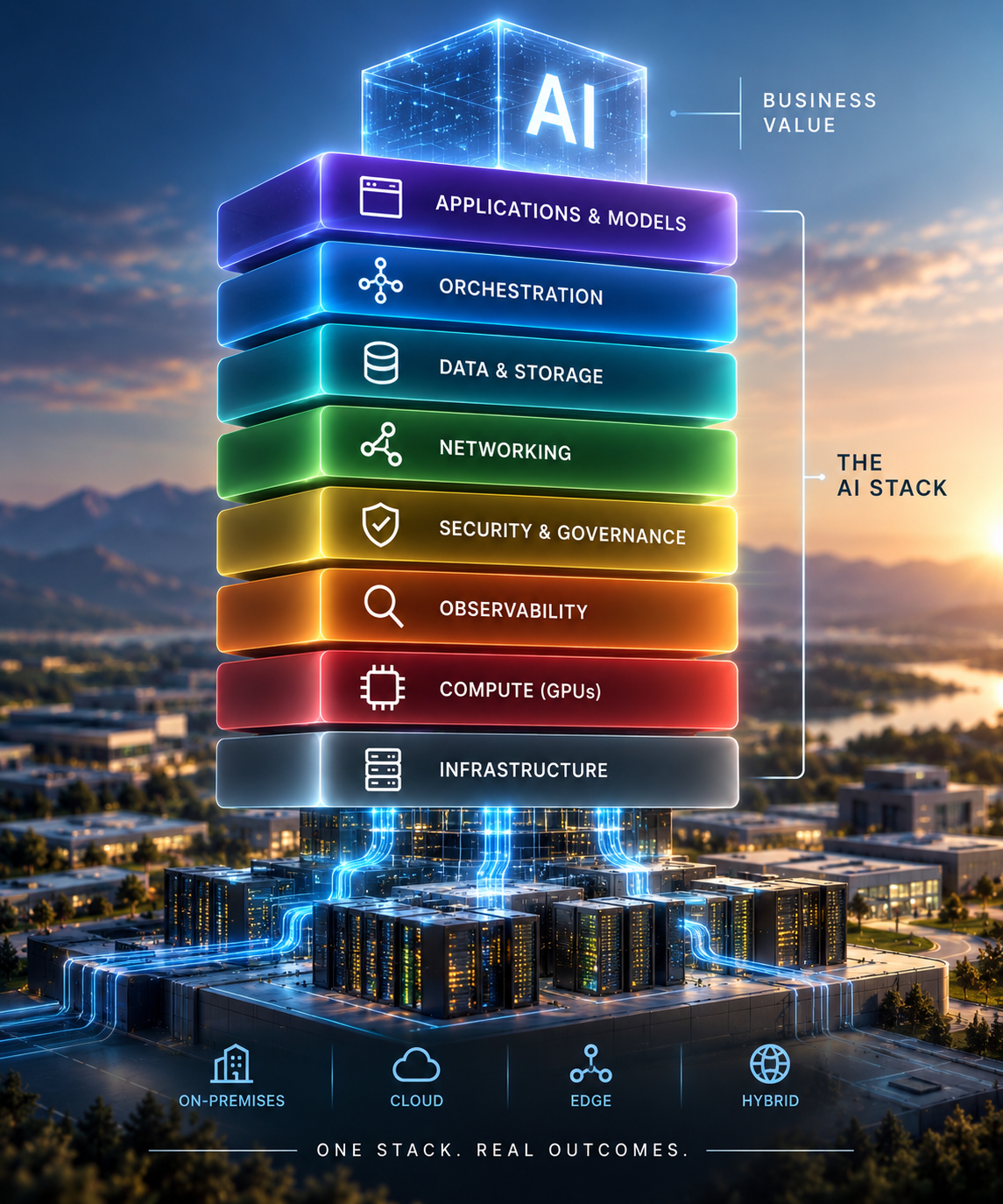
A production AI environment can require GPUs or other specialized silicon, high-performance networking, storage and data services, operating systems and drivers, Kubernetes or another orchestration layer, model frameworks, security and identity, observability, cost controls and the application or model itself. Full-stack AI infrastructure is the complete governed path from raw compute to a running production AI workload.
The challenge is not simply that there are many components. It is that they are interdependent. The compute configuration affects the network requirements. Networking affects distributed workload performance. Storage architecture affects how effectively expensive GPUs can be fed with data. Drivers and libraries have to align with hardware and model frameworks. Orchestration determines where workloads can run and how resources are allocated. Security policy affects what those workloads can access. Changes to any layer can invalidate assumptions made somewhere else in the stack.
The resulting environment therefore cannot simply be assembled as a collection of independently managed components. It has to work as a system.
This distinction matters because much of today’s infrastructure tooling was designed around individual technology domains. An organization may have excellent GPU management, excellent network management, excellent storage management and excellent Kubernetes management and still take weeks to create a usable AI environment. The operational complexity exists in the connections between them.
The Problem Gets Harder Every Time You Build Another Stack
Building one AI environment manually is possible. Highly skilled engineers can work across teams, resolve compatibility issues, configure individual layers, test the result and eventually produce a working environment. The problem is doing it again.
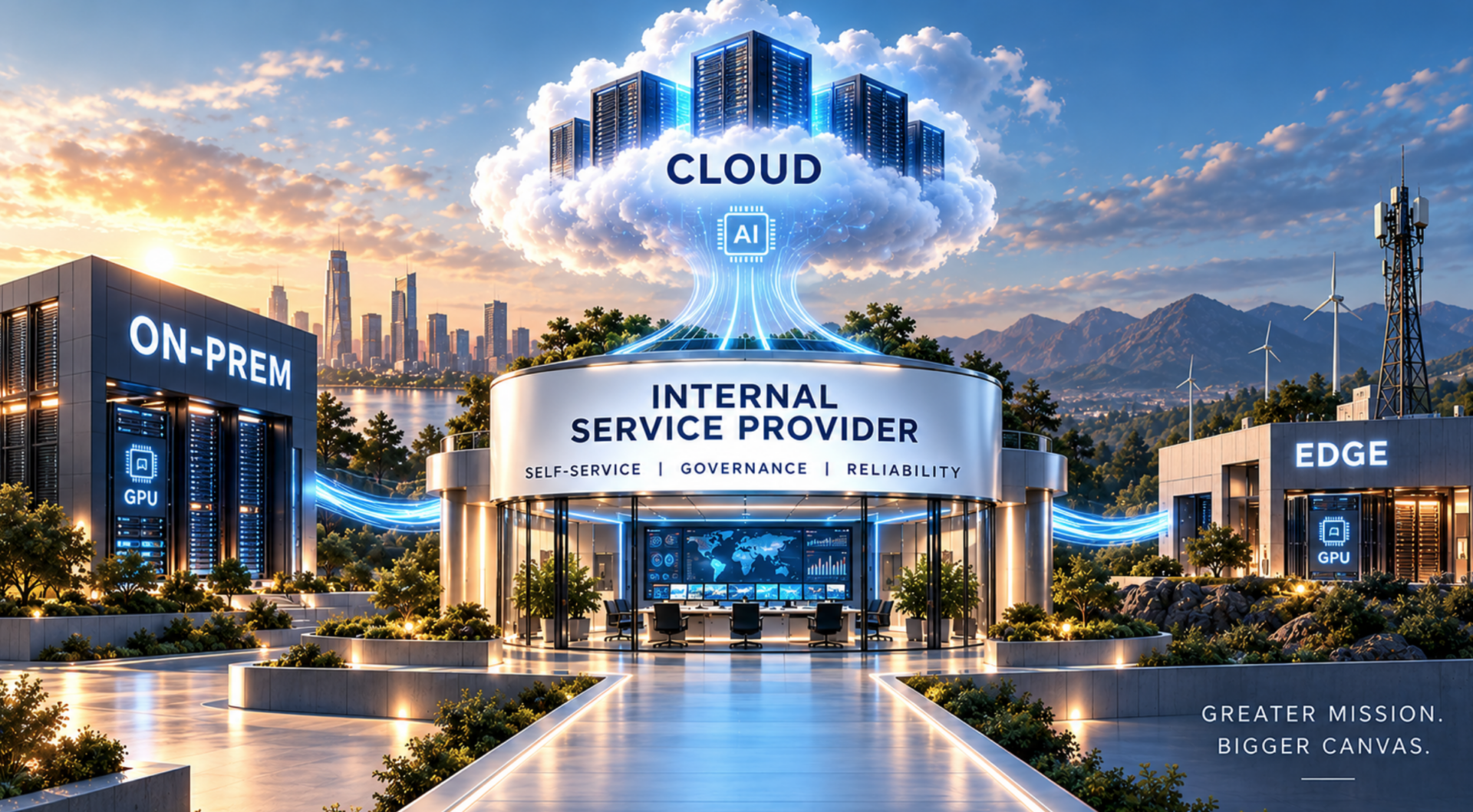
The next request may require a different GPU profile, network topology, storage configuration, security policy, model framework or deployment location. It may run in another data center, in the cloud, at the edge or across a hybrid environment. Different teams may own different pieces of it, and each change creates another opportunity for configuration to diverge.
That operating model becomes increasingly difficult to sustain as AI adoption expands. Deloitte’s 2026 State of AI in the Enterprise research reports that nearly half of enterprises have more than 31 AI pilots in progress, while 44 percent have more than 31 production-ready use cases. AI factory deployments are expected to grow from 64 percent of enterprises today to 88 percent by 2028, while scaled AI at the edge is projected to rise from 36 percent to 72 percent over the same period.
Those numbers change the nature of the infrastructure problem. An organization is no longer assembling an important AI stack once. It may need to create, modify and retire many different AI environments continuously. A process that requires infrastructure specialists to manually reconcile every layer may work for the first few projects. It does not provide an operating model for an AI factory.
More Management Tools Do Not Necessarily Mean More Control
The difficulty is not that enterprises lack infrastructure management platforms. In many cases, the opposite is true. Each infrastructure domain has accumulated increasingly sophisticated management and automation. Compute, networking, storage, cloud, Kubernetes, security and observability can all have dedicated control systems. Teams have also invested heavily in Terraform, Ansible, CI/CD pipelines and other automation. Those investments remain valuable. The problem is that the AI workload crosses all of them.
Someone still has to determine which automation should run, in what sequence, with which parameters and against which infrastructure. Dependencies have to be understood. Configuration has to be validated. Security and policy have to be applied. The completed environment has to be tested, handed to the consumer and subsequently maintained as the underlying components change.
Adding another tool that manages GPUs does not solve that problem because the GPU is only one participant in the workflow. This is where the distinction between component management and stack orchestration becomes important. Component management operates the individual pieces. Stack orchestration coordinates those pieces so that they collectively deliver a defined infrastructure outcome. For AI infrastructure, that distinction is becoming critical.
AI Is Scaling Faster Than the Operating Model
The physical infrastructure being built to support AI makes this problem considerably larger. McKinsey estimates roughly $7 trillion in cumulative capital investment is headed toward AI data center infrastructure, with global data center demand on pace to exceed 170 gigawatts by 2030. Accelerated compute workloads are growing more than 30 percent a year and are expected to represent two-thirds of all data center demand within five years.
That investment increases capacity, but capacity alone does not fix activation. Every new GPU cluster that arrives without a standardized way of assembling the infrastructure around it creates another instance of the same integration problem. Every new AI factory multiplies the number of stacks that have to be provisioned and operated. Every expansion into edge or hybrid infrastructure increases the number of environments over which that consistency has to be maintained.
The result can be an uncomfortable contradiction: organizations can simultaneously have more AI infrastructure than ever before and struggle to make enough of it productively available. Acquiring expensive compute does not guarantee productive compute. Infrastructure has to be activated before it can be utilized.
Governance Cannot Be Added After the Stack Is Built
There is another problem with assembling AI environments layer by layer. Governance frequently arrives too late. Teams focus first on getting the environment working. Ownership, policy, cost allocation, security controls and lifecycle management are then added around it. At small scale this is already problematic. At AI-factory scale it becomes increasingly difficult to manage.
A production AI stack therefore needs more than technical integration. It needs governance from the moment it is created. The environment should have an owner. Cost should be attributable. Infrastructure should be deployed inside an established policy boundary. Configuration should be compared continuously with intended state. Temporary environments should have a defined lifecycle. Changes should remain visible after deployment rather than disappearing into individual management systems.
This becomes even more important as AI agents themselves begin participating in infrastructure operations. An autonomous agent capable of requesting or modifying infrastructure operates faster than a conventional human approval process, which makes governance embedded in the infrastructure workflow increasingly important.
The Missing Layer Is Full-Stack Orchestration
The answer is not to replace every specialist infrastructure platform with one enormous management system. Networking still requires networking expertise and tooling. Storage still requires storage platforms. Kubernetes, security systems, cloud platforms, NVIDIA software and existing automation all continue to perform their respective jobs. What is missing is a layer capable of coordinating them.
A full-stack infrastructure automation platform needs to understand that an AI environment is an outcome rather than a collection of unrelated resources. It needs to coordinate the automation required across the stack, understand dependencies and sequencing, apply policy before resources are consumed, validate the completed environment and retain operational context after deployment.
That also means organizations should not have to discard the automation they already have. Terraform, Ansible, vendor APIs, scripts and validated architectures contain years of infrastructure knowledge. The objective should be to orchestrate those assets as parts of a repeatable workflow rather than replacing them with another proprietary automation silo.
Full-stack infrastructure means addressing the infrastructure layers through one coherent, automated and governed workflow rather than a collection of disconnected ones. The organization needs to move from a request for AI infrastructure to a validated, usable environment without turning the process into a relay race between infrastructure teams.
From Rack to Application
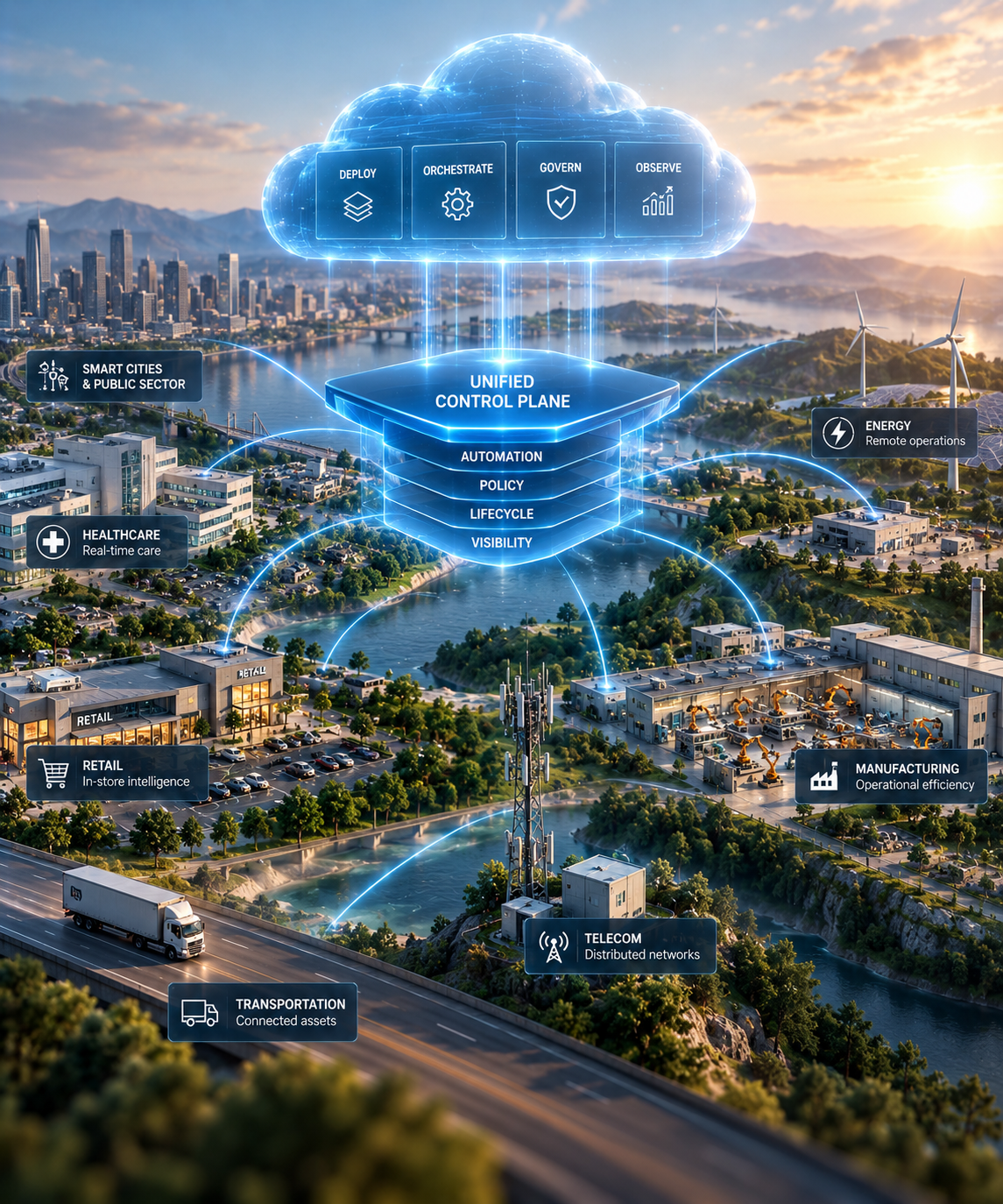
This is the problem Quali is addressing with Torque and Stack Automation by Quali. Torque provides a control plane across bare metal, multi-cloud, hybrid, on-premises, edge and GPU environments. It provides the governance layer around infrastructure consumption, including visibility into what has been deployed, ownership, cost and configuration drift. Stack Automation, developed in collaboration with Cisco (see announcement) and available exclusively through Cisco, coordinates rack-to-application provisioning with Cisco Validated Designs and third-party technologies, while incorporating existing Terraform, Ansible, Helm and other automation.
Instead of a GPU team completing its work and handing the process to networking, which hands it to storage, which hands it to the platform team, which hands it to security, the dependencies can be represented in automation and executed as a coordinated workflow.
That changes the economics of deployment. Deployment cycles that previously required weeks can be compressed toward hours when the stack is provisioned and validated together. More importantly, the next environment does not require the organization to rediscover how the previous one was assembled. The knowledge required to build the stack becomes reusable automation rather than institutional memory.
The AI Factory Has to Be Operated as a System
AI infrastructure investment will continue to grow. Organizations will deploy more GPUs, faster networking, larger storage environments and increasingly sophisticated AI platforms. None of that removes the underlying operational challenge. Buying the individual components is not the same as creating an AI factory.
The harder problem is repeatedly turning those components into complete environments that are correctly configured, validated, secured, governed, observable and ready for productive workloads. As AI deployments multiply across data centers, clouds and edge locations, that problem moves beyond what manual coordination between specialist teams can reasonably sustain.
It also exposes the limitation of managing the AI stack exclusively through its individual components. A collection of highly capable management platforms does not automatically provide management of the system they collectively create.
The organizations that get ahead of this problem will therefore not simply be those with the largest GPU footprint. They will be those capable of treating the complete AI stack as an operational unit, with every layer from accelerated compute through networking, storage and orchestration to the application deployed and governed through a repeatable process.
The GPU is an essential resource inside that system. Making the entire system work is the infrastructure challenge.
Related Resources
Scaling GPU Stacks with Torque — How Torque supports the delivery, lifecycle management, governance and optimization of the complete infrastructure stack around AI workloads.
Stack Automation by Quali — Automate the full rack-to-application workflow across networking, compute, storage, software and governance.