
MCP (Model Context Protocol) is a lightweight, extensible schema for describing, structuring, and sharing model context, the full scope of information an AI system needs to perform reasoning, act, or respond intelligently. Originally defined by Anthropic and now gaining traction across agentic AI platforms, MCP is essential to enabling context-rich, autonomous decision-making across distributed agents and systems.
It ensures that every agent, model, or orchestration layer can access not just data inputs, but the goals, environment, constraints, policies, and expectations surrounding a task, effectively enabling infrastructure and agents to share “why,” not just “what.”
Why It’s Important to Agentic AI
In traditional infrastructure, context is either assumed or statically defined (e.g., in config files, scripts, or hardcoded pipelines). Agentic AI, which relies on dynamic, adaptive, and multi-agent orchestration, requires live, structured context transmission across all layers of execution.
MCP provides the structure to:
- Pass context between AI agents, infrastructure control planes, and orchestration workflows
- Allow agents to interpret goals and policies in line with their capabilities
- Enable zero-trust environments by embedding authority, roles, and source transparency
- Optimize agent selection, task routing, and decision prioritization in real time
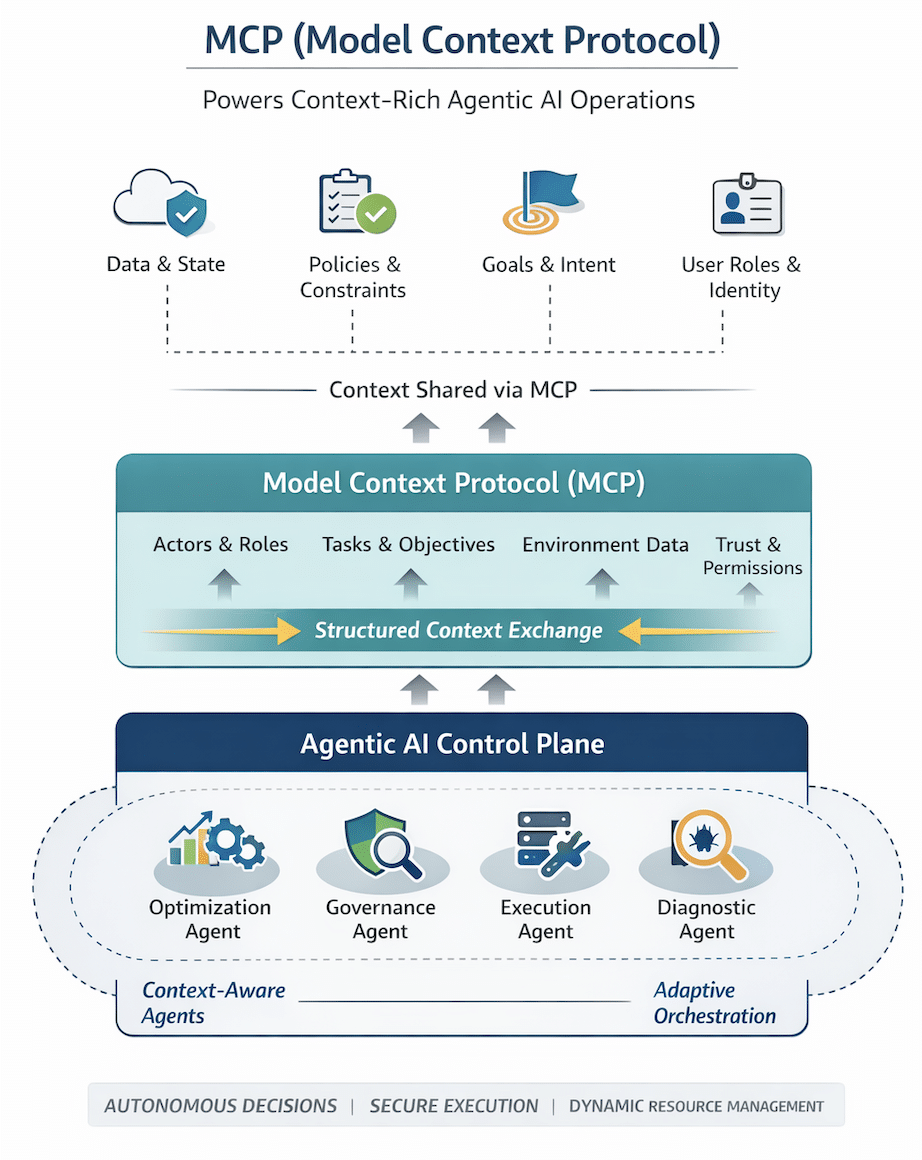
Torque + MCP: Context as Infrastructure
Torque acts as a real-world implementation layer for MCP-like principles. Its Agentic AI Control Plane enables context-sharing across specialized agents, environments, governance policies, and optimization workflows. Torque does not rely on static triggers, it reasons and acts based on contextual state that mirrors MCP models, including:
- Actor/role awareness
- Task origin and intent
- Execution constraints (e.g., budget, latency, policy)
- Telemetry from prior decisions and system health
This is critical to enabling autonomous, governed infrastructure orchestration where agents and environments negotiate, adapt, and act with minimal human intervention.
Key Capabilities (When Integrated)
- Context-Rich Task Execution: Agents operate with full visibility into objectives, resources, and constraints.
- Model-Agnostic Interoperability: MCP can be used with Claude, OpenAI, proprietary LLMs, and non-LLM agents.
- Trust and Authority Propagation: Context includes identity, origin, and execution boundaries.
- Elastic Agent Coordination: Torque uses MCP-like context to determine which agents should act, in what order, and with what privileges.
Challenges Without It
Without a protocol like MCP, agentic AI stacks fall into brittle orchestration patterns:
- Agents may act with outdated or incomplete information
- Policy violations increase as context isn’t consistently enforced
- Infrastructure may misallocate resources due to intent-oblivious provisioning
- Inter-agent coordination degrades under scale
Related Concepts
- Agentic AI Infrastructure
- AI Orchestration Protocols
- Autonomous Workflow Governance
- Context-Aware Agents
- Environment-as-Agent