

Curate
Curate is Day 0. Here’s what comes next. The inventory Curate builds is the foundation every other Torque capability runs on. The completeness of what Curate discovers directly determines the coverage of what Operate can govern.
AI agents take actions in production, causing unauthorized changes. MCP solves connectivity but not control. Torque is the control plane for all agent actions in your infrastructure.
80% of organizations have already encountered risky behavior from AI agents in production: unauthorized changes, improper access, unrecoverable workflows
1 in 3 organizations has governance controls adequate for agentic systems meaning 2 in 3 are running agents with no policy enforcement, no attribution, and no audit trail
No additional governance overhead per agentic action when Torque is the interface policy, attribution, and cost controls are automatic, not bolt on
Cloud access lets agents provision infrastructure without governance. If issues arise, there s no compliance record.
One agent scales down, another up. Each acts correctly, but none understand intentions. Without coordination, conflicts arise.
AI agents provision infrastructure, but without governance, organizations lose visibility into resource creation and value.
AI isn’t just about smarter agents. It s about ensuring they operate safely, consistently, and within organizational guardrails.
Create blueprints in natural language, launch governed environments through self service, and automatically detect and resolve drift by learning from your operational history.
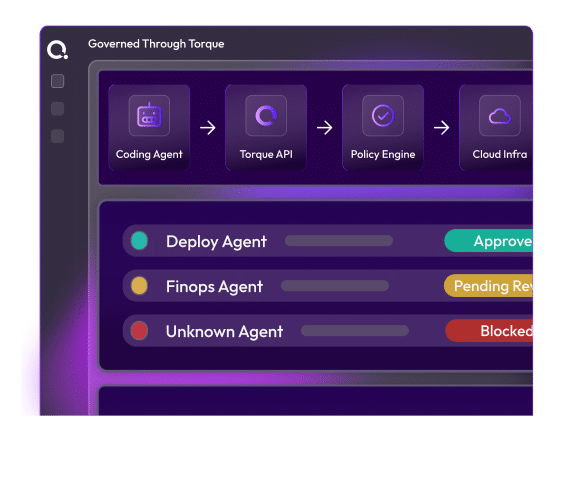
Every AI action follows the same rules as a human. We check policies before execution, enforce cost controls before provisioning, and maintain full attribution and audit trails for all MCP compatible agents.
Prevent conflicts before they impact your infrastructure. Get a shared view of your environment state to resolve conflicting actions automatically, prioritize them using policy, and coordinate agents operating simultaneously.
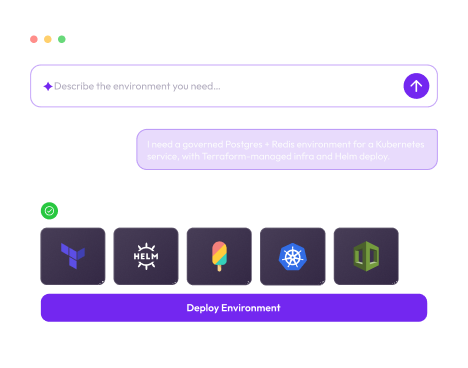
Describe what you need in plain language. The AI Environment Designer will search your curated inventory, map dependencies, and generate a compliant blueprint without YAML or platform team support.

From natural language design to managed agents, governed API access, and team coordination.
Describe your needs. The Copilot creates a blueprint from your inventory. The AI Designer turns intent into infrastructure. Users express needs in natural language, and the Copilot assembles a compliant blueprint using your curated inventory and governance rules.
Any agent. Any framework. All actions governed through a single interface. Torque exposes infrastructure via a governed API. Any compatible agent can operate infrastructure, but actions undergo policy checks, cost controls, tagging rules, and audits.
Agent roles differ from user roles, with agents having specific permissions. A cost optimization agent analyzes spending, while a deployment agent launches infrastructure. The platform enforces strict boundaries, allowing organizations to enable autonomous agents without granting unlimited access.
Multiple agents. Shared infrastructure. Coordinated through a single control plane.
As organizations deploy more autonomous agents, infrastructure becomes a shared resource. Torque maintains a unified view of environment state, detects conflicting actions, and applies organizational priorities before changes reach infrastructure.
Compatible with every major agent framework and model
Integrate with your existing tools. Torque is compatible with every major agent framework
and model using our MCP or REST API.


Curate is Day 0. Here’s what comes next. The inventory Curate builds is the foundation every other Torque capability runs on. The completeness of what Curate discovers directly determines the coverage of what Operate can govern.
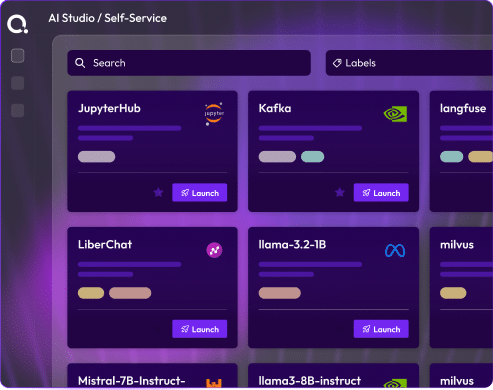
Deploy governed environments on demand, for every team. Governed blueprint catalog, AI Environment Designer, portal / ITSM / IDE / CI-CD access. Curate builds the inventory. Self-Service puts it to work.
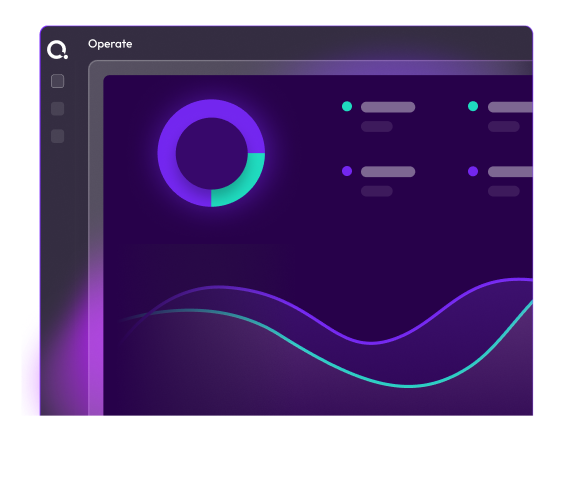
Govern, optimize, and continuously improve what you’ve deployed. Drift detection, cost attribution, AI remediation, FinOps and SRE intelligence. Operate monitors everything Curate has inventoried.
The AI Copilot that powers blueprint generation and environment design. The AI Environment Designer is part of the broader AI Copilot capability. Learn how Agentic AI operates across the full Torque platforms, from blueprint generation to operational remediation.
Standard AI responds to prompts. It generates text, answers questions, and produces outputs for a human to review and act on. Agentic AI takes actions. It does not wait for human review between steps. It assesses a situation, determines what to do, and executes, potentially triggering further actions based on the result. That distinction is operationally significant. When an AI agent can provision infrastructure, scale compute, or terminate resources without human intervention at each step, the question of what governs those actions: who authorized them, what limits apply, who is accountable for the cost, is not theoretical. It is live, in production, right now, in most enterprise environments that have deployed AI tooling.
MCP (Model Context Protocol) is an open standard, developed by Anthropic and adopted across the industry, that enables AI agents to discover and invoke external tools and capabilities in a structured, governed way. When Torque implements an MCP server, any MCP-compatible agent can discover Torque’s capabilities and call them directly, without custom integration work. The agent learns what Torque can do: provision environments, query state, inspect drift, check costs, and can invoke those capabilities as part of its reasoning process. Crucially, the Torque MCP server enforces the same policy controls, cost limits, and audit trail as any other request. The agent gets governed access to infrastructure capabilities. The organization gets a complete record of what the agent did and why.
User roles govern what a human can do in Torque based on their job function and team membership. Agent roles govern what an autonomous agent can do based on its defined scope and purpose. They are separate objects in the platform for a deliberate reason. If an agent inherits user-level permissions through a service account, its blast radius is the same as that user, potentially very broad. Agent roles are scoped specifically to what that agent needs to accomplish its purpose and nothing more. An agent responsible for cost operations has read access to cost data and the ability to surface recommendations. It cannot provision or destroy. An agent responsible for deployment can provision within its quota. It cannot modify cost policies. The scope is enforced by the platform, not by the agent developer, which is the only way to make it reliable.
Without a coordination layer, this produces race conditions and conflicting state. A cost agent terminates instances the deployment agent just provisioned. A remediation agent and a maintenance agent make incompatible changes to the same environment simultaneously. Each agent is behaving correctly from its own perspective. Together they produce an outcome no one intended and no one can easily explain. Torque maintains authoritative state across every environment in the estate. When agent actions would conflict, Torque detects the conflict before it reaches infrastructure, applies the organization’s configured priority hierarchy: typically compliance first, then SLA commitments, then cost optimization: and resolves the conflict by sequencing, blocking, or escalating. Agent developers do not need to solve this individually. It is handled at the platform level, which is the only place it can work reliably at scale.
The Copilot works with whatever is in the inventory, but the quality and accuracy of what it generates is directly tied to the completeness of what Curate has discovered. If the inventory includes 200 validated IaC modules, the Copilot can generate precise, accurate blueprints from those assets. If the inventory is partial, the Copilot’s output will reflect those gaps, it may suggest generic templates for the missing pieces, or flag that certain components are not available in the governed catalog. This is not a limitation, it is how the system maintains the guarantee that AI-generated infrastructure is built from assets your organization actually owns and governs. Starting with a complete Curate discovery is the highest-leverage step an organization can take before activating the AI Copilot.
Any agent that can call a REST API or an MCP endpoint can use Torque’s governed infrastructure surface. This includes LangChain, AutoGen, CrewAI, and any other framework that supports tool calling or MCP protocol. It includes coding assistants like GitHub Copilot and Cursor when they are configured to use external tools. It includes CI/CD pipeline agents in GitHub Actions, GitLab CI, and Jenkins. It includes any custom agent built on any model, Claude, GPT-4, Gemini, or others. The governance layer does not care about the agent’s architecture. It applies policy, records attribution, and enforces cost limits to every request, regardless of the source.
No installation. No configuration. Connect to a pre-loaded environment with a complete Curated inventory and explore the full AI Copilot capability, from natural language blueprint generation to governed external agent access.
AI Environment Designer active with a pre-loaded Curated inventory, describe what you need and watch the Copilot generate a deployable, policy-compliant blueprint
MCP endpoint accessible in the sandbox, connect any MCP-compatible agent and see governed API calls, policy enforcement, and attribution in action
Agent role examples configured showing the difference between scoped and unscoped agent access, with the governance controls enforced in real time
Multi-agent scenario available demonstrating conflict detection and resolution when two agents attempt incompatible actions simultaneously
See how Torque provides the governed AI layer that makes agentic infrastructure safe to scale, in a live session tailored to your environment, your agent landscape, and your governance requirements.