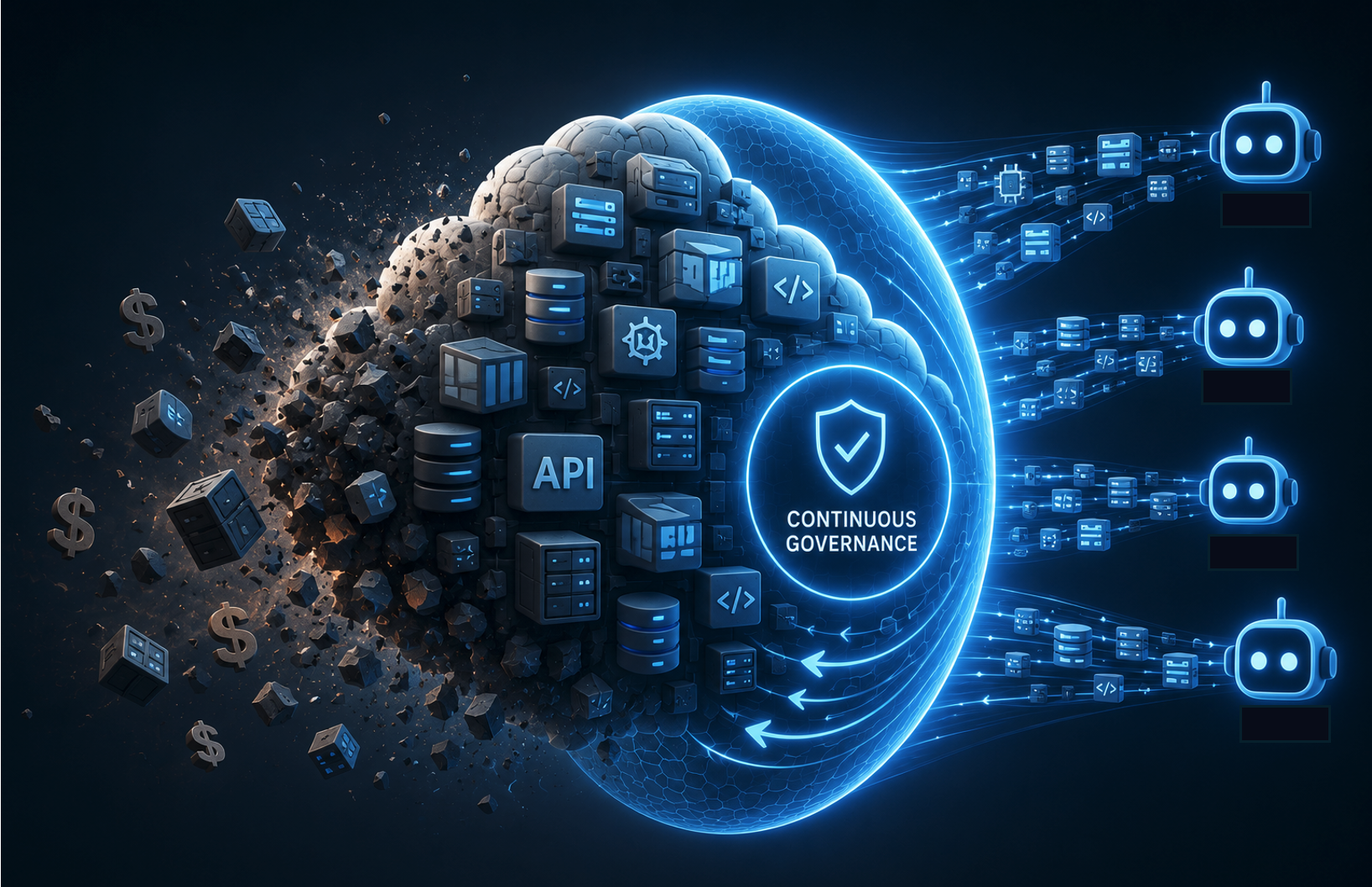
Flexera’s 2026 State of the Cloud Report contains a number that should have kept falling and didn’t: wasted cloud spend rose to 29% of IaaS and PaaS spend this year, up from 27% in 2025, reversing five straight years of steady decline. Something changed direction. The report points to AI workloads and the proliferation of cloud services making cost forecasting structurally harder than before.
The instinct is to treat this as a budgeting problem, tighter tagging, better reviews, a new FinOps dashboard. It isn’t. It’s physics. Every environment that nobody is actively watching decays toward waste, on its own, without malice or negligence from anyone. That’s not a metaphor for effect. It’s the actual mechanism, and it’s about to get a lot more input energy in the form of AI agents that create and abandon environments faster than any human ever did.
Waste Was Never the Root Problem
The standard read on cloud waste is a hygiene story: someone forgot to shut down a dev environment, a proof-of-concept from Q1 is still running in Q3, a disk got detached from a VM that was terminated months ago, and nobody noticed it was still being billed. Each of these reads as an individual lapse, and each one gets an individual fix, a tagging policy, a shutdown schedule, a quarterly cleanup sprint.
But treating every instance as a separate lapse misses the pattern underneath all of them: an environment only stays aligned with its intended state as long as something is continuously expending effort to keep it that way. The instant that effort stops, a project ends, an owner changes teams, a proof-of-concept quietly becomes permanent, the environment doesn’t hold its shape. It drifts, it idles, it orphans’ pieces of itself, and it keeps costing money the entire time. That’s not carelessness. That’s what unattended systems do, every time, by default.
The State of Decay
| What the research found | Source |
| Wasted cloud spend rose to 29% of IaaS/PaaS spend in 2026, up from 27% in 2025, reversing five straight years of decline. | Flexera, 2026 State of the Cloud Report |
| Machine identities now outnumber human identities 82:1 across enterprise environments. | Palo Alto Networks, cited via Oasis Security, 2026 |
| The average Fortune 500 enterprise will run more than 150,000 AI agents by 2028, up from fewer than 15 in 2025. | Gartner, April 2026 |
| The average organization already runs 12+ AI agents today; half operate in silos with no coordinated oversight; expected to reach 20 within two years. | Salesforce, 2026 Connectivity Benchmark |
| 94% of organizations are concerned AI agent sprawl is increasing complexity, technical debt, and security risk; only 13% believe they have adequate governance in place. | OutSystems research, 2026 |
Independent research on cloud waste and AI agent proliferation, 2025–2026.
Why Decay Just Found a New Engine
For twenty years, the thing that eventually slowed decay down was a human noticing it. A finance review flags an unusually large bill. An engineer stumbles across an orphaned resource while looking for something else. It was slow and imperfect, but it was a real brake, because humans provision environments at human speed and in human volume.
Agentic AI removes that brake. Gartner expects the average Fortune 500 enterprise to be running more than 150,000 AI agents by 2028, up from fewer than 15 in 2025, and machine identities already outnumber human ones 82 to 1 across enterprise environments today, according to Palo Alto Networks. Salesforce’s 2026 Connectivity Benchmark puts the current number at 12 or more agents per organization already, with half of them operating in silos outside any coordinated oversight. Every one of those agents is a potential requester of infrastructure, a potential creator of an environment, and a potential source of drift and orphaned resources, at machine speed, around the clock, with no finance reviewer stumbling across the bill by accident.
It’s little surprise that 94% of organizations now say AI agent sprawl is increasing complexity, technical debt, and security risk, while only 13% believe they have the governance in place to manage it, per OutSystems’ 2026 research. The brake that used to slow entropy down, a human eventually noticing, doesn’t scale to a world with 150,000 non-human requesters per enterprise. Something else has to.
Why Audits Can’t Win This Race
The natural response to rising waste is to audit more often, a monthly cost review instead of a quarterly one, more dashboards, more tagging enforcement. This helps, but it can’t actually win, because an audit is a snapshot, and decay is continuous. By the time a monthly review catches an orphaned resource, it has already been drifting and billing for weeks. Tighten the review cycle to weekly, and agentic systems creating and abandoning environments in hours will still outrun it. You cannot audit your way ahead of a process that never stops, using a process that only runs periodically.
The only mechanism that keeps pace with continuous decay is continuous counter-pressure: something that compares intended state to actual state constantly, not on a schedule, and applies that comparison equally whether the thing that caused the drift was a person or an agent.
Where Torque Fits
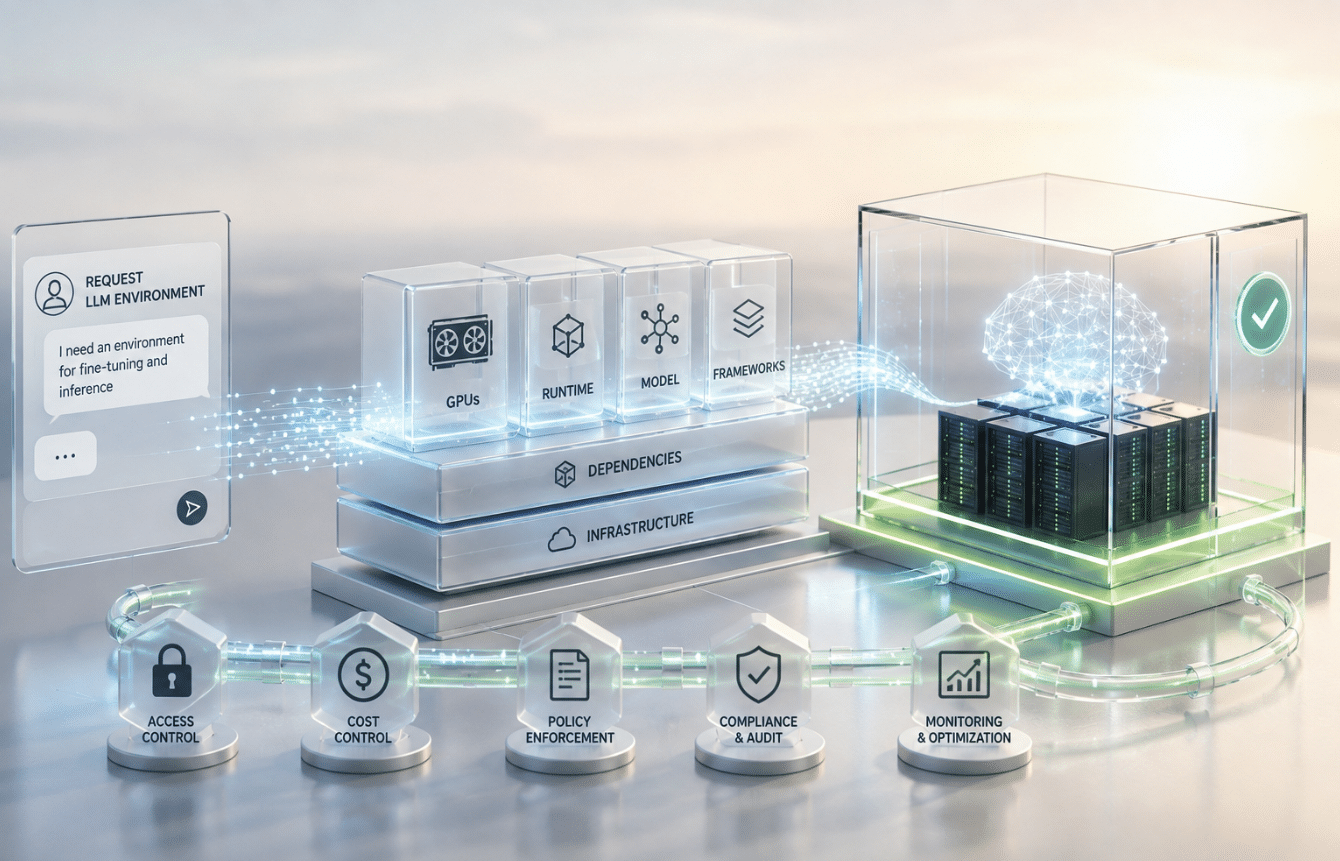
This is precisely the mechanism Torque by Quali is built around. Every environment in Torque exists as a versioned blueprint that captures not just its configuration but its owner, its business purpose, and its governed lifecycle from Day-0 through Day-2, so there is always a reference point for what the environment is supposed to be, from the moment it’s created rather than reconstructed after someone asks.
Torque’s continuous introspection compares live state to that blueprint constantly, catching drift and idle resources while they’re new rather than after they’ve compounded into a line item finance has to investigate. Cost awareness ties every resource back to the business purpose and owner that requested it, so waste is attributable in real time instead of reconciled at the end of the month. And because Agent RBAC and MCP server integration apply the same policy boundaries and bounded blast radius to agent-created environments as human-created ones, an AI agent provisioning its own test environment is governed to exactly the same standard as an engineer filing a ticket, no exceptions carved out for the requester that happens not to be a person.
Decay doesn’t stop being a law because the requester changed. The governance just has to apply to both.
How Torque Closes the Gap
| The Entropy Source | How Torque Closes It | The Outcome |
| Environments decay the moment no one’s watching: forgotten dev/test, orphaned disks, expired POCs. | Every environment is a versioned blueprint with an owner, purpose, and expected lifespan defined at creation. | Decay has a reference point to be measured against, from day one, not discovered later. |
| 29% of cloud spend wasted, and rising, as AI workloads make usage harder to forecast. | Cost awareness ties every resource back to the business purpose and owner that requested it. | Spend is attributable and governed continuously, not reconciled after the invoice arrives. |
| 150,000+ agents per enterprise by 2028, most provisioning and abandoning environments with no human pause to notice. | Agent RBAC + MCP integration apply the same policy boundaries and bounded blast radius to agent-created environments as human-created ones. | Agent-driven decay is governed at the same standard as human-driven entropy, not exempt from it. |
| Periodic audits can only ever measure a system that has already moved on. | Continuous introspection compares live state to intended state constantly, not on a review cycle. | Drift and waste are caught while they’re small, not after they’ve compounded. |
Mapping each source of infrastructure entropy to the Torque mechanism that counteracts it.
Cloud waste isn’t a discipline problem. It’s what unattended environments do by default, and by 2028, most of the things creating and abandoning environments won’t be human. A bigger dashboard doesn’t fix that. Continuous attention, applied for as long as the environment exists, does.
To see Torque in action, visit the Torque playground, and book a live demo to see how Torque delivers AI governance and cost control to solve the challenge of governance at machine speed.