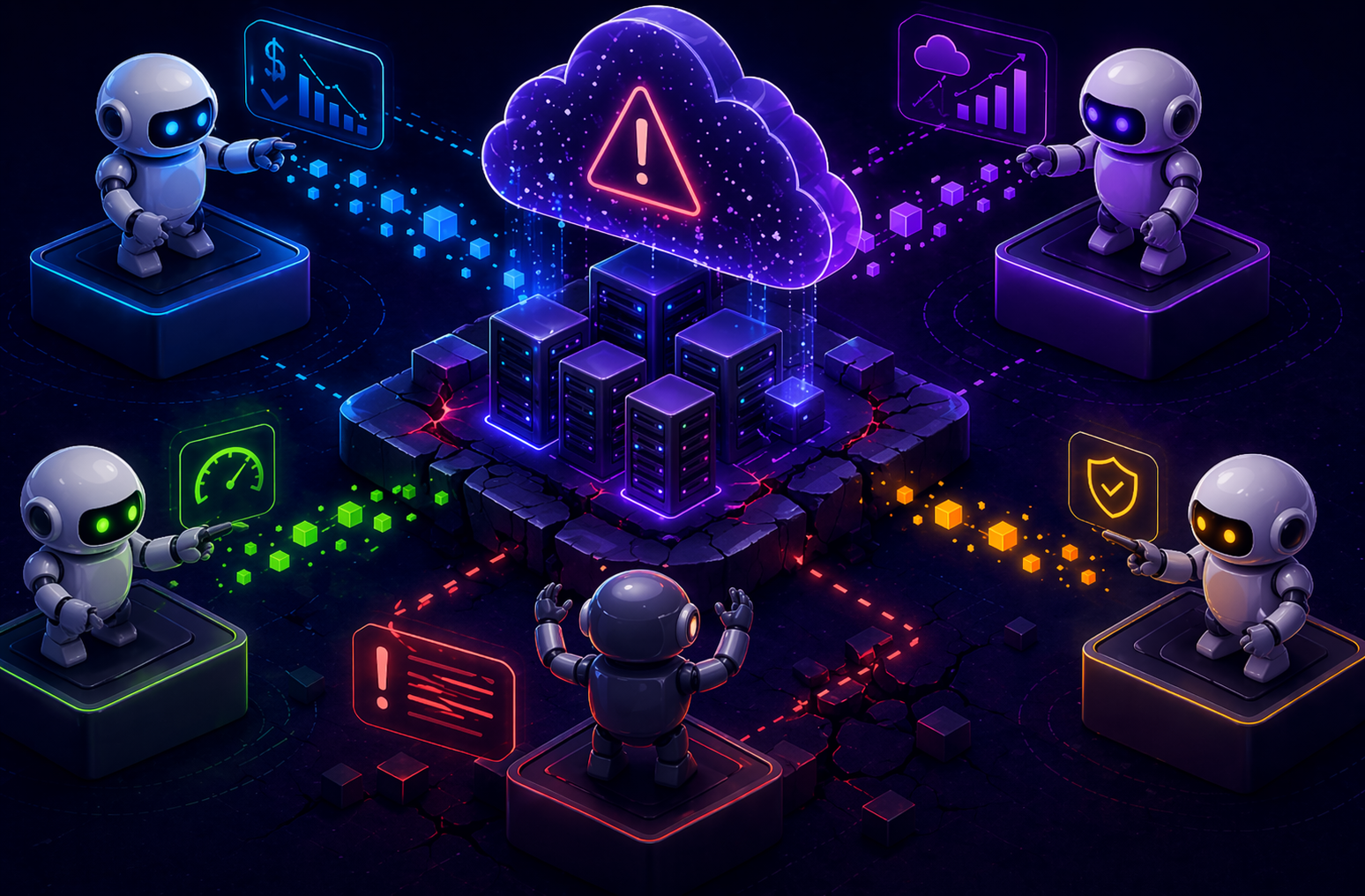
Misconfigurations, outages, data conflicts and silent compliance failures. The multi-agent AI deployments being built right now carry a structural flaw that no log will surface, no alert will catch, and no single agent will ever be accountable for.
In August 2012, Knight Capital Group lost $440 million in 45 minutes. Not because of a cyberattack or fraud but because two automated trading systems operating on the same market simultaneously had no way of knowing what the other was doing. Each was functioning exactly as designed. Together, they destroyed one of Wall Street’s most established trading firms in less than an hour. That was 2012, with relatively simple, rule-based systems.
What we are building now is orders of magnitude more complex: autonomous AI agents that reason, adapt, and make contextual decisions across shared infrastructure environments. Often dozens of them and often simultaneously.
It appears we have not learned the lesson Knight Capital taught us. We are preparing to learn it again, at cloud scale.
The Assumption Nobody Is Questioning
There is a quiet belief embedded in most agentic AI deployments: more automation means more control. Deploy an agent to optimize costs, another to manage capacity, another to enforce SLAs, another to tune performance, another to manage infrastructure environments. Each purpose-built and each doing exactly what it was designed to do.
What almost nobody is designing for is what happens when they all act on the same environment at the same time, with no visibility into each other’s decisions, no shared understanding of current state, and no mechanism to resolve the moment their objectives conflict. This is the agentic conflict problem. It is not a future risk to monitor and the conditions for it are being assembled right now, in production. It will not arrive all at once. It will creep in, stage by stage, until the cost of ignoring it exceeds the cost of fixing it. By which point, fixing it is far harder.
| Stage | Timeframe | What’s Happening | Conflict Risk |
| 1. First agent | Now – 6 months | Single agent deployed (typically cost optimization or CI/CD). Operates in isolation. | Minimal |
| 2. Early expansion | 6 – 18 months | Second and third agents added. Teams unaware of each other’s deployments. No shared state. | Low – Moderate |
| 3. Proliferation | 18 – 36 months | Four or more agents active. Occasional unexplained incidents begin. Attribution is difficult. | Moderate – High |
| 4. Systemic conflict | 36+ months | Agents regularly reverse each other’s decisions. Cloud churn cycles visible. SLA and compliance incidents unattributable. | High – Critical |
| 5. Crisis point | Without governance | A significant unattributable incident forces reactive governance. Retrofit cost far exceeds prevention cost. | Critical |
Table 1: The Agentic Conflict Adoption Timeline
This Has Already Happened, Just Not With AI.
This is not theory and it is worth recognizing that multi-system conflict is not new.
In 2010, the Flash Crash erased nearly $1 trillion in market value in minutes when automated trading algorithms began reacting to each other in a feedback loop no single system was designed to anticipate. In cloud infrastructure, similar dynamics have been documented for years under different names: autoscaling conflicts, competing remediation scripts, CI/CD pipelines and cost management tools acting on the same resources without coordination, producing churn cycles that inflate cloud bills and destabilize environments.
What is new is the decision-making capability. Traditional automation followed rules. Agentic AI exercises judgment: contextual, adaptive, goal-directed. That is what makes it valuable. It is also what makes conflict between agents qualitatively different from the script collisions of the past. When two agents, each reasoning from different data, different objectives, different environmental observations, arrive at contradictory conclusions and act simultaneously, the resulting failure can be genuinely difficult to attribute, diagnose, or even detect.
What Collision Actually Looks Like
Consider a realistic infrastructure environment running five autonomous agents concurrently, not a stress test, not an edge case. A configuration a mid-size enterprise with active FinOps, platform engineering, and SRE functions could plausibly have today.
| Time | Agent | Action | Immediate Effect |
| T+0:00 | Cost Optimization | Terminates 3 instances flagged as underutilized | Cloud spend drops — but capacity reduced without warning |
| T+0:02 | Capacity Management | Provisions 4 new instances based on its own forecast | Spend rises above original level. Net result: +1 unwanted instance |
| T+0:04 | Performance | Detects latency from terminations, scales resources up | Latency partially resolved. Spend climbs further. |
| T+0:07 | SLA | Triggered by instability, overrides and rolls back infrastructure changes | Uptime protected. Capacity and performance changes partially reversed. |
| T+0:09 | Environment Management | Pipeline trigger fires, begins modifying the now-destabilized environment | Operating on a state that no longer reflects reality. Compliance exposure opens. |
| Result | No owner | No single agent made a wrong decision | Wasted spend. SLA exposure. Compliance gap. Unattributable incident. |
Table 2: The Five-Agent Collision. A Nine-Minute Cascade
Every agent made the right call with every log showing success. Together, they have created a self-reinforcing loop of conflicting actions with no owner, no resolution path, and no audit trail that cleanly explains what went wrong.
Now consider the cost.
The Blast Radius: What No Orchestration Actually Costs
These are five realistic failure modes in any enterprise running multiple autonomous agents on shared infrastructure, each with a different cause, a different victim, and a different bill
| Scenario | What Happens | Why It’s Hard to See | Business Consequence |
| Production outage — no attributable cause | Cost, performance and SLA agents cycle against each other. Services degrade. No single change event explains it. | Dozens of changes logged across multiple agents. No unified timeline. | MTTR 3–5x longer. Average unplanned downtime cost: $5,600/minute. |
| Silent data conflict from concurrent changes | Two agents modify the same environment. The config is a hybrid of two intended states, valid enough to pass health checks, wrong enough to corrupt data. | Both changes logged as successful. No conflict flag raised. Corrupted state looks valid in standard monitoring. | Financial: transaction errors. Healthcare: record conflicts. E-commerce: pricing inconsistencies. No alarm. No timestamp. |
| Compliance gap opened and closed without human awareness | A performance agent temporarily relaxes a security policy. A compliance agent misses the window. The audit captures the exposure. | Policy change and restoration both logged. The window between them is never flagged as a risk event. | Audit finding. Mandatory remediation. Potential certification risk in PCI-DSS, HIPAA or SOC 2 environments. |
| Infinite reconfiguration loop | Infrastructure agent sets State A. CI/CD agent detects drift and resets to State B. Loop runs undetected for hours. | Hundreds of valid change events logged. No anomaly alert fires. The volume pattern is the signal — but nothing watches for it. | Engineers spend days in change logs. Deployment pipelines fail unpredictably. Teams manually disable agents, reversing months of productivity gains. |
| Security window opened at every scaling event | Capacity agent provisions instances. Security hardening agent hasn’t yet applied its policy baseline. Instances are live and unprotected. | Provisioning logged. Baseline application logged. The gap between them isn’t treated as a risk event. | Repeats at every scaling event. One successful attack during a window: data exfiltration, ransomware, breach notification, regulatory investigation. |
The pattern across all five is the same: every agent acted correctly. The failure lives in the space between them, unowned, unmonitored, and unresolvable by any individual agent working alone.
The Business Impact: What the Logs Won’t Tell You
Beyond the specific scenarios above, the consequences map directly to outcomes leadership teams measure:
- Resource churn: Agents provision and terminate the same resources in short cycles, 5–15% cloud spend inflation with zero business value. At $1M/month cloud spend, that’s $50–150k wasted monthly.
- SLA breach: Agent-triggered instability causes availability or latency degradation. Contractual penalties typically 10–30% of monthly contract value per breach event.
- Compliance gap: Agent change bypasses a policy guardrail; a second agent obscures the audit trail. The organisation has no defensible explanation for a configuration state no human authorized.
- Incident investigation: No single agent owns the failure. Root cause spans multiple decision chains. 3–5x longer MTTR than conventional incidents. Senior engineering hours lost to inconclusive post-mortems.
- Automation trust collapse: Teams manually override agents after repeated unexplained failures. Productivity gains from agentic AI partially or fully reversed.
The compliance exposure tends to surface latest and hurt most. Auditors do not accept ‘the agent didn’t know’ as a control. The organization is accountable for what its automated systems do, and multi-agent environments without a governance layer are systematically producing changes that are difficult to trace, harder to attribute, and nearly impossible to defend in an audit.
Detecting the Problem: You May Already Have One
One of the more insidious characteristics of multi-agent conflict is that it does not always look like a failure. Individual agents report healthy status. Infrastructure metrics fluctuate within ranges that seem normal. There is no single error event to investigate. Detection requires a different kind of observability, one that looks across agents rather than within them. The signals exist. The question is whether your monitoring stack is built to surface them.
| What You’re Seeing | What It Likely Means | Urgency |
| Cloud costs rising with no workload increase | Resource churn cycle between competing agents | Investigate |
| Infrastructure incidents with no clear change event | Conflict distributed across multiple agent decision chains | Act Now |
| Compliance violations with no human-initiated change | Agent action bypassed a guardrail another agent was enforcing | Act Now |
| One or more agents executing at unusually high frequency | Agent repeatedly responding to changes made by another | Investigate |
| SLA degradation without a known trigger event | Downstream symptom of cascading agent conflict | Investigate |
| Engineers unable to attribute incidents to a single cause | Root cause is multi-agent, conventional monitoring cannot surface it | Monitor Closely |
Table 4: Early Warning Signals
The prerequisite for catching these signals early is a unified observability layer that captures agent decisions, not just infrastructure state, and correlates actions across agents on a shared timeline. Most monitoring stacks today are not built for this.
The Root Cause: Agents Are Excellent at Tasks and Catastrophically Bad at State
Ask most teams what they need to scale AI agents and they will say: better models, more GPU, lower inference latency, faster context windows. These are real concerns. They are also not the constraint. The constraint is that AI agents are excellent at tasks and catastrophically bad at state.
An agent can write Terraform. It can analyse a cost anomaly. It can detect a security misconfiguration and propose a remediation. What it cannot do, by its fundamental architectural nature, is know what every other agent is doing simultaneously, maintain awareness of shared infrastructure state across concurrent operations, or guarantee cleanup if something fails midway through a multi-step process.
This is not a limitation that a better model will solve. It is a structural property of how agents work. They operate with private memory. They have no native awareness of other actors in the same environment. They are designed to act, and act they will, regardless of what else is in motion around them.
In a flat multi-agent system, coordination costs grow quadratically with agent count. Double the agents, quadruple the overhead. Research has shown that beyond roughly eight to ten concurrent agents, inter-agent communication overhead begins to dominate productive work. The marginal benefit of adding another agent goes negative.
Your existing tools won’t save you here. Infrastructure as Code defines environments, it does not orchestrate lifecycle events or maintain awareness of concurrent agent activity. CI/CD pipelines manage delivery, they were built for the sequential, human-initiated world of build-test-deploy. Cloud management platforms were designed for human operators reviewing dashboards. None of them were designed for the observe-decide-act loop that agentic systems operate on, where governance that runs at human speed is governance that doesn’t run at all.
A Framework for Governance
Preventing multi-agent conflict is ultimately a governance problem, not a technology problem. The technology exists. What is missing is the architectural thinking — the deliberate design of how agents are authorized to act, how their decisions are coordinated, and what has authority when they conflict.
Before any framework can be implemented, organizations need to know where they stand.
| Level | Characteristics | What’s Missing | Exposure |
| Ad Hoc — Most Orgs Today | Agents deployed independently. No shared state. No cross-agent visibility. Governance assumed, not enforced. | Everything: coordination, observability, priority hierarchy, escalation paths. | Critical |
| Aware — Emerging Practice | Teams know which agents are deployed. Some cross-agent monitoring exists. Priority hierarchy documented but not enforced at runtime. | Orchestration layer. Real-time shared state. Automated conflict resolution. | High |
| Governed — Where You Need to Be | Orchestration layer active. Agents read shared state before acting. Policy hierarchy enforced at runtime. Human escalation paths defined. | Ongoing tuning as new agents are added. | Managed |
Table 5: Governance Maturity Levels
Three principles should anchor the path from ad hoc to governed:
- Shared state before action. Every agent should have read access to a shared environment state that reflects current conditions and recent decisions by other agents. An agent that can see what just changed, and who changed it, can avoid a conflicting decision. Most current architectures do not implement this.
- A defined priority hierarchy. Not all agent objectives are equal. Compliance and security guardrails sit at the top. SLA commitments follow. Cost optimization operates within whatever space remains. That hierarchy needs to be codified and enforced, not assumed.
- An orchestration layer with real authority. Individual agents should not have unconstrained authority to act on shared infrastructure. An orchestration layer, aware of all agent activity, empowered to sequence or block conflicting actions, and capable of escalating to a human when conflict exceeds predefined thresholds, is what transforms a collection of autonomous agents into a governed system. Without it, you don’t have a multi-agent deployment. You have a multi-agent experiment running in production.
The Leadership Questions That Cannot Wait
Most IT executives do not currently have the visibility to know whether this problem is already affecting their organisation. Not because they aren’t paying attention, because the monitoring infrastructure required to surface multi-agent conflict does not yet exist in most environments. The signals, when they appear, look exactly like everything else.
Cloud costs rising could be growth. Infrastructure instability could be configuration drift. An SLA breach with no clean root cause could be a vendor problem. A compliance gap that appeared with no human-initiated change could be a reporting error. Each of those explanations is plausible. Each is also exactly what multi-agent conflict looks like from the outside. The automation does not absorb the responsibility. It transfers the consequence while obscuring the cause.
IT executives who are not asking the following questions of their teams right now are operating with a blind spot that will only widen as agentic deployments scale:
- How many autonomous agents are currently active in our infrastructure environment?
- Do any of them act on overlapping resources?
- What happens when two of them make conflicting decisions simultaneously?
- Who or what has authority to resolve that conflict?
If those questions do not have clear answers, the organisation is already in stage two or three of the adoption timeline above. The conflict is not coming. It is building.
The Infrastructure to Get This Right Already Exists
The governance architecture required to manage multi-agent conflict is not a future research project. A new generation of agentic AI-native platforms has been built specifically to address it.
Quali Torque is one example, built as an active control plane that maintains authoritative, real-time environment state across all infrastructure, enforces policy at the point of provisioning, and provides the orchestration layer that governs how autonomous agents interact with shared resources.
Agents operating within a Torque-governed environment are not acting blind. They read from a shared state that reflects what every other agent has just done. They operate within policy guardrails enforced at runtime, not assumed at design time. When agent actions conflict or approach thresholds that require human judgment, escalation paths are defined and triggered, not improvised under incident conditions.
The organisations adopting this model now are not slowing down their agentic deployments. They are building on a foundation that allows those deployments to accelerate, because the governance layer is already in place before the conflict arrives.
Proactive Agent Orchestration
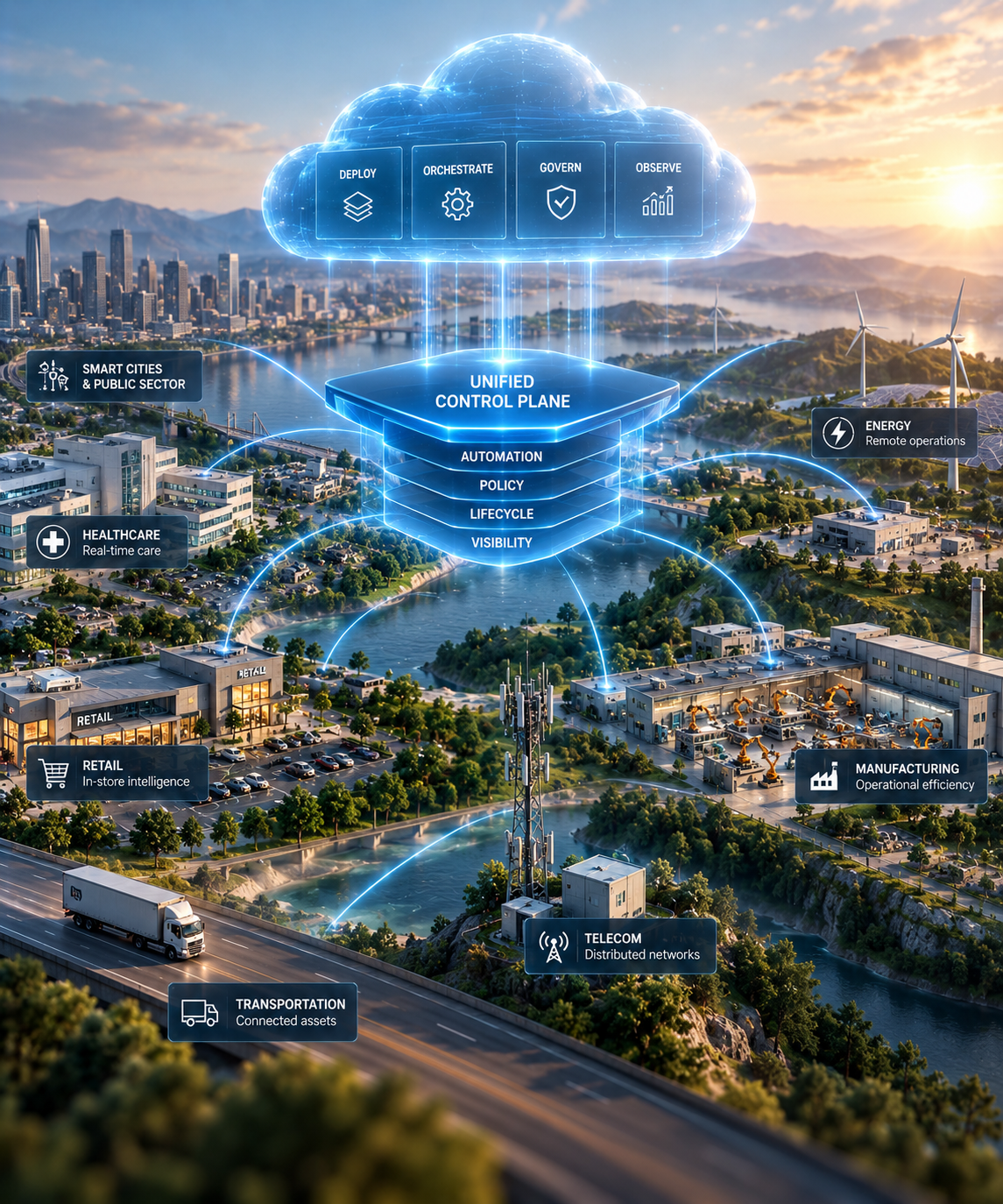
The purpose of Torque is to act as the governing control plane between autonomous agents and the shared infrastructure they act on, the layer that makes multi-agent deployments safe to scale.
At its core, Torque maintains authoritative, real-time environment state across all infrastructure. Before any agent acts, it reads from a shared state that reflects exactly what every other agent has just done. That single capability, shared awareness before action, eliminates the most common class of agent conflict: two agents making individually correct decisions that are mutually destructive because neither knew what the other was doing.
Beyond state, Torque enforces policy at the point of execution, not as a retrospective audit. Cost guardrails, security baselines, compliance boundaries and SLA protections are applied at provisioning time, before an agent’s action takes effect, not after the damage is done. If an agent’s proposed action would breach a policy threshold, it is blocked or escalated before execution, not flagged in a log after the fact.
Torque also manages environment lifecycle end-to-end: sequencing agent operations in the correct order, enforcing dependencies between steps, and guaranteeing automatic rollback if something fails mid-execution. No orphaned resources, no locked state files and no environments drifting into unknown states while agents continue to act on them.
The practical result is a measurable reduction in infrastructure agent conflict across every dimension that matters:
- Resource churn cycles broke. Agents no longer provision and terminate the same resources in competing loops
- Compliance gaps closed. Policy enforcement at execution time means no agent action can silently bypass a guardrail
- Incident attribution restored. A unified, cross-agent decision timeline replaces the fragmented logs that make post-mortems inconclusive
- SLA exposure reduced. Conflict-driven instability is intercepted at the orchestration layer before it reaches production services
- Engineering capacity returned. Teams stop spending days in change logs and start shipping again
Organizations running Torque are not slowing their agentic deployments. They are accelerating them, because the governance foundation that makes autonomous agents trustworthy is already in place before the next agent is added. It is not as a roadmap item, but being used in production. For many what remains is the organizational decision to prioritize governance before the first unattributable incident makes it unavoidable.
Summary…
The issue being raised is a serious one and for some it is going to take a business impacting event to be addressed. Knight Capital had 45 minutes. The Flash Crash took less than twenty. In both cases, the systems were doing exactly what they were designed to do. In both cases, nobody had designed for what happened when they encountered each other.
The agentic AI deployments being built right now are more capable, more numerous, and more deeply embedded in critical infrastructure than anything that existed in 2010 or 2012. The potential for conflict is not smaller. It is larger, slower to surface, and harder to attribute, which makes it more dangerous, not less and the executives who will navigate this well are not the ones who wait for the incident that forces the conversation. They are the ones asking the hard questions now.
The timeline from manageable to systemic is not theoretical. Organizations deploying their second and third agents today, without coordination architecture in place, are building toward a systemic conflict problem within eighteen to thirty-six months. The organizations already at four or more agents without a governance layer may already be there.
The technology to get this right exists today, not as a roadmap item, but in production. The architectural pattern is proven. The implementation is available. What remains is the organizational decision to prioritize governance before the first unattributable incident makes it unavoidable.
That decision is available to you right now. In eighteen months, for many organizations, it will not be a choice, it will be a response. To see Torque in action, visit the Torque playground, or book a live demo to see how Torque is a major contributor to address the risks caused by agentic agent conflict.