Fifteen billion devices, thousands of mismatched sites, a governance model still built for the pilot, and now an AI layer most of those sites were never designed to carry. What the data says about running the edge at production scale, and what closes the gap.
A retail chain’s inventory forecasting model, a hospital’s diagnostic imaging pipeline, a factory floor’s defect detection system: none of these can wait on a round trip to a distant data center, and none of them can go down without real consequences. The edge has quietly moved from pilot project to production dependency, and most organizations are still running it with the operating model they built for the pilot.

The scale problem is not hypothetical anymore
More than 15 billion edge devices are deployed globally today, and the market itself is being pulled upward by one force in particular: AI. IDC research shows about 27 percent of organizations are already deploying edge AI, with 54 percent planning to within two years. Cisco puts a sharper point on why. More than 75 percent of enterprise data is now created at the edge, and AI agent queries generate up to 25 times more network traffic than a traditional chatbot query. Centralized data centers were never built to absorb that volume of inference happening at the branch office, the retail store, and the factory floor simultaneously.
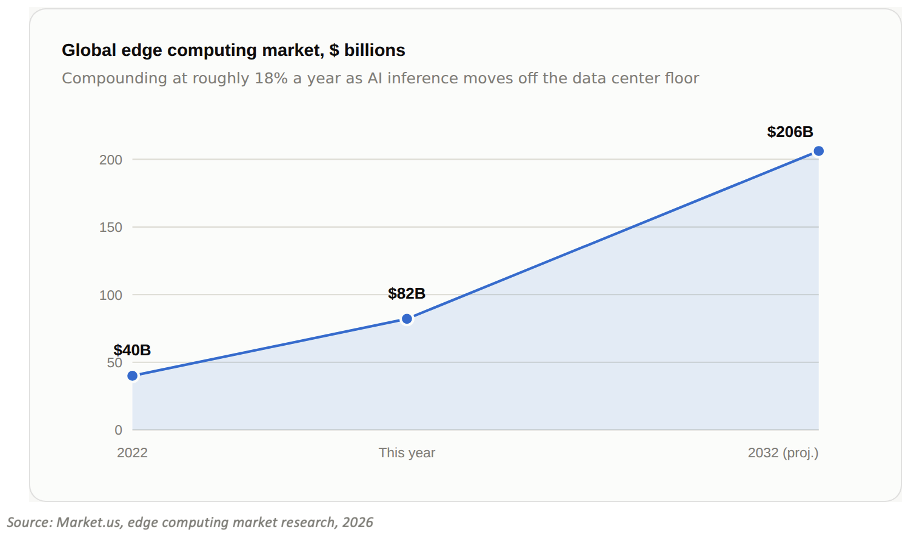
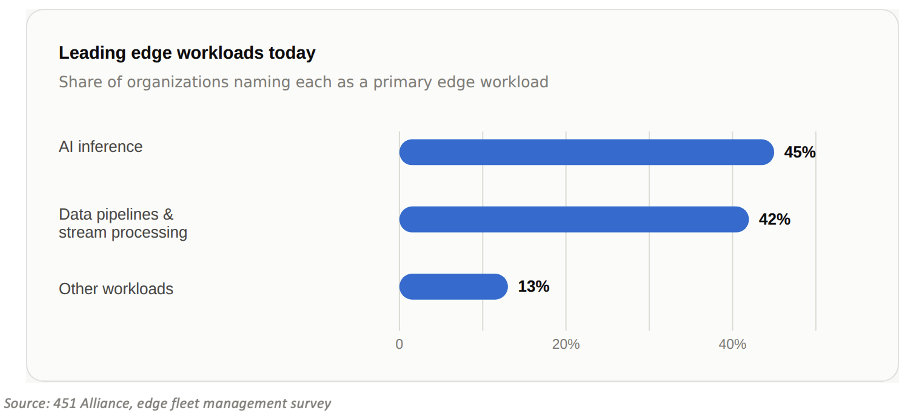
The workload mix confirms the shift directly. AI inference, covering vision systems, anomaly detection, and forecasting, is now the leading edge workload, followed closely by data pipelines and stream processing. Seventy-one percent of organizations expect AI inference to drive significant or transformative change to their edge operations requirements within the next two years.
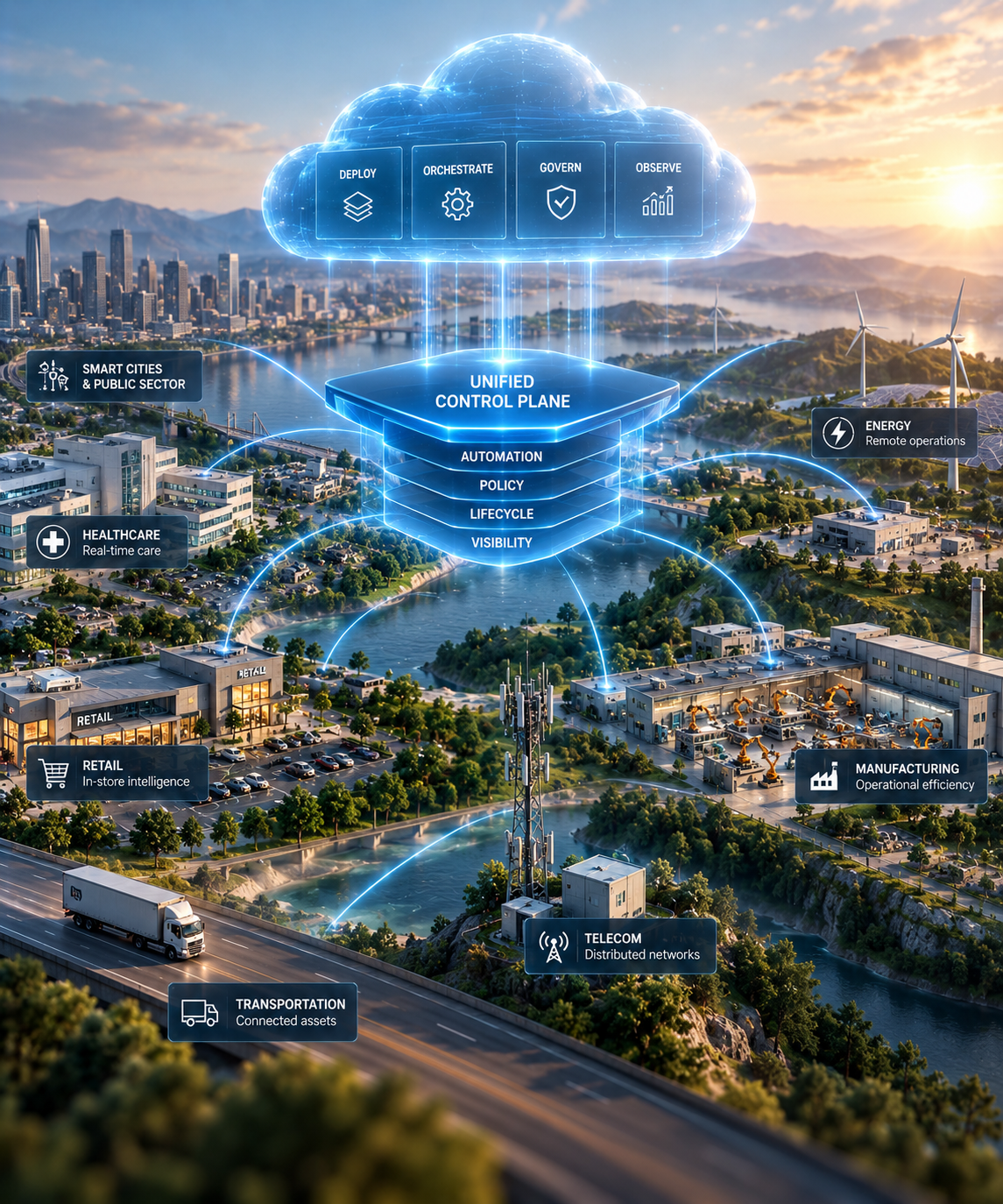
Industries impacted by the edge build-out
The spend is not abstract. It concentrates in industries where the workload cannot move to a distant data center without breaking the reason it exists.
| Industry | What’s Pulling it to the Edge | Data Point |
| Manufacturing | Defect detection and process monitoring on the production floor, where a round trip to a central data center is too slow to act on | 24% of the U.S. edge computing market |
| Healthcare | Diagnostic imaging and point-of-care inference moving closer to where care is delivered | 38.1% CAGR, 2022–2028 |
| Retail | Inventory forecasting and real-time demand signals running at the store rather than a regional hub | SLA-bound among the 47% of edge workloads now held to defined SLAs |
| Safety-critical & regulated operations | Industrial control and similarly regulated environments, where the cost of downtime or drift is severe | 28% of organizations classify their primary edge workload this way |
Sources: Market.us edge computing statistics; 451 Alliance edge fleet management survey
Why fragmentation is the real constraint
Scale alone would be manageable if edge environments were uniform. They are not. Most organizations don’t run one edge site, they run an edge fleet, the full collection of edge hardware and locations they operate as a single estate, anywhere from ten sites to ten thousand. The gap between how mixed those fleets actually are and how they get operated is where most of the pain concentrates.
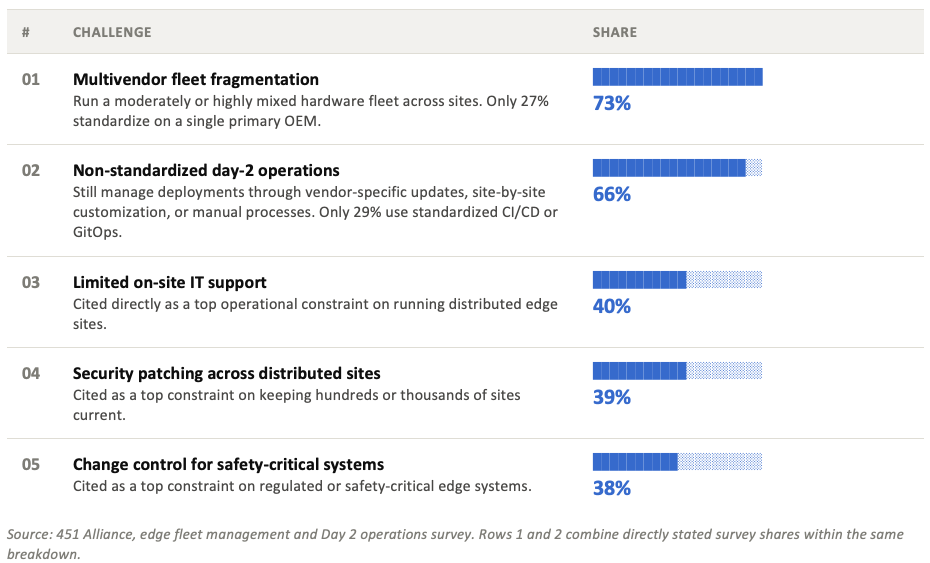
None of these are hardware problems. They are the direct consequence of running hundreds or thousands of sites, each potentially on different equipment, through operational processes designed for a handful of centralized data centers. Given that mismatch, 67 percent of organizations say having a single edge operations platform that can manage a multivendor fleet from one control plane is highly important or mission-critical.
Edge users and how they experience the challenge
The same fragmentation lands differently depending on where someone sits in the organization.
| Role | What They’re Accountable For | Where the Friction Turns Up |
| IT / platform leadership | Now owns edge operations centrally at 46% of organizations | A real capability gap even inside IT: only 81% feel equipped to navigate this scaling, and just 65% of business teams working alongside them do |
| Site & branch operations | Keeping the local system running day to day, often alone | Absorbs the top-cited constraint directly: limited on-site IT support (40%) |
| Security & compliance teams | Patching and change control across every distributed site | Carries the patching (39%) and change-control (38%) constraints without a standardized pipeline to lean on |
| Business & line-of-business leaders | Depend on the edge application staying up and compliant | Own the consequences when an SLA-bound (47%) or safety-critical (28%) workload goes down, without owning the infrastructure underneath it |
Source: 451 Alliance, edge fleet management survey; Deloitte, State of AI in the Enterprise 2026
Why AI raises the bar, not just the workload
The workload growth already covered explains why edge infrastructure needs to scale. It does not explain why AI specifically makes that scaling harder. AI changes three things about the edge that a general fragmentation problem does not capture on its own: how much power and cooling a site needs, what has to be managed after the hardware is running, and who is actually available to manage it.
| What Changes | Why It’s Different from general Edge Ops | Data Point |
| Power & cooling density | Edge cabinets were typically built for well under 1 kW of networking gear. AI inference hardware is pushing many of those same cabinets toward 5 to 10+ kW, in sites with no dedicated facilities staff to manage the heat. | 5–10+ kW per cabinet, up from <1 kW |
| Model lifecycle management | Keeping a site’s hardware patched is not the same job as versioning a model across heterogeneous chipsets, catching concept or data drift with limited on-site bandwidth, and rolling back a bad update safely across thousands of devices at once. | New discipline on top of infrastructure ops, not a replacement for it |
| AI-specific skills gap | The people already stretched thin on-site are also the least likely to have AI-specific skills. This lands directly on the 40% of organizations already citing limited on-site IT support as a top edge constraint. | 72% of employers report difficulty filling roles; AI skills now rank hardest to find |
Sources: Chatsworth Products, edge AI infrastructure guide; AiThority, edge AI model lifecycle management; ManpowerGroup, 2026 Global Talent Shortage survey
None of this shrinks the case for a single governed control plane at the edge. It expands it. The same drift detection and policy boundary that catches a misconfigured network setting is the same discipline that eventually has to cover a model that drifted out of accuracy, or a GPU node running hotter than its site was ever designed for. Today’s edge automation and governance tooling, including Quali’s, handles the first kind of drift well. The second kind, AI-specific lifecycle management at the edge, is where the industry as a whole is still building.
What unified edge actually requires
That statistic, 67 percent calling a single control plane mission-critical, defines what “unified edge” has to mean in practice. It is not one vendor’s box replacing every other vendor’s box. It is a convergence of compute, networking, storage, and security into a platform that can be provisioned, monitored, and updated consistently, regardless of how mixed the underlying fleet is, and it has to support the range from ten sites to ten thousand without the operating model changing in between.
Cisco’s own move into this space, its Unified Edge platform converging compute, networking, storage, and security with Cisco Intersight for centralized management, is a direct response to that requirement. It addresses zero-touch provisioning and configuration consistency at the hardware and platform layer, tackling what Cisco itself describes plainly: legacy edge networks were not built for AI.
“Traditional data centers are not equipped to handle the shift from centralized model training to real-time inference happening at the edge.”
Ron Westfall, HyperFrame Research
Where today’s approach still falls short
Hardware convergence solves part of the problem, but not the operational layer sitting on top of it. Consolidating compute, network, and storage into one chassis does not by itself standardize how a thousand of those chassis get deployed, kept in policy, and reconciled when configuration drifts, which the data above shows is still happening manually or semi-manually at a majority of organizations. A converged box at each site is still a fragmented fleet if the deployment and governance process around it is not equally unified.
How Torque and Stack Automation address each challenge
This is the layer where deployment automation and a governed control plane have to extend out from the data center to the edge rather than stopping at its door
| Challenge | Quali Capability | Value Delivered |
| Multivendor fleet fragmentation | A single control plane across bare metal, multi-cloud, hybrid, on-premises, edge, and GPU environments | One governed view of every site regardless of hardware mix, instead of a separate tool per vendor |
| Non-standardized day-2 operations | Continuous drift detection with automatic reconciliation, | Configuration drift is caught and corrected across thousands of sites automatically, not discovered site-by-site during an audit |
| Limited on-site IT support | Low touch automation from rack to full application stack deployment | What used to require manual, on-site coordination compresses into an automated workflow measured in hours |
| Security patching across sites | Policy-bound, agent-safe provisioning with compliance embedded from the point of deployment | Every edge environment carries its policy boundary from day zero, rather than being patched into compliance afterward |
| Change control for safety-critical systems | Continuous cost, ownership, and configuration visibility across every environment Torque governs | A full record of what changed, where, and under whose authority, without a manual change-review cycle per site |
The bottom line.
A converged chassis at one site is not a unified edge. An edge fleet is unified when it is governed by the same control plane, the same policy, and the same drift and cost visibility as everything else in the infrastructure estate, whether that is one data center or ten thousand distributed sites. While the Edge is fully established, what is left is closing the distance between the hardware convergence platforms now arriving and an operating model built for the scale, heterogeneity, and criticality edge infrastructure has already reached.
Visit the hybrid-infrastructure page for an understanding of how Quali can help you alleviate the issues of managing and scaling the edge.