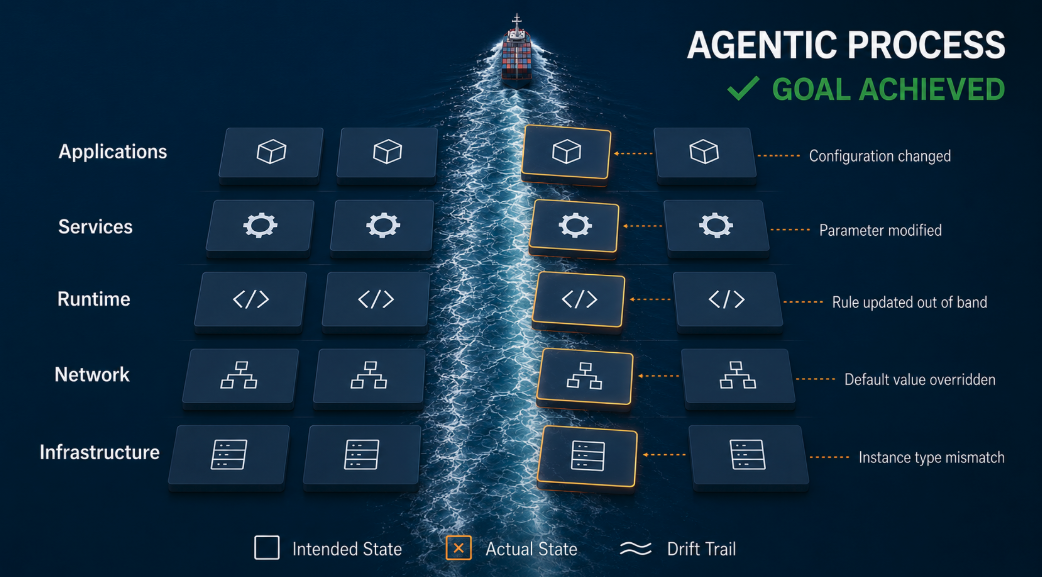
Most organizations believe production is protected. The code cannot change without a release. The environment, however, is a different matter entirely. And for AI systems, the environment is not background noise. It is the difference between the model you tested and the model you are running.
Production Changes. You Just Can’t See It.
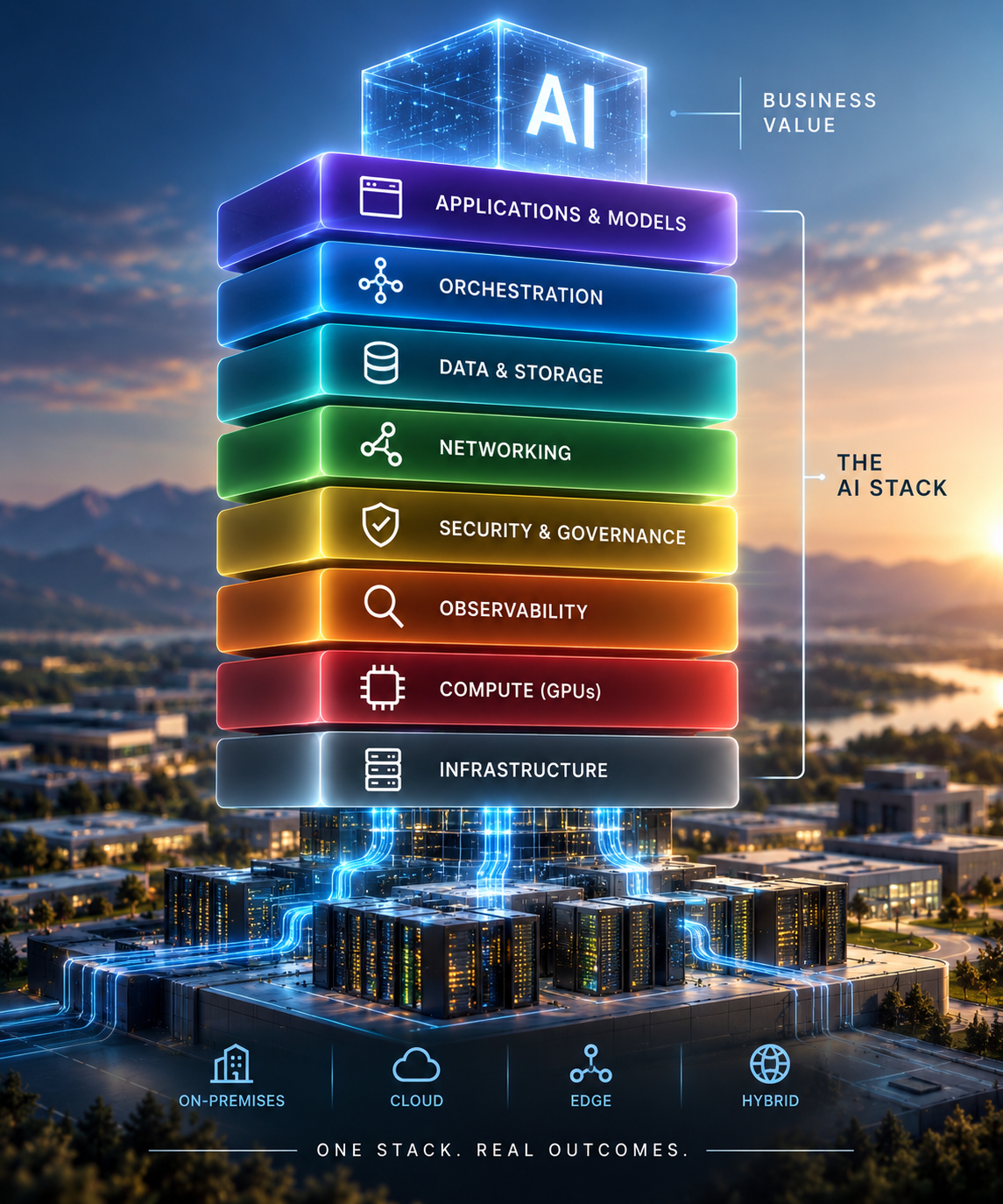
The change management process protects the code. It was never designed to protect the environment. Beneath every AI model in production sits a full infrastructure stack: container runtimes, GPU drivers, runtime libraries, data pipelines, network policies, API gateway configurations, storage volumes. Each has its own update cadence. Each has vendors, automation processes, and maintenance windows that change it on timelines entirely independent of your release calendar.
A container base image is patched for a security vulnerability. A cloud provider updates a managed service to a new minor version. A GPU driver is refreshed during a scheduled maintenance window. None of these events trigger a change request. None appear in the application release log. All of them change the environment in which your AI model operates.
For traditional software, the failure mode is visible: an error, a crash, a timeout. For AI systems, the failure mode is silent. The model continues to run. Requests are processed. Responses are returned. The model’s outputs shift, sometimes subtly, sometimes significantly, without any signal that anything has changed. The system health dashboard shows green. The model is making different decisions.
75% of businesses observed AI performance declines over time without proper monitoring. Over half reported revenue loss from AI errors. The declines are not model failures. They are environment failures. (Galileo AI, 2024)
Detection is the necessary first step. But detection alone is not governance. Knowing that drift has occurred does not tell you what changed, what risk it creates, who owns the affected environment, or what the safe path to remediation looks like. The gap between a drift alert and a governed resolution is where most organizations’ current capabilities break down.
Torque closes that gap. Not with a faster alert. With a complete loop.
Five Capabilities. One Closed Loop.
Torque’s approach to infrastructure drift is built around the detect-explain-act-record loop. Each stage is necessary. The loop is not complete without all four. The five capabilities below are how Torque operationalizes each stage in production AI infrastructure.
Torque compares live environment state against the blueprint specification continuously, not periodically. When a resource changes outside the platform, whether through a console fix, a cloud provider update, or an automated maintenance process, Torque identifies the deviation and surfaces the specific configuration items that have changed. Not a status flag. Not a dashboard indicator. A named list of exactly what drifted: the container image version, the GPU driver revision, the security group rule, the network policy. Investigation time collapses from hours to seconds. The operator knows what happened before they begin to ask why.
A raw configuration diff tells you what changed. It does not tell you what it means. Torque’s agentic layer translates the diff into a structured impact assessment: what risk category the change creates (security, governance, reliability, or cost), who owns the affected environment based on its metadata, which other environments share the same configuration and may be similarly affected, and whether the change appears authorized or anomalous. The explanation is produced automatically. It does not require a senior engineer to interpret a configuration delta and map it to a risk framework. In large environments running hundreds of AI workloads simultaneously, that automation is not a convenience. It is the only way to keep pace with the rate at which environments change.
Every detected drift event has one of three correct responses. Revert to blueprint: the change was unintended, restore the intended configuration. Codify the change: the change was intentional but not captured in the blueprint, update the blueprint to reflect the authorized state. Accept with exception: acknowledge the change, document the risk, allow it to persist with a time-bounded record. Torque presents all three options directly from the environment detail page. Approval workflows are enforced automatically based on environment tier and risk classification. A low-risk change in a development environment may be reverted by the environment owner without escalation. A configuration change in a production AI system validated for regulated use requires a different approval path. The governance level matches the stakes. The operator does not decide how much oversight to apply. The platform enforces it.
The most insidious source of infrastructure drift is the environment that was never meant to be permanent. A proof-of-concept stack built for an evaluation. A demo environment created for a customer presentation. A performance testing environment left running after the load test completed. Each accumulates configuration changes, emergency fixes, and automated updates over its lifetime until the environment running bears little resemblance to the environment that was created. Torque applies time-to-live policies to every environment. When the lifecycle ends, the environment and everything inside it is decommissioned automatically. Extensions require deliberate action. No environment runs indefinitely by default. This eliminates an entire category of drift event at the source, before it has a chance to accumulate.
Every drift event, its risk classification, the approver, and the exact remediation applied is captured in a complete, exportable audit record. For regulated organizations, this record is not a byproduct of governance. It is the output. When a Federal Reserve examiner asks what changed in the production environment running a credit model in the past 90 days, the answer needs to come from an operational system, not from a reconstruction of log files, change tickets, and memory. When a GxP auditor asks whether the validated configuration matches the production configuration, the answer needs to be documented and current. Torque’s audit trail per environment covers every provisioning event, configuration change, drift detection, and remediation action. The record is structured for compliance reporting rather than requiring custom extraction.
What Changes When the Loop Is Closed
The difference between organizations running production AI with and without closed-loop drift governance is not primarily technical. It is operational. Detection tools exist in most environments. What is missing is the loop that connects detection to explanation, explanation to governed action, and action to a complete audit record.
| Without closed-loop drift governance | With Torque |
| Drift discovered through incidents, performance degradation, or audit findings | Drift detected continuously, surfaced with named configuration items before it produces symptoms |
| Investigation takes hours: what changed, when, who owns it, what does it mean? | Impact assessment produced automatically: risk category, owner, blast radius, authorization status |
| Remediation is ad hoc: the operator decides how to respond and whether to document it | Three governed dispositions enforced by risk classification, approval workflows applied by environment tier |
| Long-lived environments accumulate drift invisibly over weeks and months | Time-to-live policies decommission environments at lifecycle end, eliminating the accumulation window |
| Audit evidence requires reconstruction from logs, tickets, and memory | Every drift event produces a complete, exportable compliance record from the operational system |
| Regulated organizations cannot demonstrate production environment consistency to examiners | Every environment has a complete governance history covering detection, classification, approval, and remediation |
The Stakes Are Not the Same in Every Industry
For most organizations, infrastructure drift creates operational risk: degraded model performance, unexplained behavioral shifts, difficult debugging. For regulated organizations, it creates something more consequential.
In financial services, a production environment that has drifted from its validated configuration may no longer satisfy the model risk management requirements of the Federal Reserve’s SR 11-7 guidance, the EBA’s Model Risk Management Guidelines, or the EU AI Act. The model running in production is not the model that was validated. The validation documentation describes a system that no longer exists in its documented form.
In pharmaceuticals, a system running in a configuration that differs from its GxP-validated state under FDA 21 CFR Part 11 or EU GMP Annex 11 is potentially operating outside its formal validation. Continuous monitoring, anomaly detection, and automated audit trails are not optional enhancements for pharmaceutical AI. They are the technical controls that keep the validated system and the running system synchronized.
In healthcare, clinical decision support systems and AI diagnostic tools fall under FDA oversight as Software as a Medical Device. The infrastructure environment in which the model runs is part of the performance specification. An environment that drifts from the specification documented at premarket review changes the system that clinicians are relying on.
Governance Is Not the Dashboard. Governance Is the Loop.
Most organizations have some form of infrastructure monitoring. Many have drift detection of one kind or another. What most do not have is the closed loop that makes detection operationally useful: the agentic explanation that translates a configuration diff into a risk assessment, the governed remediation that enforces the appropriate level of oversight, and the audit record that makes the response provable rather than merely plausible.
The enterprises running production AI with confidence are not the ones with the most sophisticated models. They are the ones whose governance infrastructure is as advanced as their AI capability. They can answer three questions with documented evidence rather than informed assumption:
- Does the production environment match the environment in which the model was validated? Not in general terms, but with a current, named comparison of intended state against actual state.
- When drift is detected, is the response governed and documented, or is it ad hoc and unrecorded?
- If a regulator asked today what changed in the production AI environment in the past 90 days, could that record be produced from the operational system?
Torque makes all three questions answerable. The detection is continuous. The explanation is automatic. The remediation is governed. The record is complete.
Configuration drift in production AI is invisible until it produces consequences. Torque makes it visible, explainable, and resolved before the consequences arrive.
Quali Torque is a purpose-built for this model, giving engineering teams agentic AI that works within guardrails, surfaces its work for human review, and develops the contextual awareness to become genuinely more capable over time.
To see Torque in action, visit the Torque playground, and book a live demo to see how Torque will ensure your infrastructure remains governed and controlled.
Sources: Galileo AI enterprise AI performance monitoring report (2024) · Evidently AI Enterprise Survey (2024) · Gartner, AI Projects in I&O Stall Ahead of Meaningful ROI Returns (April 2026) · Wolters Kluwer survey of banking professionals on AI governance readiness (June 2026) · Federal Reserve SR 11-7 · FDA 21 CFR Part 11 · EU GMP Annex 11 · EU AI Act Article 72