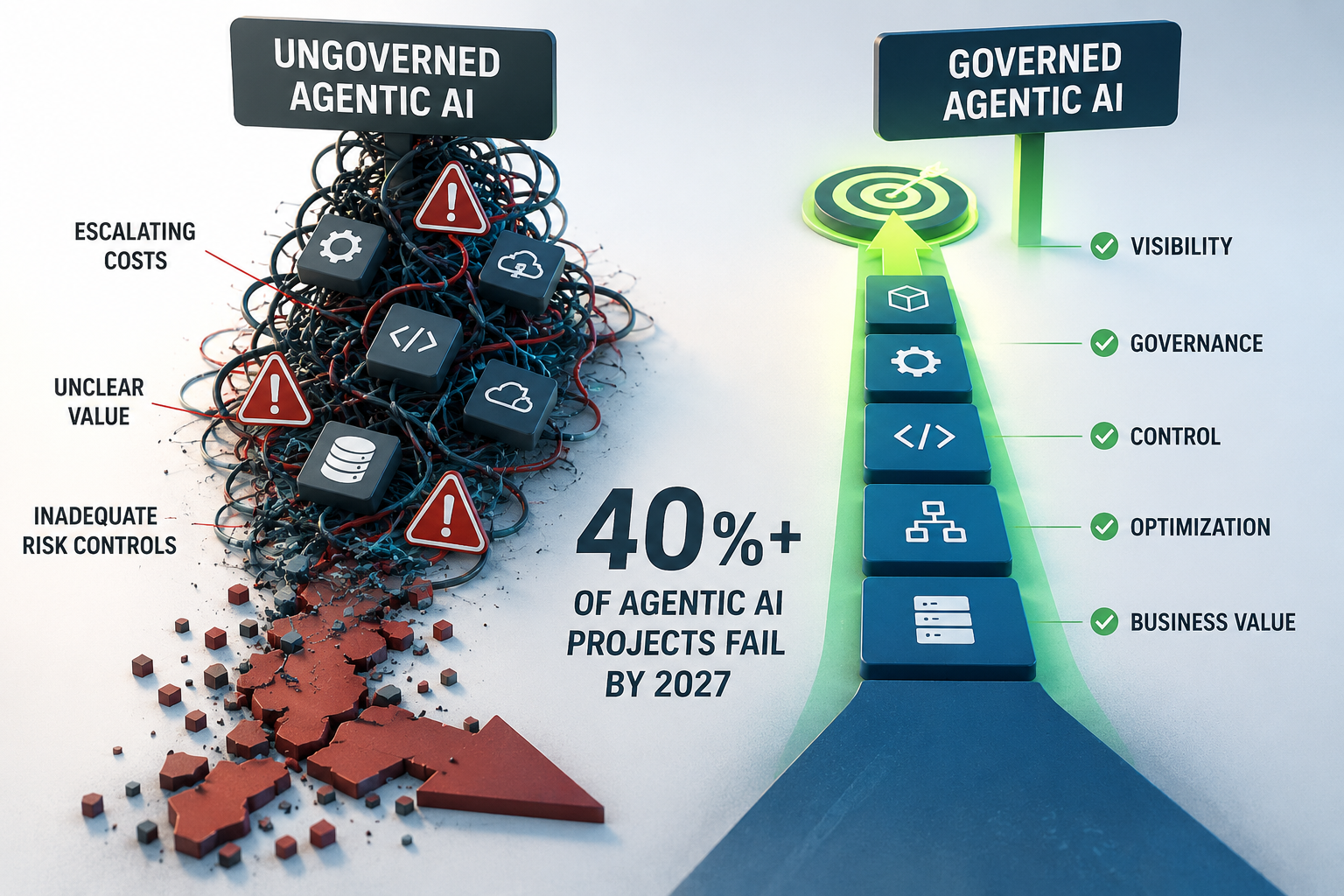
Gartner has put a number on something infrastructure teams have felt for years: more than 40% of agentic AI projects will be canceled by the end of 2027. The official reasons are escalating costs, unclear business value, and inadequate risk controls. Gartner’s survey data says the failures are actually concentrated, auto-remediation, self-healing infrastructure, agent-led workflow management, and a different story appears. These are not model problems. They are the exact points where an autonomous system meets an infrastructure estate that was never built to be changed by anything other than a human with a ticket number.
This is not a history lesson about the evolution of automation. It’s a description of what’s sitting under most enterprises right now, and why putting AI in charge of any part of it just changed the risk calculation permanently.
The Estate Nobody Mapped
Walk into almost any mid-to-large enterprise and ask for a single, current picture of what infrastructure exists, who owns it, and how it’s managed, and you will not get one. You’ll get several, each partial, each maintained by a different team, and each already slightly wrong by the time it’s shown to you.
Unsurprisingly 89% of enterprises now run multiple cloud providers, and most of them run more than one infrastructure-as-code or automation stack to manage those providers separately. Infrastructure teams commonly juggle up to nine tools for provisioning, cost management, and monitoring, and more than a fifth of teams run between ten and fifteen. Every one of those tools has its own idea of what ‘correct’ looks like, with none talking to the others. Tool sprawl is now the single most-cited obstacle to integrating AI into infrastructure operations at all, reported by 70% of enterprises.
None of this is a failure of any individual team’s judgment. Every tool was the right choice at a certain time and in isolation. But the aggregate result is an infrastructure estate that is fragmented by design, coordinated by no one, and understood completely by nobody, human or otherwise.
The Rule That Quietly Held For Twenty Years
Fragmentation like this has existed for a long time, and enterprises have survived it, because of one unspoken rule: the only thing that changed a production environment was a human, and a human came with a ticket, a review, and a rollback plan. Drift still happened, the emergency console fix at 2 a.m., the manual patch that never made it back into the IaC, but it happened at human speed, in human volume, leaving a human-shaped trail that could eventually be found.
That rule is what made the fragmentation tolerable rather than dangerous. It was never fixed. It was just slow enough to survive.
Then the Requester Stopped Being Human
Agentic AI breaks that rule on purpose. The entire value proposition of an infrastructure agent is that it doesn’t wait for a ticket, it detects, decides, and acts, continuously, without a human in the loop for every change. That is precisely what auto-remediation, self-healing infrastructure, and agent-led workflow management mean in practice, and it’s precisely where Gartner’s April 2026 survey of infrastructure and operations leaders found AI initiatives failing most often.
McKinsey’s numbers show why this is a live problem rather than a future one: 62% of organizations are already piloting AI agents against their infrastructure, even though no more than 10% have scaled agents into any single function yet. The pilots are running today, inside the same fragmented, ungoverned estate described above, and McKinsey separately projects infrastructure costs rising two- to threefold by 2030 against flat budgets, which is its own pressure to move fast rather than govern carefully.
An AI agent that learns, adapts, and makes its own decisions doesn’t behave like a script. It doesn’t fail loudly. It doesn’t necessarily explain a change the way a person filling out a change ticket would. It just starts operating differently inside an environment that has quietly drifted out from under it, and because the fragmentation described above means no single system has a current, coordinated view of that environment, nobody notices until the outcome shows up somewhere else: a cost spike, a compliance gap, an audit that can’t be completed.
The State of Play, By the Numbers
| What the research found | Source |
| 89% of enterprises now use multiple cloud providers, and most run two or more IaC/automation stacks to manage them. | Flexera, 2026 State of the Cloud Report |
| 72% of infrastructure teams run up to nine separate infrastructure or observability tools; over a fifth run 10-15. | CNCF Observability Survey |
| Tool sprawl is limiting AI integration for 70% of enterprises. | Zapier, 2026 AI Sprawl Survey |
| Only 28% of AI use cases in infrastructure & operations fully meet ROI expectations; 20% fail outright. | Gartner, survey of 782 I&O leaders, published April 2026 |
| The most common AI failure points cited by I&O leaders: auto-remediation, self-healing infrastructure, and agent-led workflow management. | Gartner, April 2026 |
| More than 40% of agentic AI projects will be canceled by the end of 2027, over cost, unclear ROI, or inadequate risk controls. | Gartner, June 2025 |
| 70% of enterprises will run agentic AI as part of IT infrastructure operations by 2029, up from under 5% in 2025. | Gartner, “Predicts 2026: AI Agents Will Transform IT Infrastructure and Operations,” Dec 2025 |
| 62% of organizations are piloting AI agents; no more than 10% are scaling them in any single business function. | McKinsey, 2026 |
| IT infrastructure costs are projected to rise two- to threefold by 2030, while budgets stay roughly flat. | McKinsey, “Reimagining Tech Infrastructure for Agentic AI,” 2026 |
Independent research on infrastructure fragmentation and agentic AI failure, 2025–2026.
What the Failure Data Is Actually Showing
Put the two halves of Gartner’s research together and the picture sharpens. Only 28% of AI use cases in infrastructure and operations fully deliver on ROI; 20% fail outright. The failures cluster in exactly the domains, auto-remediation, self-healing, agent-led management, where an autonomous actor needs a coherent, current, governed picture of the environment to operate safely. And Gartner expects 70% of enterprises to be running agentic AI inside IT infrastructure operations by 2029, up from under 5% today. That’s not a gentle ramp. That’s most of the market putting an autonomous decision-maker into an estate that, per the data above, is already fragmented across a dozen tools and multiple clouds with no single owner.
The 40% cancellation figure isn’t really a verdict on whether agentic AI works. It’s a bet on whether governance catches up to fragmentation before autonomous change hits enterprise scale. Right now, for most organizations, it hasn’t.
Where Torque Fits
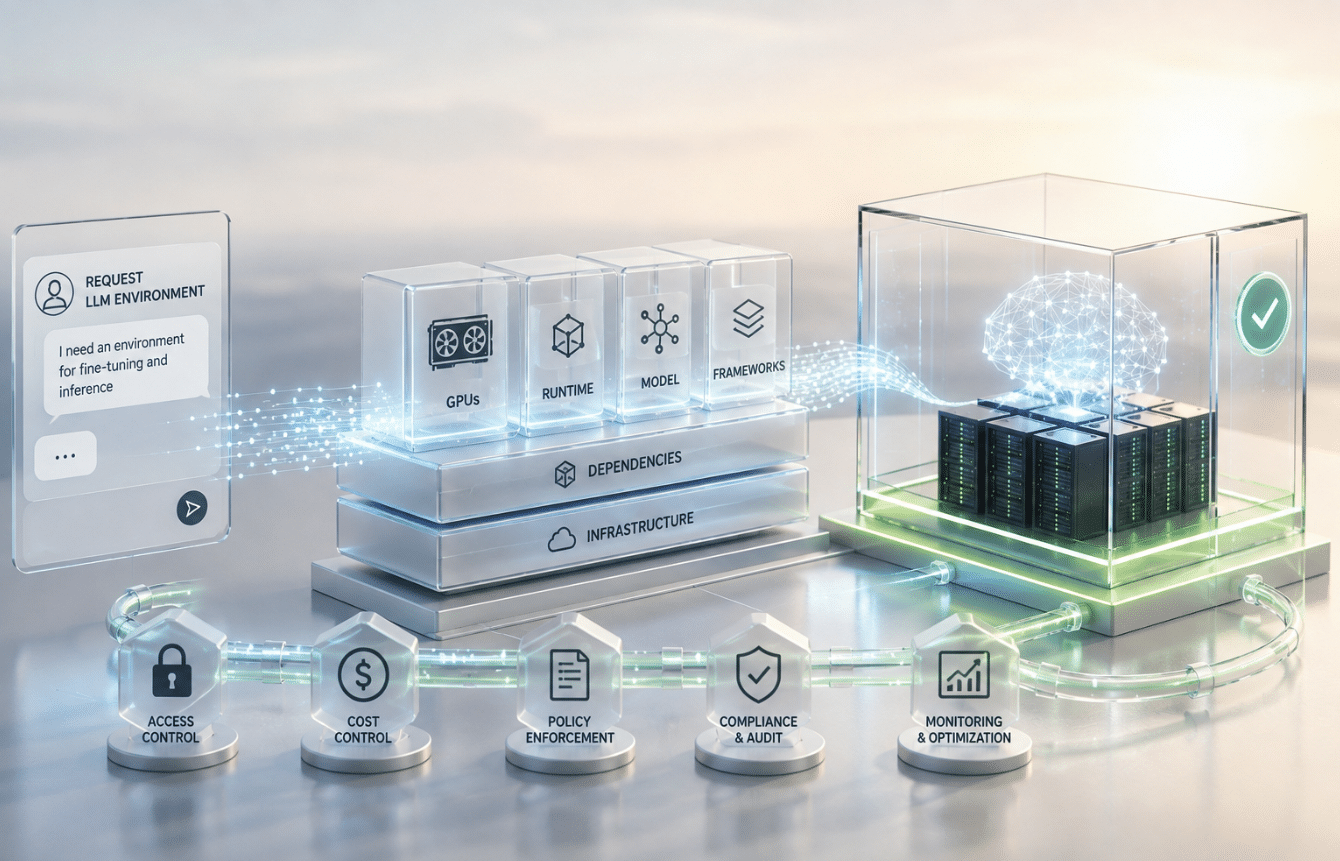
This is the exact problem Torque by Quali was built to close. Every environment in Torque is defined as a blueprint, a versioned, policy-embedded specification covering every component, configuration, and governance constraint required for a complete deployment, so governance exists from the moment an environment is created, not as an audit performed on it afterward.
Torque’s drift management runs as a closed loop rather than a point-in-time check: it continuously compares live state against the blueprint across the full stack, no matter which of the underlying tools, Terraform, Kubernetes, cloud-native services, actually made the change, and surfaces exactly what diverged. Critically, that governance doesn’t stop at the human/agent line.
Torque’s Agent RBAC and MCP server integration let AI agents interact with infrastructure directly, but only within policy-defined boundaries, with a bounded blast radius so an autonomous agent can’t exceed the permissions its role allows. Every provisioning event, drift detection, and remediation action, whether triggered by a person or an agent, lands in a single audit trail built to satisfy compliance review, not just internal curiosity.
In other words: the fragmentation in the table above and the autonomy described in Gartner’s failure data are two sides of the same problem, and they need one answer, not two. Torque’s blueprint model absorbs the fragmentation; its closed-loop governance absorbs the autonomy.
The Actual Bet
The organizations that beat Gartner’s 40% figure won’t be the ones with better AI agents. Most competitors will have access to comparable models. They’ll be the ones who closed the governance gap between a fragmented infrastructure estate and an autonomous decision-maker before that gap turned into a canceled project, a compliance failure, or a cost spike nobody can explain.
How Torque Closes the Gap
| The Failure | How Torque Closes It | The Outcome |
| Fragmented estate: 9-15 tools, multiple clouds, no shared view of what’s running. | Blueprint model normalizes Terraform, Kubernetes, and cloud-native resources into one versioned, policy-embedded spec. | One current, coordinated picture of the environment, instead of several partial ones. |
| #1 cited AI failure domain: auto-remediation & self-healing infrastructure. | Closed-loop drift management continuously compares live state to the blueprint across the full stack. | Remediation acts on verified, specific drift, not a guess at what changed. |
| #2 cited AI failure domain: agent-led workflow management; “inadequate risk controls.” | Agent RBAC + MCP server integration apply policy-defined boundaries and a bounded blast radius to every agent action. | Agents can act on infrastructure, but never outside the permissions their role allows. |
| Can’t prove what changed, when, or why, the compliance and audit exposure. | Every provisioning, drift, and remediation event, human or agent-triggered, lands in one audit trail. | An audit-ready record, built for compliance review rather than reconstructed after the fact. |
Mapping each cited failure mode directly to the Torque mechanism that addresses it.
That’s not a model question. It’s an infrastructure question, and it’s already answerable.
To see Torque in action, visit the Torque playground, and book a live demo to see how Torque delivers AI governance and cost control to solve the challenge of governance at machine speed.